×

Justice continues anti-Amendment 2 road show in Beckley

BECKLEY — He might have openly supported eliminating tangible personal property taxes in 2018, but Gov. Jim Justice and his dog hit the road for a second time Monday to advocate against adoption of Amendment 2 by voters in November.

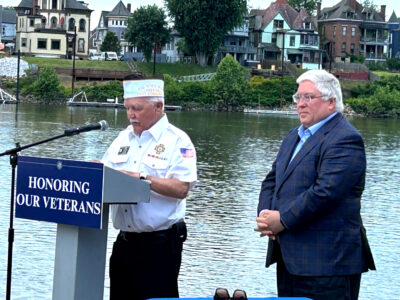
Justice and Babydog held a community conversation in Word Park and Beckley on Monday afternoon to inform voters about his concerns if Amendment 2 receives enough votes on Tuesday, Nov. 8. He held a similar event Friday in Wheeling.

“On November the 8th, if we pass Amendment 2, we will not be able to stop this. We won’t be able to stop it at all. The machinery and inventory tax will be passed,” Justice said.

Amendment 2 would give lawmakers the legal authority to reduce or eliminate six categories of tangible personal property taxes if approved by voters on Election Day, including taxes on machinery and equipment, inventory, and motor vehicles.

“(They) coupled with it the ability to get rid of your personal (property) tax on vehicles,” Justice said., “Why is that there? It’s there to get your vote. That’s all there is to it.”

The amendment itself doesn’t lower or eliminate any taxes, but Republicans in the West Virginia Legislature have already drafted a bill to be introduced during the 2023 legislative session in January that would eliminate all six tangible personal property tax categories beginning in July 2023 if Amendment 2 is approved.

The draft bill would also cut personal income tax rates by a combined 10% across all six brackets, returning more than $800 million to taxpayers each fiscal year. The elimination of tangible personal property taxes in the draft bill would return more than $515 million to taxpayers.

County governments and county school systems that rely on those funds would be compensated for their assessed value of those tangible personal property taxes from collections out of the general revenue fund. A formula would also provide counties a minimum of $1 million in addition that could be used for budgets or for eliminating their regional jail bills.

Justice is a supporter of phasing out the personal income tax and called a special session in July for his own 10% personal income tax cut — a bill that had the support of House of Delegates but not the state Senate. But he is against Amendment 2 and against the Republican legislative plan to cut the personal income tax and eliminate tangible personal property taxes though he does support eliminating taxes on motor vehicles.

A combination of years of flat budgets, natural growth in tax revenue, federal COVID-19 relief and infrastructure dollars freeing up state tax dollars, and a spike in coal and natural tax collections led to a $1.3 billion tax revenue surplus for the general revenue fund at the end of the last fiscal year in June.

“Amendment 2 allows the Legislature to take, depending on whose estimate we use, $450 million to $550 million away from our cities and counties, and take that money to Charleston and then you get to go to the Legislature every year and ask the Legislature if you can have that money back,” said Dave Hardy, cabinet secretary for the Department of Revenue, speaking directly to local officials. “To make matters worse, two-thirds of that … is going to be used to subsidized large business, not returned to the people of West Virginia.”

Tax revenue numbers for the first two months of the current fiscal year already show a $234.2 million tax revenue surplus. Justice said it was risky to rely on the general revenue fund to keep counties and school systems funded.

“What happens if the surpluses go away? What will happen to our counties, our schools, our fire department and our policemen? What will happen? We’ll have to turn back to them and make cuts,” Justice said. “If you want to vote for that, that’s your power and I will absolutely stand right behind your vote and recognize and respect it. But I’ll look right back at you and say I tried to tell you, or I told you so.”

Justice believes it makes more economic sense to cut personal income tax rates instead of eliminating tangible person property taxes — a goal of the state business community for more than 30 years and the recommendation of two different governor’s tax reform commissions spanning two decades.

“We can get rid of our state income tax,” Justice said. “We are on a pathway that is so blooming good, we can get rid of it. All of these states around us can’t do it. They’re lower than us, but they can’t do it. We can do it.”

Even Justice himself supported elimination of the machinery/equipment and inventory tangible personal property taxes — the two largest drivers of tangible personal property tax revenue — in 2018 and 2019, making it part of his Just Cut Taxes and Win platform in his 2018 State of the State address and having a joint resolution introduced on his behalf to put the idea to voters in a constitutional amendment.

“I would have never believed there was a chance on God’s Earth that we could be on a pathway to getting rid of the personal income tax in West Virginia,” Justice said. “At the time I would have absolutely been an advocate of getting rid of the machinery and inventory tax, we didn’t have any choice. We didn’t have any chance of doing anything else. Today, we really do.”

Justice said he has not heard from any of the new major manufacturers that have announced projects in West Virginia over the last nine months that they want their tangible personal property taxes eliminated. Though many major economic development deals often involve payment in lieu of taxes (PILOT) deals where companies sell their equipment to the state and the state leases the equipment back to the company at low rates to avoid tangible personal property taxes.

“Today, I have the insight of the Nucor’s and the Green Power’s, Berkshire Hathaway, and all the people that have come and continuing to come. And they have not asked me to get rid of the machinery and inventory tax,” Justice said. “What is going on in Charleston … is exactly what is going on in D.C. Swamp. The lobbyists, the big giant manufacturers that are out of state. They want a bigger cut.”

Sides have been drawn, with the West Virginia Chamber of Commerce and the West Virginia Manufacturer’s Association supporting Amendment 2, while the West Virginia Association of Counties, the County Commissioners Association of West Virginia, and the West Virginia Association of School Administrators have come out against the amendment. Some individual counties have also started weighing in for it, against it, and some remaining neutral.

Justice will hold another community conversation later today in Charleston in the parking lot of the Kanawha County Courthouse.

“Amendment 2 is a big risk, a great big risk at a time where we don’t need to take that level of risk,” Justice said.

Steven Allen Adams can be reached at sadams@newsandsentinel.com

Starting at $2.99/week.

Subscribe Today