
Hardesty: West Virginia public school systems must embrace school choice
Trending
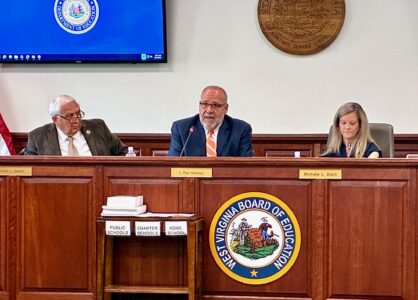
CHARLESTON - West Virginia Board of Education President Paul Hardesty said that since school choice continues to be supported by Gov. Patrick Morrisey and the Legislature, county systems need to make themselves the most appealing school choice option of all.
Speaking during the state Board of Education’s regular monthly meeting Wednesday at the Department of Education’s offices at the State Capitol Complex, Hardesty issued a clear directive to all 55 county boards of education and superintendents regarding the new reality of the educational landscape: Public schools are no longer the sole providers of education but are one of several “school choice options.”
"You might not like what I have to say, but I don’t really care. School choice is here to stay," Hardesty said. "Our 55 county superintendents and boards need to understand that. We are one of the school choice options. We need to make our option more accommodating to parents and children."
Hardesty’s remarks came following the approval by the state board of a waiver for WVBE Policy 2525, Section 5.1.b, relating to pre-kindergarten eligibility and enrollment. Under this new statewide waiver, families will be granted the flexibility to enroll their 5-year-old children in pre-K rather than moving directly into kindergarten.
The option is available for children who have no prior history of attending a public preschool program. Hardesty said the need for the policy change was brought to his attention by Del. Jordan Maynor, R-Raleigh.
"There was a child in Raleigh County. The parents wanted that child to enroll in pre-K, but because of some language in this policy, the child had reached an age to where it was going to be thrust into the kindergarten model," Hardesty said. "The parents didn’t want that ... I said, look, this needs to be addressed, and we’ll do so immediately.”
Hardesty instructed the Department of Education to begin reviewing all policies approved by the state board to eliminate old and outdated policies in order to make public school options more appealing to parents compared to private education, Christian education, home schooling, learning pods and microschools.
"We need to make our option more accommodating to parents and children,” Hardesty said. "We’ve got to change the image, change the mindset, and the way we’ve always done business in the past.”
According to this year's October headcount report, there were 234,957 students enrolled in the state's 55 county school systems, a 2.52% decrease from fall enrollment this time last school year and a 15.32% decrease from the 277,452 fall enrollment number in 2015.
The decrease in student enrollment has forced county school systems to make tough choices about closing and consolidating schools. Last December, the state Board of Education approved requests from six counties to amend their comprehensive educational facilities plans involving the closure of 15 public elementary, middle and high schools, consolidating those students with existing schools in the counties.
The number of public schools in the state decreased from 637 last year to 618 as of October for a 2.98% decrease. The closures of the 15 schools approved by the state board last month represent a 2.4% decrease in schools.
"We’ve got to change our image," Hardesty said. "I don’t want any superintendent to ever say in a public meeting again, 'Well, that’s the way we’ve always done things.' That’s got to stop. We are competing for enrollment, whether we want to believe it or not. And the only way we’re going to get more enrollment is to be more accommodating, more receptive and more accessible to parents and students."
James Paul, the newest member of the state board appointed by the governor in February and the former executive director of the state Professional Charter School Board, encouraged county superintendents and board of education members to submit requests for other policy waivers to the state board and help identify policies that should be updated or eliminated.
"If it is going to improve efficiency, thoroughness, academic outcomes in the schools, we are open to that, it seems," Paul said. "If there are policies that are creating unnecessary burdens for the counties or schools, the right path is to bring those requests here. There’s a process to do it."
Steven Allen Adams can be reached at sadams@newsandsentinel.com.