
Mixed progress for W.Va. districts: One released, one extended, and one intervention by state board
Trending
CHARLESTON -- The West Virginia Board of Education voted Wednesday to release Randolph County Schools from its state of emergency and extend the state of emergency for Roane County Schools, but Harrison County Schools are now under partial state takeover.
During Wednesday’s monthly state Board of Education meeting, members voted to release Randolph County Schools from its state of emergency after achieving a balanced budget, increasing its unassigned fund balance to over $4 million, implementing personnel reductions and putting into place a school consolidation plan.
The move comes more than one year after the state Board of Education first declared Randolph County Schools in a state of emergency due to the board's reluctance to approve school consolidation due to transportation concerns, a lack of understanding regarding personnel decisions, and a deteriorated relationship with previous county superintendent Shawn Dilly.
The state board required the county to create a comprehensive plan to address the deficiencies identified by the Department of Education. Office of Accountability Director Alexandra Criner said the requirements of the plan included training and support for county board members, the superintendent working with an assigned mentor, and other action steps to ensure a school consolidation plan was approved.
Randolph County Schools Superintendent Derek Lambert thanked department officials and the state board for working with the county over the last 13 months to get its financial house in order.
“Randolph County Schools has taken significant systemic actions to improve the long-term financial position,” Lambert said. “I and the new Board of Education in Randolph County recognize that there is still work to be done, but I do believe that Randolph County is in a much, much better place now than they were a year ago.”
According to Lambert, Randolph County Schools closed two public schools and implemented extensive personnel reductions in force (RIFs), including the elimination of 46.5 positions.
“These actions combined with the ongoing expenditure controls have strengthened the county’s financial outlook,” Lambert said.
As of the end of the previous fiscal year on June 30, the current expense fund revenues totaled $42.1 million, exceeding expenditures by approximately $1.47 million before the year-end closing activities.
Preliminary calculations for the fiscal year 2026 show an estimated general current expense fund unassigned balance of over $4 million, an increase from the prior year. The county board adopted a balanced budget for the fiscal year 2027 budget that maintains the required 5% reserve.
State Superintendent of Schools Michele Blatt made the recommendation to remove Randolph County Schools from the state of emergency while also continuing to provide assistance to the county as well as monitoring.
“I believe that the (Department of Education) will continue to prioritize monitoring and support for a period of at least 12 months to ensure that local improvements are sustained,” Blatt said.
The state board also praised the progress being made by Roane County Schools but voted to keep the public school system in a state of emergency for an additional six months as it continues to improve.
The state board voted last July to place Roane County Schools in a state of emergency due to financial conditions where declining enrollment, low building utilization, and excess personnel caused the county school system to go into a deficit for fiscal year 2025 and a projected deficit for fiscal year 2026.
“In July 2025 … we reported a $1.3 million deficit to close out the year,” said Roane County Schools Superintendent Michelle Stellato. “At that time when I stood here, we were projected to grow that deficit by an additional half million dollars during last school year, resulting in a $1.8 million estimated deficit … Instead, through the actions taken over the past 12 months, we have reduced that deficit to approximately $1.2 million.”
Stellato said the county made a number of changes to be more efficient and mindful of tax dollars, including extending the life of its school bus fleet instead of buying new buses, reviewing service contracts line-by-line, bringing more services in-house, better use of competitive bidding, closing and consolidating schools, and RIFs.
“This progress was not achieved through one initiative or one set of decisions, but instead a result of a fundamental shift in how we approach every dollar that is entrusted to our district,” Stellato said. “We challenged ourselves to ask a simple question every day, is there a more efficient way to do this? That mindset led to countless decisions that individually may seem very small, but collectively made a significant impact on what we were able to do.”
The state board also declared a state of extraordinary circumstances in Harrison County Schools due to severe administrative overreach by local board members and a massive budget deficit caused by excessive staffing. Blatt recommended that the board initiate a partial intervention in Harrison County, stripping the local school board of its authority over significant financial and personnel decisions.
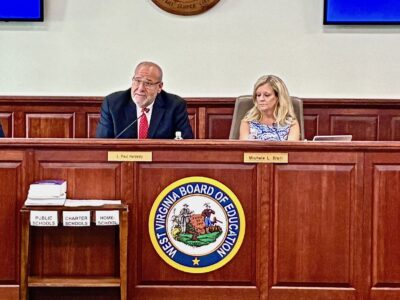
State Board of Education President Paul Hardesty praised the leadership in Randolph and Roane counties for remembering their fiduciary responsibilities to taxpayers, while having harsh words for Harrison County Board of Education officials.
“This is pathetic,” said Hardesty, who was voted in for a third term as state board president Wednesday. “This is absolutely pathetic in the fact that a board of education would for two years running, basically disregard the RIF and transfer process, knowing you’re that many positions over formula and basically erode your fund balance to the point that they’ve done.”
According to the department, Harrison County Board of Education members reportedly interfered in staffing, scheduling, and discipline, bypassing the chain of command and undermining the superintendent. The school district also employs 239 positions over the state school aid funding formula. While 150 of those excess positions are funded by an excess levy, department officials said the total cost is unsustainable.
The district's unrestricted fund balance is projected to drop from $23.1 million in FY25 to potentially $7 million by the end of FY27 -- a $16 million reduction in two years.
“You know what? You have what’s called a fiduciary responsibility to manage the taxpayers’ funds in an appropriate manner to offer the best opportunities for the children of Harrison County,” Hardesty said. “I’ve read this report three times and I get more aggravated each time I read it.”