Gee: Changes at WVU will help secure its future
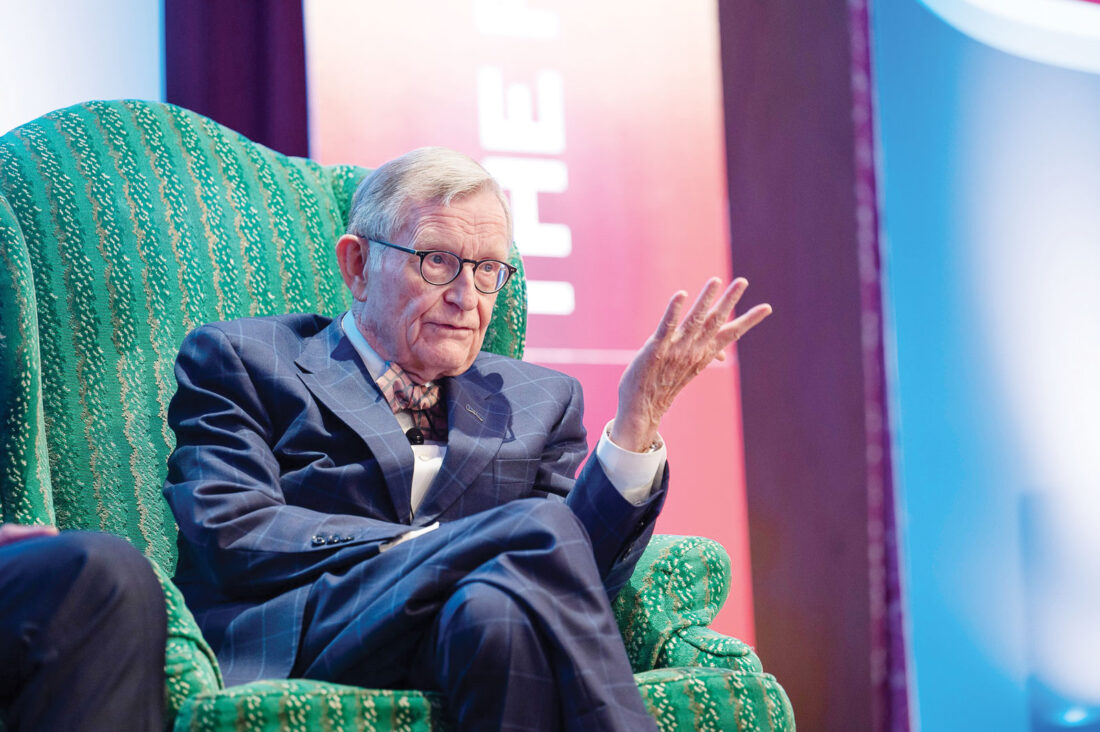
WVU President E. Gordon Gee believes the changes and cuts being made at WVU will position the university to weather coming changes to public higher education as a whole. (Photo Provided)
CHARLESTON — With the first set of recommendations approved to eliminate 28 undergraduate and graduate degree programs, West Virginia University President E. Gordon Gee says more needs to be done to ensure the state’s flagship university continues to lead into the future.
“We’re an academic institution and we have gone through an academic process and sometimes those are a little bit painful,” Gee said Tuesday in a virtual sit-down with editors from Ogden Newspapers publications in West Virginia and Pennsylvania.
On Friday, the WVU Board of Governors approved the elimination of 10 undergraduate programs and 18 graduate programs, and the merging of three other programs into existing degrees.
Combined with a reduction of faculty throughout other degree programs, the recommended program eliminations and faculty cuts will affect 143 faculty members, or more than 5% of all faculty at WVU. That is on top of an additional 135 positions cut at the university, including 38 faculty earlier this summer.
WVU is trying to close a $45 million hole in its current $1.2 billion fiscal year 2024 budget and stave off the potential for a $75 million structural deficit by 2028. Officials hope to use the savings from cuts to fill this year’s hole and reinvest further into the more than 300 existing degree programs WVU will continue to offer.
The recommendations were the result of phase two of WVU’s Academic Transformation program. Created at the urging of the Board of Governors in 2016, the WVU Provost’s Office accelerated phase two of the program following the end of COVID-19 and the decade’s long decline in student enrollment at WVU.
“We made our decisions. We then had to vet them with a variety of folks. Then we had to go through this appeals process, and I had no idea whether or not our board would ultimately support some of the decisions we made, because they were pretty far reaching,” Gee said. “We did not go for the low-hanging fruit. We went for the long ball. I feel very blessed that the board did support what we’re doing, but now we need to make it work, and that’s what we’re about.”
The university will notify affected faculty by Oct. 16 with layoffs to begin by May and severance packages provided. Students affected by the program cuts are being notified, with teach-out plans for students in programs being phased out.
According to WV MetroNews, officials began Monday looking at making changes to 130 different programs at WVU after the Board of Governors approved recommendations from the Provost’s Office. These range from further reducing faculty, merging programs, discontinuing the programs, or leaving the programs alone.
Another 19 student-support programs also are under review, according to the non-profit news website West Virginia Watch. These include libraries, career services, the Center for Veterans, Military and Family Programs, the Honors College, the LGBTQ+ center and WVU Press, among others.
A review of the WVU Extension Service that provides support services in all 55 counties and financial reviews of WVU’s satellite campuses at Potomac State College at Keyser and WVU Tech at Beckley also are in the works.
A vocal group of faculty, students and alumni have opposed the program and faculty cuts, staging walk-outs and protests over the last several weeks. The WVU Student Government Association adopted two resolutions opposing the changes and the WVU University Assembly consisting of mostly full-time faculty approved a resolution of no confidence in Gee and called for a pause in the Academic Transformation process
Gee said he wished he could have done a better job at preparing the university for change. The author of two books and an upcoming third book on the future of higher education, Gee said he called for change during his first address at WVU in 2014 after returning as president of the university he first presided over in 1981.
“There’s a couple of things that I wish that we could have done better. One is to really get people acclimated to the notion of change,” Gee said. “In my very first speech that I gave at the university, I said we’re going to have to change, and then every speech I’ve given since then. I think that I did not do a good enough job at making people believe that we had to change.”
Gee said public higher education is facing three problems. Financially, colleges and universities are charging too much tuition, they’re not being responsive to the needs of parents, and are not using their resources wisely. Secondly, Gee warns of a demographic cliff, with fewer people having children and fewer high school graduates choosing college creating a smaller pool of people for colleges and universities to recruit from. And lastly, Gee said colleges and universities have lost the trust of the public.
“When I became president of this university in 1980, the Gallup Poll at that time showed that 95% of the American public felt that higher education was a positive good,” Gee said. “The latest Gallup Poll, which came out about six weeks ago, shows that it’s now down to below 36% and going south fast. In other words, what has happened is we have lost the trust of the American people.
“We don’t produce cars. We don’t produce widgets. We only produce ideas and relationships and students. And if we lose the belief by the American public that the universities are good, we are in very serious trouble,” Gee continued. “We’re really trying to recapture the trust of our public by listening to our students, by listening to our parents, by listening to our business leaders, by making certain that we are creating programs that really are worth it, and, most importantly, that we’re doing things much differently than the way we’ve done it before.”
Gee announced earlier this summer he will step down as president in 2025 after the university’s Board of Governors extended Gee’s contract by a year, then move into a teaching position in the WVU College of Law. University officials have said they plan to do a nationwide search as soon as next year for Gee’s replacement.
Looking toward the future, Gee hopes the next president of West Virginia University will continue its mission of being the state’s flagship, land-grant, research institution, someone who values the history and traditions of West Virginia and someone who values the changes that Gee and his administration are making at the university.
“I want someone who will continue to believe that higher education is not only a great opportunity, but the change is absolutely imperative to what we’re trying to do in higher education and that they would continue the change process that we’ve developed,” Gee said. “There are so many good people that will want to have this job. I just want to make it so that it’s a very attractive job and an opportunity for someone to come in and really, really continue to do the good work that the faculty and staff have been doing at the university.”
Local News

Boot me out of the ballgame: A College World Series appreciation of Lambert Bartak

Picture this: Belpre facility work advances
Perry adds cybersecurity prof to assist in complex cases
Local business owner completes Goldman Sachs program
PARKERSBURG — The owner of Wine Down on Market has successfully completed the prestigious Goldman Sachs 10,000 ...

Memorial Health System to hold MemorialRx open house June 24 in Marietta