
West Virginia House of Delegates meets for first time following primary contests
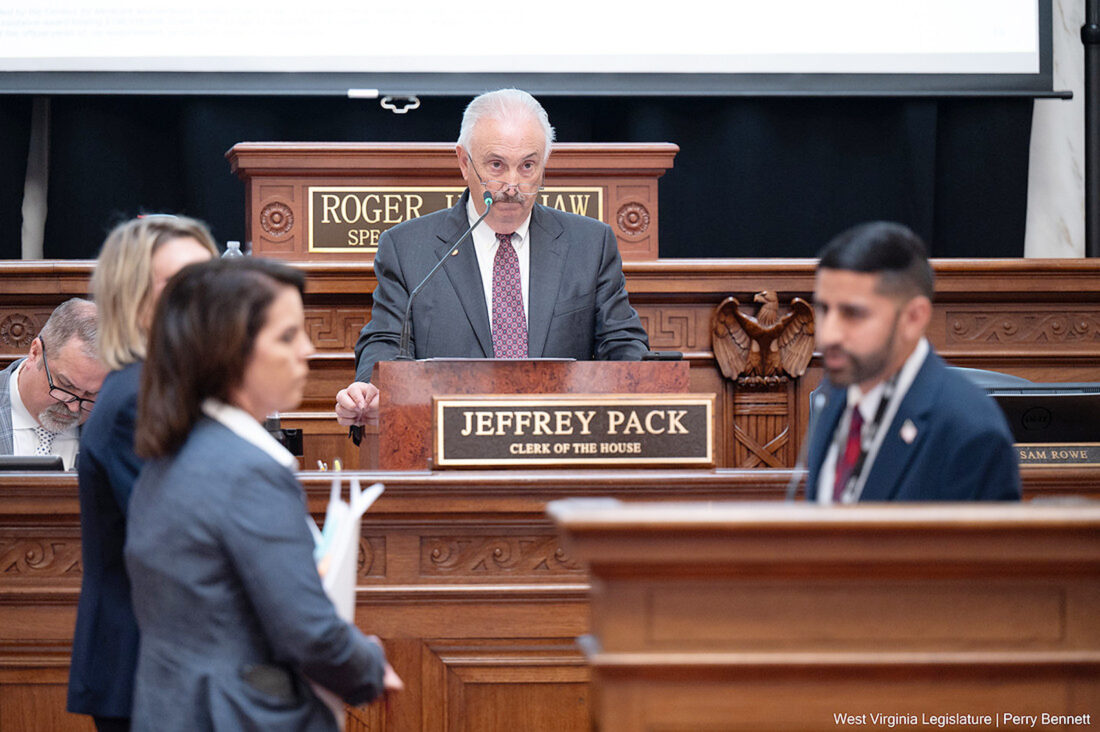
House Finance Committee Chairman Vernon Criss, presiding over one of Monday's House of Delegates meetings, listens as Department of Health Secretary Dr. Arvin Singh answers one of his questions about the federal Rural Health Transformation Program. (Photo courtesy/West Virginia Legislative Photography)
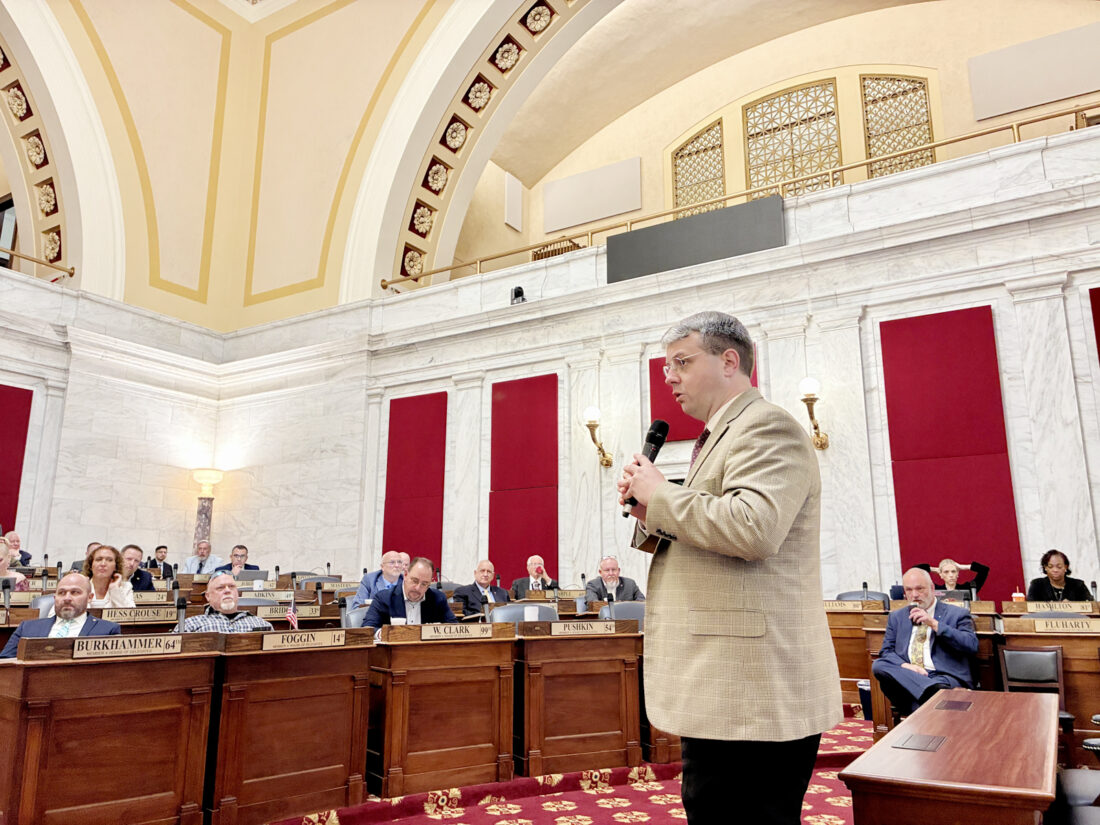
House Speaker Roger Hanshaw welcomes members of the House of Delegates Monday for the first of two days of informational meetings. (Photo by Steven Allen Adams)
House Finance Committee Chairman Vernon Criss, presiding over one of Monday's House of Delegates meetings, listens as Department of Health Secretary Dr. Arvin Singh answers one of his questions about the federal Rural Health Transformation Program. (Photo courtesy/West Virginia Legislative Photography)
House Speaker Roger Hanshaw welcomes members of the House of Delegates Monday for the first of two days of informational meetings. (Photo by Steven Allen Adams)
Trending
CHARLESTON - With last week’s election seeing several incumbent members of the West Virginia House of Delegates lose their primaries, House members came to the State Capitol Building Monday for a series of two-day meetings.
Legislative interim meetings for both the House and the state Senate do not begin until June, but House Speaker Roger Hanshaw said it was important for House members to come together and continue discussions of topics that came up during the 2026 legislative session.
"We have some things that we need to do to pick back up on where we left it as the House in March," said Hanshaw, R-Clay.
"Our goal two years ago in restructuring the way the House of Delegates ran committees was to begin moving away from how many bills do we pass and more towards how many problems are we solving," he continued. "What are the real issues that are plaguing the State of West Virginia and our 1.8 million people, and how do we best address those issues? Sometimes that’s passing a bill, but sometimes it’s not."
All 100 seats in the House are up for election in November as they are every two years. In the contested House GOP primaries on May 12, 21 incumbents were able to secure their nominations in contested primaries and move on to the general election. Seven out of nine members of the House Democratic caucus had no primary opposition.
Fourteen House Republican incumbents lost in the primary: Del. Mark Zatezalo, R-Hancock; Del. Jeff Stephens, R-Marshall; Del. Bill Bell, R-Wetzel; Del. Betsy Kelly, R-Tyler; Del. Bill Anderson, R-Wood; Del. Vernon Criss, R-Wood; Del. Scot Heckert, R-Wood; Del. Daniel Linville, R-Cabell; Del. Jordan Bridges, R-Logan; Del. Greg Watt, R-Webster; Del. Stanley Adkins, R-Nicholas; Del. Marshall Clay, R-Fayette; Del. Keith Marple, R-Harrison; and Del. Laura Kimble, R-Harrison.
Two members of the House Democratic caucus - House Minority Whip Shawn Fluharty, D-Ohio, and House Finance Committee Minority Chairman John Williams, D-Monongalia - are running for state Senate seats and will not be returning to the House next year.
Monday morning’s meetings began with a general session review of the functions of legislative oversight of state government presented by Del. Tristan Leavitt, the president of Empower Oversight, a nonprofit organization that focuses on independent oversight at the federal level.
"It is way easier to do oversight than to pass a bill,” said Leavitt, R-Kanawha, a former member of the federal Merit Systems Protection Board with staff experience on the U.S. House Oversight and Government Reform Committee and U.S. Senate Judiciary Committee. "It’s much easier to be able to gather information and to highlight problems than to get one single bill to move forward and fix it."
Members of the House Finance Committee, led by Chairman Criss, received reports Monday morning on state revenue collections and tax credits, a progress report on the state’s consolidated lab, and an update on changes made to the Supplemental Nutrition Assistance Program (SNAP) caused by the federal One Big Beautiful Bill Act.
Starting in fiscal year 2028, states will be required to provide matching funds for program allotments based on their Payment Error Rate. West Virginia's PER has shown a consistent downward trend, dropping from 10.98% in 2023 to an estimated 6.36% in 2025. The state aims to reach a sub-6% error rate by the end of fiscal year 2026 to avoid an estimated $26.9 million penalty.
"If you have an error rate below 6%, you won’t have a penalty," explained Janie Cole, commissioner for the state Bureau for Family Assistance. "If you have an error rate between 6% and 7.99%, you will have a 5% penalty; 8% to 9.99% or above, a 15% penalty. And that percentage is the percentage of annual allotments for that year.
"So, what does that mean for us? In 2025, if our estimates are correct, our error rate is 6.36%. So, our state match, our penalty that we would have to pay ... will be $27.6 million,” Cole continued.
Cole outlined specific strategies to mitigate these errors, including the use of predictive modeling software and enhanced beneficiary education to clarify reporting responsibilities to avoid the projected $27 million penalties.
Officials with the Department of Health provided the Finance Committee with an update on the $199 million federal Rural Health Transformation Program. The state has an Oct. 30 deadline to legally obligate all funds, with a July 31, 2027, internal deadline for grantees to submit final invoices, and a Sept. 30, 2027, deadline for all cash to be distributed to close the federal grant period.
"Our entire program is aligned with the Make America Healthy Again initiative," said Dr. Arvin Singh, the secretary of the Department of Health. "We aim to make West Virginia healthier and stronger by improving health outcomes, strengthening the rural workforce and building a self-reliant economy through prevention, innovation and partnership.”
To date, $2.9 million has been spent for administrative and stand-up costs for the program, with $160 million in contractual Announcements of Funding Availability and $62 million in active/closed solicitations in the state OASIS system.
RHTP currently employs 10 staff members with a target of 18. The state is utilizing KPMG for project management, policy formalization and AFA development. The projected cost for the first fiscal year is approximately $12.5 million, or roughly $1 million per month.
"We are using consultants to help with the standup of this program," Singh said. "The speed to execution is critical here, and having those consultants in place has allowed us to have the subject matter experts and speed to enact such a program."
Under questioning, Criss noted that federal law typically limits administrative costs to 10%, or $20 million. With consulting fees at $12.5 million and other administrative/staff costs at $8 million, Criss expressed concern regarding a potential $1 million overage, though Department of Health officials disagreed.
"You’re over the $20 million figure," Criss said. "(Singh) had exclaimed that he was going to be under $20 million on overhead. But when you add the consulting fees, which I would consider as overhead costs, you’re over by a million dollars. So, now you’re in violation of federal law, evidently, by being over by one million dollars."
Criss also questioned whether RHTP dollars would be awarded to companies and programs in-state offering services or to out-of-state providers.
Steven Allen Adams can be reached at sadams@newsandsentinel.com.