
Celebrating 175 Years of the Diocese of Wheeling-Charleston: A journey of faith and perseverance
Trending
On July 19, 1850, the Diocese of Wheeling was established by Pope Pius IX, marking the adventurous beginning of the present Diocese of Wheeling-Charleston.
The diocese is celebrating the milestone from July 19, 2025, through July of 2026, to reflect on how it began and how it has prevailed -- giving praise and honor to God. From pioneering founding bishop, Bishop Richard V. Whelan, to present shepherd, Bishop Mark E. Brennan, the diocese has persevered to share the Gospel by word and deed within its families, parishes, schools, hospitals and organizations.
The Diocese of Wheeling-Charleston's clergy, religious, laity and staff strive to exemplify the resilience, faith and courage of their ancestors - the hard-working souls who built the Church in these mountains.
Blessed Land
In 1749, as an expedition led by French explorer Pierre Joseph Celoron de Blainville of New France (Canada) unfolded to claim land along the Ohio River, Masses were celebrated by Jesuit priest, Fr. Joseph Pierre de Bonnecamp, who served as de Blainville's chaplain, navigator and secretary, documenting the trip and ultimately creating the first official map of the Ohio Valley.
Father Bonnecamp journaled that six "Celoron Lead Plates" were buried during the celebrations on the shoreline at the various points where the tributaries met the Ohio River. One was found in Point Pleasant, W.Va., in 1846, measuring 11 inches by 7.5 inches, and the inscription claiming the land for France. (Both France and Great Britain laid claim to the Ohio River Valley, and the French and Indian War ultimately resulted in a decisive victory for Great Britain.)
Few and Far Between
It was more than 200 years ago when Jesuit and Redemptorist missionaries braved the mountainous terrain of western Virginia to serve the few Catholic families who had settled in the region. These visits, however, were infrequent. Like the Apostles and first disciples, these missionary priests relied on the hospitality of those they encountered, sleeping where they could -- a barn, a cave, under the shade of a tree, or if blessed enough in the humble home of a kind soul. They ate what they could, packing staples for their journey, but when those ran out their mission and well-being depended on the people who lived in the hills and valleys of this land.
Their efforts though were not in vain.
By 1818, more Catholic families settled in western Virginia following the completion of National Road.
The first Masses in Virginia were celebrated in homes, on farmland, along creeks and tops of mountains. A growing Catholic population resulted in the need to establish the Richmond diocese, encompassing the entire state of Virginia, in 1820.
By 1821, Wheeling had its first Catholic church constructed in St. James Parish -- on land donated by Noah Zane at the corner of 11th and Chapline streets in Wheeling. However, the church was not assigned a resident priest -- Fr. Francis Rolof -- until 1828.
Eastern Panhandle -- Tracks to Expansion
St. John Parish (later known as St. Joseph's) in Martinsburg was established in 1825 and was served by the Rev. John B. Gildea.
By the 1830s, growth and expansion of the railways westward led German and Irish immigrants to settle in this region of western Virginia.
For Harpers Ferry and Martinsburg, this meant an expanding Catholic community. The Martinsburg Catholics had purchased the land for their church building in 1802, but waited 34 years to see it completed. Before this, families gathered for Mass in private homes and later a rented house until the first church was completed. The parish's second church was completed in 1860 and dedicated to St. Joseph. The church was used as a headquarters for the occupying Union troops during the Civil War, with the main floor serving as a hospital and the basement as a stable for the soldiers' horses. A school was opened in 1870 and staffed by lay teachers until the Sisters of Charity arrived in 1883.
Whelan Enters Diocese History
In Harpers Ferry, St. Peter's Church was constructed in 1833 on a rocky hilltop near the Maryland border. In 1834, a young priest, Fr. Richard V. Whelan, was assigned to what would become the iconic Harpers Ferry church, taking residence there. Whelan, a Maryland native, also served the Martinsburg mission. When the church at Martinsburg was completed, Whelan moved his residence there.
Five years later, in 1841, Whelan was named the second bishop of the Diocese of Richmond.
Growing Pains
In 1846, Bishop Whelan moved to Wheeling in the northwestern corner of the Diocese of Richmond. He took charge of St. James Parish and opened a small school for German Catholic children.
Within two years, women from the Visitation Sisters came to Wheeling to open the Wheeling Female Academy (later known as Mount de Chantal Academy).
Also in 1848, St. Patrick Parish in Weston was established to serve an increasing Catholic community of Irish immigrants who had labored on the Staunton and Parkersburg Turnpike. Father Austin Grogan purchased property at a corner of High Street for $100 to build a two-story church. Because of the generosity of both Catholics and non-Catholics, the church was opened in 1848 without debt.
The year 1849 saw the establishment of St. John Church in Summersville and a newly constructed St. James Church in Wheeling -- moved from its Chapline Street location to 13th and Eoff Street in Wheeling.
In 1853, the Sisters of St. Joseph (today the Congregation of St. Joseph) arrived in Wheeling to operate a hospital, which continues to thrive today as WVU Medicine Wheeling Hospital, the oldest Catholic hospital in West Virginia. The sisters' essential ministries in health care, catechism, evangelization, education, charity and prayer have continued for more than 170 years, an indelible and living link to the earliest days of the diocese.
Brutal Honesty
While Catholic populations grew, clergy in western Virginia had a nearly impossible task. Priests were given assignments covering a 100-mile radius, traveled by horseback or on foot.
Bishop Whelan was exhausting the hospitality of bordering priests and knew that in order to properly serve and evangelize, he had to attract priests and seminarians from outside of Virginia, Pennsylvania and Maryland.
So, putting pen to paper, he wrote a seminary in Ireland.
He knew he had to be brutally honest to attract young men who not only embraced a strong relationship with Christ, but also a strong backbone and an adventurous willingness to endure the many hardships required.
Bishop Whelan's recruiting pitch to All Hallows Seminary in Dublin, Ireland, advised prospective priests:
"Catholics are very few and generally very scattered, requiring a priest sometimes to attend a circuit of 100 miles in diameter." He described the state as "quite unimproved, less so perhaps than many portions of the remote west, exceedingly mountainous, with bad roads, and a very uncultivated population. (Any missionary) must expect a life of great labour and fatigue, much exposure to the cold, heat, and rain, bad roads, very indifferent diet and lodging, but little respect for his dignity, few Catholics, little of society, a compensation barely adequate to support him in the plainest and most economical manner. I wish no one to be taken by surprise. Many of our missions are just such as this; and I want no priest who does not come fully prepared to enter upon such a charge, certain that his recompense is not to be expected here, but hereafter. Make the young men whom you may think of selecting fully aware of this; inform them that there are places much more desirable elsewhere, where they may labour advantageously, and that if they select my Diocese I shall regard their character and honor compromised if afterwards they flinch, and I shall even refuse an exeat where there is no other good controlling motive."
The young priests took Whelan's warnings to heart. Not only did they travel to labor in these West Virginia mountains, but they also continued an association for more than 180 years.
He had a Reputation -- Tough As Nails
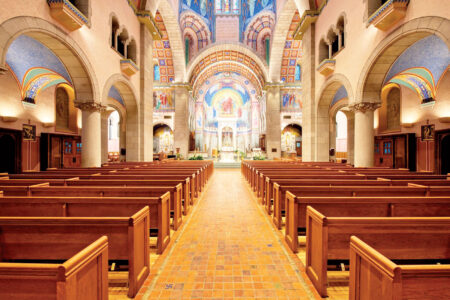
When the original St. James Church in Wheeling had fallen into disrepair, Whelan led the campaign for a new church to be constructed. A site was secured and, in 1847, a cornerstone laid for the parish that later became the Cathedral of St. Joseph.
But it wasn't just his determination and administration that was so impressive; it was also his strength. It was Whelan that climbed more than 200 feet in the air to place a cross on top of the new spire at St. James' after construction workers refused the dangerous task.
In 1872, Whelan successfully appealed to Pope Pius IX to change the patronage of St. James to St. Joseph, reasoning that Joseph -- the Terror of Demons and Guardian of the Redeemer, patron of the entire church -- would further protect and strengthen the faithful of the Diocese of Wheeling.
Becoming Their Own
In 1849, Whelan convinced the Church hierarchy in the Archdiocese of Baltimore to divide the Diocese of Richmond by the natural barriers of the Allegheny Mountains.
On July 19,1850, the Holy See established the Diocese of Wheeling. The diocese included all of what is now West Virginia except for the eastern panhandle and Potomac highlands, and included several counties in southwestern Virginia, all the way to the Tennessee border.
Four days later, on July 23, 1850, Blessed Pope Pius IX named Whelan as the first bishop for the diocese.
According to Whelan's diocesan records from 1850, churches completed, or nearing completion were in Martinsburg, Harpers Ferry, Bath (Berkeley Springs), Union (Monroe County), Sweet Springs, Tazewell Court House (Va.), Wytheville (Va.), Wheeling, Parkersburg, Howesville, Fairmont, Morgantown, Weston, Braxton Court House, Summersville, Charleston, and Grafton.
Whelan died at the age of 65 in 1874.
It took another 100 years, in 1974, for the Holy See to redraw the boundaries of the diocese to correspond with the state and further rename it as the Diocese of Wheeling-Charleston.