
U.S. Supreme Court upholds W.Va. transgender student-athlete prohibition
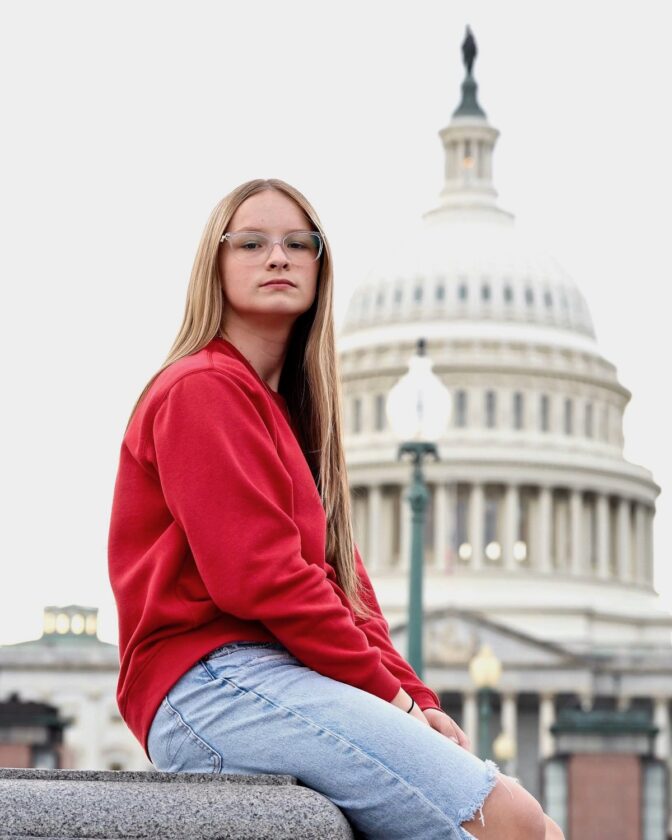
Becky Pepper-Jackson (Photo Courtesy/Will Martinez, ACLU)

U.S. Supreme Court (File photo by Steven Allen Adams)
Becky Pepper-Jackson (Photo Courtesy/Will Martinez, ACLU)
U.S. Supreme Court (File photo by Steven Allen Adams)
Trending
CHARLESTON – A majority of the justices on the U.S. Supreme Court said a West Virginia law prohibiting transgender girls and women from participating in sports designated for biological girls and women did not violate the rights of a Harrison County transgender girl.
In a 6-3 decision Tuesday, the U.S. Supreme Court ruled in favor of West Virginia and Idaho, which passed similar laws described as being aimed at protecting biological girls and women from being forced to compete against biological boys and men who became transgender girls and women.
“Separate sports teams for biological males and biological females are reasonable: Given the inherent physical differences between the sexes, allowing only biological females to play on women's and girls' teams can reduce the risk of physical injury and ensure fair competition,” wrote Justice Brett Kavanaugh, penning the opinion on behalf of Chief Justice John Roberts and the four other conservative members of the court.
“Our role is not to judge the wisdom, fairness, or logic of the law before us, but only to ensure that it does not violate the equal protection guarantee of the Fourteenth Amendment,” Kavanaugh continued.
House Bill 3293, passed by the West Virginia Legislature in 2021, requires student-athletes in middle school, high school and college to participate in sports that match the student's sex assigned at the time of their birth. The law applies to sports regulated by the NCAA and other college interscholastic organizations. The law is now called the Save Women's Sports Act.
Becky Pepper-Jackson, a 16-year-old Harrison County high school cross country and track athlete who has identified as a girl since third grade and takes puberty-blocking medication, filed a lawsuit against HB 3293 in May 2021 when she was 11, shortly after the law went into effect. She placed first in shot-put in the state girls high school track and field championship in May.
Attorneys for Pepper-Jackson -- which include the ACLU-WV, Lambda Legal, and Cooley LLP -- alleged that HB 3293 violated her federal Title IX rights, prohibiting the exclusion of students from education programs on the basis of sex, as well as her rights under the Equal Protection Clause of the 14th Amendment to the U.S. Constitution. But Kavanaugh wrote that neither West Virginia’s nor Idaho’s laws conflict with Title IX or the 14th Amendment.
“Consistent with Title IX and the Equal Protection Clause, we hold that the States may maintain women's and girls' sports for biological females,” Kavanaugh wrote. “They may determine eligibility for women's and girls' sports based on biological sex. The Constitution and Title IX do not require an overhaul of women's and girls' sports throughout America.”
In a dissenting opinion, Justice Sonia Sotomayor argued the majority misapplied the legal standards for sex-based classifications and ignored crucial factual distinctions regarding transgender athletes who have not undergone male puberty.
“This litigation implicates deeply sensitive, contentious, and evolving issues,” Sotomayor wrote. “These circumstances demand exercising judicial restraint, not rushing to answer conclusively difficult questions without sufficient evidentiary development.
“In opting otherwise, the majority extends great sympathy to those it favors: the young cisgender girls and women who play sports,” Sotomayor continued.” I share that sympathy. Playing sports can lead to benefits that are immeasurable, and many are understandably invested in ensuring that competition stays fair and safe. Because the majority, however, inflicts a hardship on those it disfavors without giving them the fair and full opportunity the Constitution requires to litigate their contentions, I respectfully dissent."
The U.S. District Court for the Southern District of West Virginia allowed the law to be enforced, the U.S. Fourth Circuit Court of Appeals overruled that decision, preventing the law from being enforced while the case was pending. The Supreme Court rejected an effort by then-Attorney General Patrick Morrisey to appeal that ruling barring enforcement of the law while the case was pending.
The U.S. Supreme Court agreed to take up the state’s appeal last year, with oral arguments taking place in January. W.Va. Attorney General J.B. McCuskey praised the decision.
“This is a monumental victory for every female athlete who has ever competed, or dreamed of competing, on a fair and safe playing field,” McCuskey said. Today’s Supreme Court decision affirms what common sense and the law have long made clear: States have the right to designate sports teams based on biological sex, not gender identity. Without that delineation, Title IX is turned on its head and decades of hard-fought progress to advance female athletes is erased.”
State, national and international athletics regulators have begun changing their rules under pressure. President Donald Trump signed an executive order early in 2025 barring transgender girls and women who were born as males from participating in sports with biological females.
The NCAA in early 2025 updated its policies to abide by Trump's executive order, limiting competition in women's sports to student-athletes assigned female at birth only. The International Olympic Commission also set a 2026 target to update its policies, which could limit participating of transgender athletes in future Olympic competitions.
Last year, the West Virginia Legislature passed Senate Bill 299, modifying state regulations on pubertal modulation, hormonal therapy, and gender reassignment. SB 299 eliminates narrow exceptions for the use of medication gender-affirming care for minors.
Morrisey also signed Senate Bill 456 last year - the Riley Gaines Act - which defines "male" and "female" in state code and protects single-sex spaces. The bill is named for Riley Gaines, who first made headlines in 2022 after competing against Lia Thomas, a transgender woman who was on the University of Pennsylvania's swim team. Morrisey appealed the lower court ruling in 2024 as attorney general.
“Today’s decision will be remembered as one of the most important victories for women’s athletics since the enactment of Title IX itself,” Morrisey said in a statement Tuesday.
“For far too long, Americans watched as this debate unfolded and wondered whether the promise made to generations of women and girls would endure,” Morrisey continued. “Today, the Supreme Court answered that question. The protections established under Title IX remain meaningful, the integrity of women’s sports remains worth preserving, and states retain the authority to defend fair competition.”
McCuskey inherited the case in 2025 when he first took office succeeding Morrisey as attorney general. The case was argued before the U.S. Supreme Court last summer by state Solicitor General Michael Williams.
“I am immensely proud of my team for not only getting this issue before the Court but for delivering sound and successful arguments,” McCuskey said. “This landmark victory will give all states, not just West Virginia, the clarity and confidence to ensure fairness and safety for female athletes today and for generations to come."
Attorneys opposing the West Virginia and Idaho bans on transgender student-athletes said in a statement Tuesday they were disappointed in the Supreme Court’s ruling.
"This is a heartbreaking ruling for our clients and transgender girls like them who've asked for nothing more than the same opportunities afforded to their peers." said Joshua Block, senior counsel for the ACLU's LGBTQ & HIV Rights Project. "The reality is that the equality of transgender women and girls takes nothing away from, and in fact promotes, the equality of all women and girls. We will continue to advance the fundamental principle that all young people deserve equal opportunity to thrive and succeed."
"This ruling is deeply harmful for transgender women and girls who only asked for the ability to participate in sports with their peers," said Sasha Buchert, senior attorney and director of the Non-Binary and Transgender Rights Project at Lambda Legal. "Countless studies have demonstrated the myriad benefits that come with participation in team sports. Now, one population, transgender youth and collegians, are targeted for specific and baseless discrimination. We will not be deterred and will continue to fight back to secure the equal participation that all youth, including transgender youth, deserve."