
West Virginia Democrats fail to block ERA reconsideration
Anti-abortion groups oppose ratification of Equal Rights Amendment
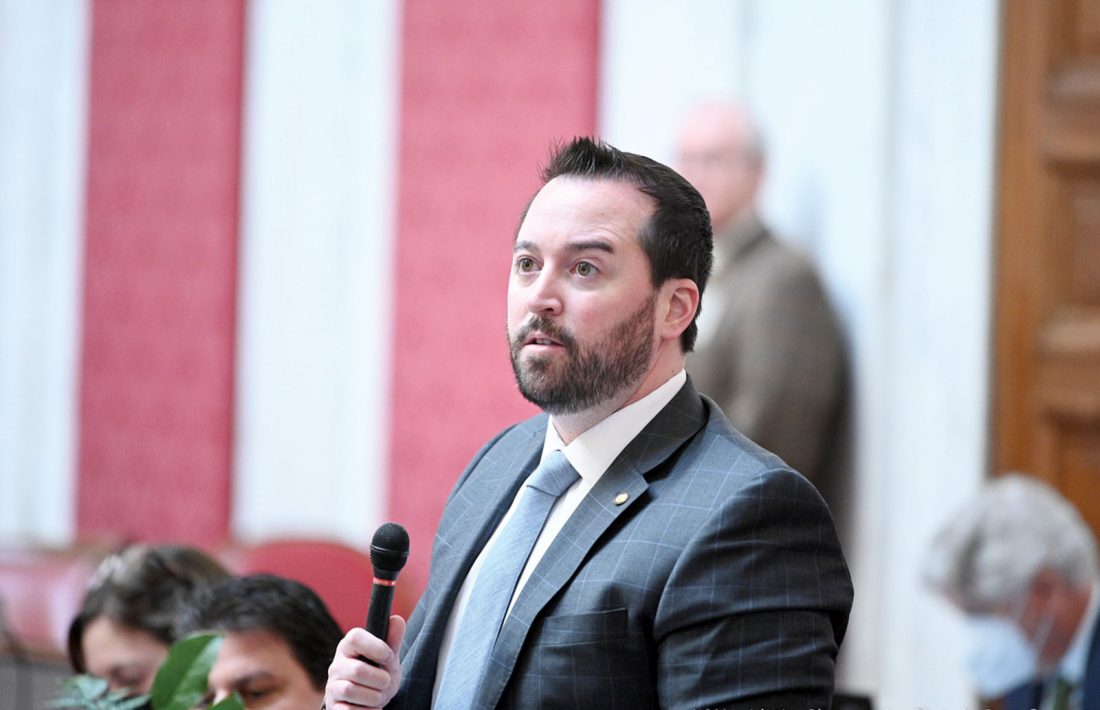
House Minority Whip Shawn Fluharty tried to get the House of Delegates to rejected a state Senate resolution making West Virginia’s ratification of the Equal Rights Amendment in 1972 null and void. (Photo Provided)
CHARLESTON — In an attempt to offer a Valentine’s Day gift to West Virginia’s women, Democratic members of the House of Delegates attempted to block consideration of a resolution that would clarify the state’s ratification of women’s rights ended in 1979.
House Minority Whip Shawn Fluharty, D-Ohio, made a motion Monday morning to reject a message from the West Virginia Senate announcing the passage of Senate Concurrent Resolution 44, clarifying the state’s ratification in 1972 of the Equal Rights Amendment. The motion failed 18-75 along party lines.
SCR 44 would make it clear that the state’s ratification of the ERA on April 22, 1972, was only valid until March 22, 1979, the six-year deadline placed on states to ratify the proposed constitutional amendment. Only 35 states had ratified the ERA within the six-year time frame.
The ERA would have added an amendment to the U.S. Constitution, stating that “Equality of rights under the law shall not be denied or abridged by the United States or by any State on account of sex.” The amendment needed three-fourths of states to ratify the ERA, or 38 states.
“It’s a stain on our state and a stain on our country for us to even be taking this up, yet here we are today moving this forward in the House on what day? Valentine’s Day,” Fluharty said. “Happy Valentine’s Day, West Virginia women! The West Virginia Legislature thinks you don’t count.”
“Our courts have said that women are not entitled to the same protections under the law as men,” said Del. Barbara Evans Fleischauer, D-Monongalia. “This resolution is a slap in the face to all the people who worked for equal rights.”
Del. Diana Graves, R-Kanawha, said she supported the ERA as proposed 50 years ago. But she said that members should be allowed to accept the Senate message on SCR 44 and debate it.
“In my opinion … we should allow this to go through the committee process,” Graves said.
“It’s astonishing to me to get up and say, ‘we just need to go through the process, the procedural aspects of all of this,'” Fluharty said. “I would like to know what amendments you plan to make? Are you going to pick parts out where you think women don’t matter as much? Is that what we’re doing next? What process do you need? What amendments do you need? What we need is to send a message that we’re not going to tolerate this crap.”
Since 1979, three states have ratified the ERA, bringing the total to 38 states. Advocates for the ERA are trying to get Congress to pass resolutions eliminating the six-year deadline for ERA. However, since Congress passed the joint resolution creating the ERA, six states have rescinded their earlier ratifications, something some constitutional scholars believe is not allowed under the Constitution.
Supporters of SCR 44, such as West Virginians for Life and National Right to Life, argue that the resolution does not rescind the state’s earlier ratification but only states that the ratification was only valid between 1972 and 1979.
“Over the weekend, I received a message from a Democrat friend of mine,” said House Majority Leader Amy Summers, R-Taylor, as she prepared to read the message to the body. “‘I’m very upset about the how the media is portraying Friday’s Senate vote as rescinding the state’s ratification of the Equal Rights Amendment’ … all it says is the state’s ratification should be deemed to have expired when the amendment did in 1979.”
“SCR 44 does not ‘rescind’ West Virginia’s 1972 ERA ratification. It does something rather distinct from that, and more important,” said Douglas Johnson, director of the ERA Project for National Right to Life, in an email Saturday.
Supporters believe that attempts to revive the ERA would allow Congress to pass a bill creating a right to abortion – something that the 1972 U.S. Supreme Court decision Roe v. Wade put in place.
“The majority of West Virginia legislators are pro-life and do not want to see their pro-life laws invalidated by a political stunt that makes use of the West Virginia vote on an ERA that expired decades ago,” said Wanda Franz, president of West Virginians for Life, in a statement after Friday’s vote by the Senate on SCR 44.
“This measure is an emphatic repudiation of the attempts by Democrats in Congress, and Democratic attorneys general, to hijack long-expired actions by state legislatures as part of their unconstitutional scheme to jam the pro-abortion ERA into the Constitution,” said Johnson said in the same press release.
Steven Allen Adams can be reached at sadams@newsandsentinel.com
Local News

St. Paul’s United Methodist Church to mark 125th anniversary

Community comes together for 10th Annual Dash for Diabetes

Teen of the Week: McLean makes time for everything he wants to do

29th annual Mid-Ohio Valley Multi-Culture Fest kicks off Friday at Civitan Park
Memorial Health System announces Louden, King and Mossbarger to the Department of Dermatology
MARIETTA - Memorial Health System has announced the addition of three local providers to its Department of ...
Farmers Castle Museum to hold open house for Juneteenth
BELPRE – Farmers Castle Museum, operated by the Belpre Historical Society, will have an open house from 1-4 p.m. ...