
Parkersburg City Council tables proposed Urban Renewal Authority change in 5-4 vote
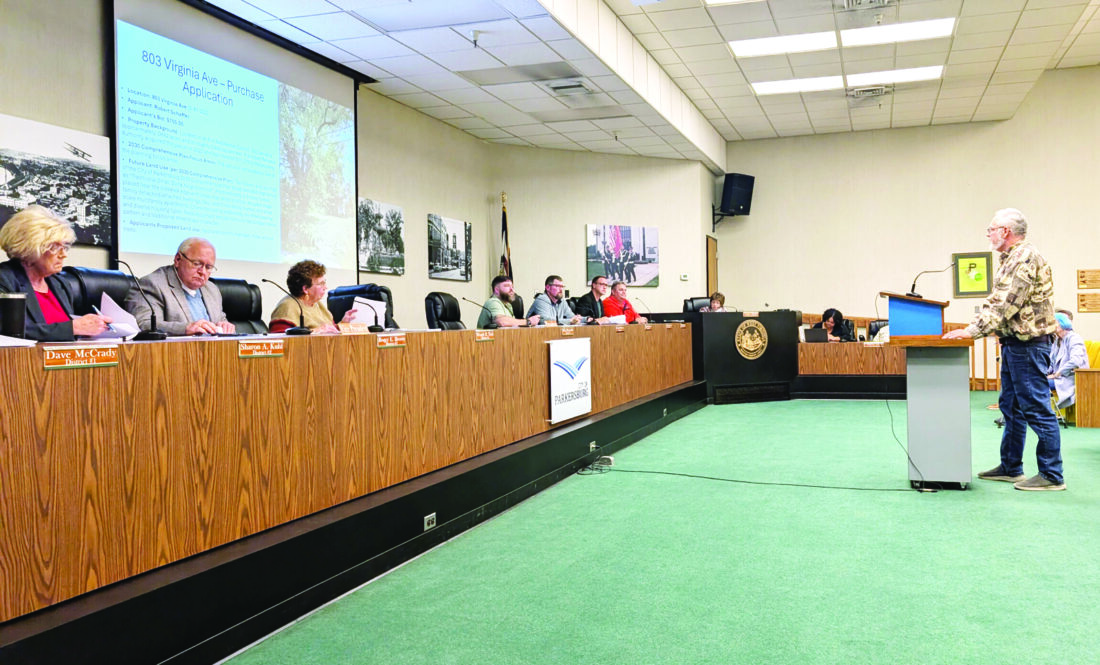
A Parkersburg resident addresses City Council members acting as the Urban Renewal Authority during a URA meeting in November. (File photo)
PARKERSBURG – After debate and multiple proposed amendments, Parkersburg City Council narrowly voted to table a resolution changing the makeup of the Urban Renewal Authority. The authority – which acquires property through buying, donations and eminent domain and sells it – is made up of all nine members of council. They were still meeting as the authority as of 10 p.m. Tuesday following the regular council session. The resolution would have changed the membership, after amendments, to seven members – two from council and five appointed residents of the city. But it was tabled on a 5-4 vote as council members debated whether the control of a six-figure budget and the authority’s powers should rest with a board primarily made up of unelected individuals. “Right now, URA is political. This takes the politics out of it,” said Councilwoman Sharon Kuhl, who chairs the authority this year. Councilman Mike Reynolds said he’s voted against changes to the authority’s membership in the past but believes it’s time for council to try a different approach. “We’ve proven we aren’t very good at developing. We’re not developers,” he said. But Councilman Chris Rexroad said “to turn over the amount of money that the URA operates with to a majority of appointed officials is not in the best interest of the city or the taxpayers’ money.” The original proposal would have had one council member on the authority and six people appointed by the mayor and confirmed by council. It called for four people who possess “necessary experience and expertise” in banking, real estate, finance, development, planning, policy, construction, land preservation “or another practical field.” The remaining two members would maintain membership “with a recognized local civic organization.” Council voted 7-2, with Councilwoman Wendy Tuck and Councilman Zak Huffman opposed, to change the mix to two council members and five appointees. Rexroad made a motion to flip it to five council members and two appointees, but that failed 3-6, with only Tuck and Huffman joining him in voting for it. The breakdown of the five appointed members between subject matter experts and members of civic organizations under those configurations was not discussed. The original text said a majority of the members had to be residents of the city, with Kuhl saying last week others could work in the city but not necessarily live in it. City Attorney Blaine Myers recommended changing “a majority” to “all members.” That amendment passed unanimously. Rexroad attempted to introduce amendments requiring any decisions of the revamped authority involving money or contracts to be approved by council and to limit members’ terms to one year, but withdrew them after Myers said those changes were likely not allowed under state code. “Yes, we control the purse strings” by allocating money to the authority in the budget, Rexroad said. “But … we have no control over the spending of that money as this is written.” Huffman said part of the reason he was elected was to serve on the URA. “I just can’t justify putting unelected people in the majority,” he said, noting the city employs people who are knowledgeable about development and contributes to organizations that specialize in development. Tuck asked if the authority could exercise eminent domain and who would be left holding the bag if the authority was sued or a deal went south. Myers said all duties and liabilities would remain the same as under the current setup. Tuck made the motion to table and it passed 5-4, with Kuhl, Reynolds, Councilman Rob Moore and Council President Andrew Borkowski opposed. Some people spoke against the proposal during the public forum, with Parkersburg resident Brian Hayden saying the inclusion of non-residents didn’t comply with state law, that law does not require any form of expertise and the city shouldn’t decide which civic organizations are recognized. Parkersburg resident Sherry West suggested Mayor Tom Joyce was advocating for the change to “mitigate some of the sweetheart deals on Parkersburg property that he and others have had a hand in.” During his executive message, Joyce said he has no vote on any transactions approved by the authority and that he did not have a hand in the resolution appearing on the agenda. “I found out about this resolution when (City Clerk) Connie (Shaffer) sent out the agenda,” he said. Parkersburg resident Caci Petrehn said she was not necessarily opposed to the change but questioned the process, with it only coming up for discussion at this meeting and just requiring one vote as a resolution. Council also voted 7-2, with Tuck and Huffman opposed, to approve the final reading of an ordinance raising pool rates for the first time since 2019. Three people spoke against the move in a public hearing. City resident Ray Vannoy said grant money given to organizations such as the YMCA of Parkersburg could be used to offset rising costs. The YMCA is also the contractor to operate the pool, which comes from the general fund. It received $20,000 from the city’s federal Community Development Block Grant budget to support its Camp navigator scholarship fund. “Why can’t we use that money so we don’t have to raise something for children to use?” he said. Joyce acknowledged he was “not crazy about raising the rate” but noted prices are increasing everywhere, including what the city has to pay to supply and staff the pools. He said the city continues to fund the Schools to Pools program, providing passes for 300 to 350 income-eligible children each year. Borkowski said the increase doesn’t cover the cost to operate the pool. “Raising these rates only allow us to lose less money, subsidize less,” he said. “At some point you have to raise them incrementally or you’re going to get down the road and you’re going to have to really jump them up and make it even worse on people.” One speaker, who did not give his name, said he understood the reasoning but asked officials to reassess the decision and lower the rates as prices for other things cool. In other business, council unanimously approved the final readings of two ordinances setting a pay range for a civilian training officer in the Fire Department. They voted 8-1, with Tuck opposed, to approve the final reading of an ordinance approving pay increases for civil service employees in the police and fire departments and part-time workers, reflecting the 4.2% cost-of-living adjustment in the budget for the new fiscal year beginning July 1. Evan Bevins can be reached at ebevins@newsandsentinel.com.