
Money Bomb: Morrisey-linked groups pour millions into legislative races
Trending
CHARLESTON - Five different political groups have spent more than $1.6 million since March either lifting up Republican incumbents and candidates or directly opposing sitting GOP lawmakers, with some of those groups having connections to Gov. Patrick Morrisey.
Combined, these five groups had spent $390,798 as of April 22 opposing Republican incumbent members of the House of Delegates and state Senate, according to a review of data filed with the Secretary of State’s Office.
In some cases, Morrisey, a Republican, has publicly endorsed the primary opponents of these lawmakers. On the other hand, $578,391 has been spent by these same groups to support incumbent GOP lawmakers seen as reliable allies of the governor.
Steve Roberts is president of the West Virginia Chamber of Commerce, a group representing half of the employers in the state. The chamber’s political action committee makes endorsements in legislative races each election cycle. As a longtime political observer, Roberts said he has never seen this level of spending in midterm legislative contests.
"State legislative races in West Virginia are being nationalized for the first time, especially in an off-year primary election," Roberts said. "What we're seeing is loads of money coming into West Virginia, some of it traced to out-of-state billionaires, but loads of money coming in from out of state to influence elections for the West Virginia House of Delegates and the West Virginia State Senate."
Mitch Carmichael, a former longtime member of the House of Delegates and former Senate president, called the amount of money being spent on these midterm statehouse contests "unprecedented."
"Yeah, this is a lot of money for influence of legislative races," he said. "And most people traditionally recoil when they hear how much money is being utilized to influence races."
Jackpot
Five groups are driving this spending: Americans for Prosperity (AFP), School Freedom Fund, Sugar Maple PAC, Make Liberty Win and Mountaineer Conservative Action.
AFP, which has a West Virginia chapter, is a national conservative advocacy organization founded 17 years ago by David and Charles Koch. AFP-WV advocates for tax cuts, regulatory reform, eliminating the certificate of need process for health care services and expansion of school choice.
As of April 22, AFP-WV had spent $570,004 on legislative races. Of that, $534,013 was in support of nine incumbent lawmakers and 12 GOP primary candidates, while $35,991 opposed five GOP candidates, including four incumbents: Senate Majority Whip Ben Queen, R-Harrison; House Finance Committee Chairman Vernon Criss, R-Wood; House Finance Committee Vice Chairman Clay Riley, R-Harrison; and Del. Scot Heckert, R-Wood.
"Make no mistake: The policy trajectory of West Virginia is at stake this May," said AFP-WV State Director Jason Huffman in an April 1 press release. "That's why we are engaging in an unprecedented number of races to elect principled policy champions who will fight for the common-sense reforms we know will make the Mountain State a better place to live, work, and raise a family."
AFP-WV backed Morrisey in the May 2024 Republican primary for governor over five other candidates. The group spent more than $700,000 that primary period supporting the eventual governor, focusing its efforts of grassroots campaigning. AFP-WV was critical of Criss and Riley over a proposed bill earlier this year that would have made reforms to the Hope Scholarship educational voucher program, while the group butted heads with Heckert last year over a failed effort to repeal certificate of need.
The second largest spender to date was School Freedom Fund, an independent expenditure committee created by Club for Growth, a national conservative public policy advocacy organization whose political action committee supported Morrisey in 2024.
School Freedom Fund had spent $447,136 as of Wednesday. Of that total, $140,051 was spent opposing nine GOP candidates and incumbent delegates, including Criss; Riley; Heckert; Del. Jeffrey Stephens, R-Marshall; and Del. Gary Howell, R-Mineral. Sitting state senators being opposed by School Freedom Fund are Sen. Tom Takubo, R-Kanawha, and Sen. Vince Deeds, R-Greenbrier.
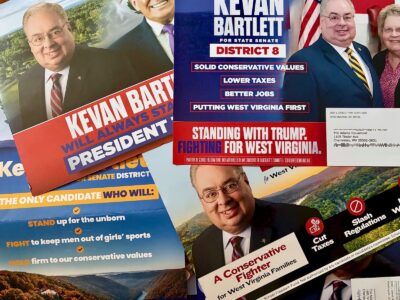
School Freedom Fund has spent $307,085 supporting 17 GOP candidates, including primary opponents to Criss (Charles Hartzog), Heckert (Melissa McCrady), Riley (Megan Krakewski), Stephens (Don Dewitt), Howell (Charles "Dutch" Staggs), Takubo (former delegate Chris Pritt), and Deeds (Jonathan Comer). School Freedom Fund is also supporting state Sen. Laura Wakim Chapman, R-Ohio; state Sen. Ann Charnock, R-Kanawha; state Sen. Kevan Bartlett, R-Kanawha; and state Sen. Darren Thorne, R-Hampshire.
In March 2023, Club for Growth Action donated $2.1 million to Black Bear PAC, a pro-Morrisey political action committee. Both groups raised more than $5 million to support Morrisey’s 2024 primary campaign for governor.
The third largest spender was Sugar Maple PAC, who shares a treasurer with several Morrisey-connected fundraising groups. According to its most recent campaign finance report, Sugar Maple raised $565,000 between January and March, including $100,000 from pro-school choice advocacy group "Yes. Every Kid;" $100,000 from GOP megadonor Jeff Yass; and $100,000 from Thomas Klingenstein, a hedge fund manager and chairman of the board of trustees for the conservative Claremont Institute.
In turn, Sugar Maple spent $279,867 on legislative races, including $123,703 spent opposing nine GOP candidates: Criss, Riley, Heckert, Stephens Howell, Deeds and Takubo. The PAC spent $156,174 supporting 10 candidates, including Chapman, Bartlett and Charnock.
According to WV MetroNews, Sugar Maple’s treasurer, Charles Gantt, also served as treasurer for Black Bear PAC and West Virginia Prosperity Group, the nonprofit that started out as Morrisey’s gubernatorial transition organization. Gantt also served as treasurer of a political action committee that supported Morrisey’s failed 2018 GOP primary for the U.S. Senate.
Other groups spending money in legislative races include Make Liberty Win, a national conservative advocacy group that spent $207,415 since April 10. Of that, $184,857 was spent opposing 35 GOP candidates, including 22 incumbent House members and six incumbent state senators.
Mountaineer Conservative Action, which is focusing on state Senate races, spent $172,797 since April 15, including $150,193 opposing Takubo and four other GOP state senate candidates: Marc Harman (opposing Senate President Pro Tempore Jay Taylor, R-Taylor), Del. Bob Fehrenbacher (opposing state Sen. Mike Azinger, R-Wood), Jeff Disibbio (opposing state Sen. Mark Maynard, R-Wayne) and Ken Reed (opposing Thorne).
Show me the money
Looking at specific House and Senate races, these five groups have spent a combined $132,441 to oppose Takubo, a former Senate Health and Human Resources Committee chairman and former Senate majority leader.
Takubo was one of three candidates for Senate president at the end of 2024, with the Republican caucus choosing Randy Smith, R-Preston. These groups have spent a combined $46,392 to support Takubo's primary opponent, Pritt.
Deeds was the second largest target, with these groups spending $76,839 to oppose his re-election to the Senate and $53,901 to support Comer, a relative of Kevin Comer, the banquet supervisor for the Governor’s Mansion and a constituent services liaison for Morrisey.
Bartlett, a pastor and former member of the House who was appointed in 2025 to fill a Senate vacancy left when Mark Hunt took office as state auditor, was the largest Senate beneficiary of spending by these groups, with $93,718 in support.
On the House side, Heckert is the largest target of these groups, who have spent $23,309 to oppose and $33,950 to support his primary opponent, McCrady. These groups spent a combined $20,762 opposing Riley while spending $33,480 to support Krajewski, his primary opponent; and spending $18,475 to oppose Criss and $28,060 to support Hartzog.
Morrisey has made a number of endorsements so far this primary season, including backing Chapman and Azinger for re-election, and Comer over Deeds in the District 10 race. Morrisey has also made no secret of his disdain for other incumbents, such as Criss and Riley, criticizing the House Finance Committee chairman and vice chairman for not supporting his agenda this past session.
"With the right team in the Legislature and in the Executive Branch, we can help WV reach her potential, address the affordability challenges facing our citizens, advance educational attainment, improve health care outcomes, fix our infrastructure, and retain our values," Morrisey said in a social media post last week.
"I'm not going to support candidates who are too afraid to take the bold actions required to move WV up in the economic rankings," Morrisey continued. "I'm not satisfied with mediocrity and don't want to keep doing things the way they've always been done. ... We need candidates who will help us advance a policy agenda that puts West Virginia first."
Know before you go
Midterm primary elections usually do not attract as much attention as contests that coincide with presidential primaries and traditionally have low voter turnout. According to the Secretary of State’s Office, there are more than 1.19 million registered voters for this year’s primary. Also, the Republican primary is closed to unaffiliated voters for the first time in decades.
Roberts said he sees the involvement of these groups in West Virginia politics as a way to get the biggest bang for their buck.
"I think those groups have determined that West Virginia legislative (elections) are relatively inexpensive, and that you simply can put some money into West Virginia, and your dollars will go a long way," Roberts said. "To me, this looks very much like out-of-state interest groups have chosen West Virginia, and probably some other states, to really influence the outcome of legislative elections."
Carmichael said this amount of spending is a sign that the state is getting the attention of these national groups and playing a larger role on the national stage.
"It underscores the fact that West Virginia is an important component in the national framework of larger issues," he said. "I think to that extent, we should be encouraged by the fact that there are so many people interested in the outcome of West Virginia elections and that are willing to invest private sector dollars into these races."
Roberts acknowledged that the First Amendment and past judicial decisions, such as Citizens United, provide private groups a larger megaphone for supporting or opposing candidates. But he said West Virginians need to be skeptical of some of the messaging voters are seeing from these groups through mailers, social media and advertising.
"Nobody’s denying anyone’s right to free speech," Roberts said. "But I think West Virginia voters would want to recognize that there is sort of an internal West Virginia faction, and there is an external West Virginia faction, and the external faction is putting a lot of money into state legislative races."
Carmichael said this level of spending by outside groups is likely to keep increasing, with efforts continuing to distort the positions of candidates. He urged voters to be more vigilant in seeking out accurate and vetted information about the candidates and not solely relying on messaging by these independent expenditure groups.
"Many of these pieces that are funded by various groups have a distorting element to it. There’s no question about that. But we have to always lean into the bedrock principle of freedom of speech," Carmichael said. "It has been ruled on ... that people have a right to do this. The onus now is on the citizens of West Virginia to be an informed voter. Being a good citizen is not just a spectator sport. You have to invest your time and effort to learn about the candidates’ real, true positions.”
West Virginia’s primary election day is Tuesday, May 12. Early voting begins Wednesday, April 29.
Steven Allen Adams can be reached at sadams@newsandsentinel.com.