
Trending
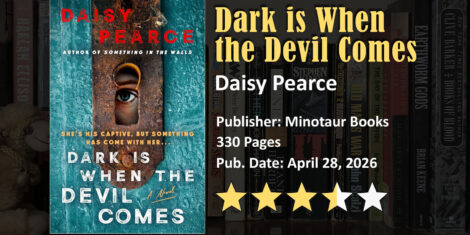
If you're a garden variety serial killer, you may have planned for a lot of contingencies when designing your murder basement. I'm not sure Andrew from Daisy Pearce's "Dark is When the Devil Comes" could've conceived the unique challenges posed by his latest victim.
Hazel is estranged from her sister Cathy and has recently moved back in with her parents to ride out a bitter divorce. She's adrift and seemingly the perfect victim, but she isn't alone in her head when Andrew kidnaps her and locks her in his basement cell. She has a darker half, an "other sister," that causes her to do terrible things to the people she loves.
Soon the drugs suppressing that side of her begin to fade from her system. Hazel needs to escape while she can still trust her own senses.
Meanwhile, on the outside, Cathy is desperate to find her missing sister. She teams up with a former classmate, a goody-two-shoes named Suzie, to find Hazel before it's too late.
It's a slow-burn thriller, easing up the tension levels until it starts to rocket forward in the final half.
Pearce walks a fine line, presenting Hazel's chapters in a first-person POV where you can't be entirely sure what's real and what's delusion. Maybe she's being haunted by a demonic being straight out of a Silent Hill video game or maybe she's just losing her mind again.
The symbolism feels deliberate: Andrew uses a large drill to subjugate and murder women. Hazel, Cathy and Suzie could be pressed into the Triple Goddess archetype of the Mother, the Maiden and the Crone. Which is which, and how the "other sister" fits in, would be spoiler territory.
***
Short takes on some recent reads:
* "World War Z: An Oral History of the Zombie War," by Max Brooks. Inspired by the oral histories of Studs Terkel, this novel covers the zombie apocalypse through the voices of the survivors. It's epic and sweeping in scope, with the kind of political underpinnings that gave George Romero's zombie movies that little extra bite. Hollywood attempted to adapt it into a movie starring Brad Pitt and failed miserably.
* "The Murder at the Vicarage," by Agatha Christie. The first appearance of Miss Marple, the nosy and knowledgeable amateur sleuth who goes around solving crimes. I haven't read much of Agatha Christie's work, but I plan to continue. Miss Marple seems more fun than Christie's other series protagonist, Hercule Poirot.
* "Assassin's Apprentice," by Robin Hobb. I'm not sure a fantasy novel about the son of a prince being trained as an assassin can be considered "cozy," but here we are. The stakes are low for this first installment of Hobb's Farseer Trilogy, but the character work is top notch. The psychic powers are a nice bonus.
* "Midnight Mass," by F. Paul Wilson. Vampires have undergone many transformations over the decades, but Wilson brings them back to their non-sparkly roots. These vamps would not look natural on a Victorian fainting couch. These are nasty, brutish creatures with human collaborators. The story centers on Father Joe, a priest determined to take back his church from the monsters who defiled it.
* "Free Fire," by C.J. Box. The further adventures of Joe Pickett, Wyoming game warden, as he investigates a man who committed the perfect crime: gunning down four people in a section of Yosemite National Park that is not subject to any laws.
* "Virgin," by F. Paul Wilson. The body of Mary is found in a cave 2,000 years after the crucifixion. Religious shenanigans ensue. It's a solid little adventure that I wanted to like more than I did. The ending was undercut by feeling rushed and being tied up with a Very Important Message. "Midnight Mass" was better.
Terry L. Estep can be reached at testep@newsandsentinel.com.