West Virginia Legislative Lookahead: House leaders focus on economic development, Senate focus unclear
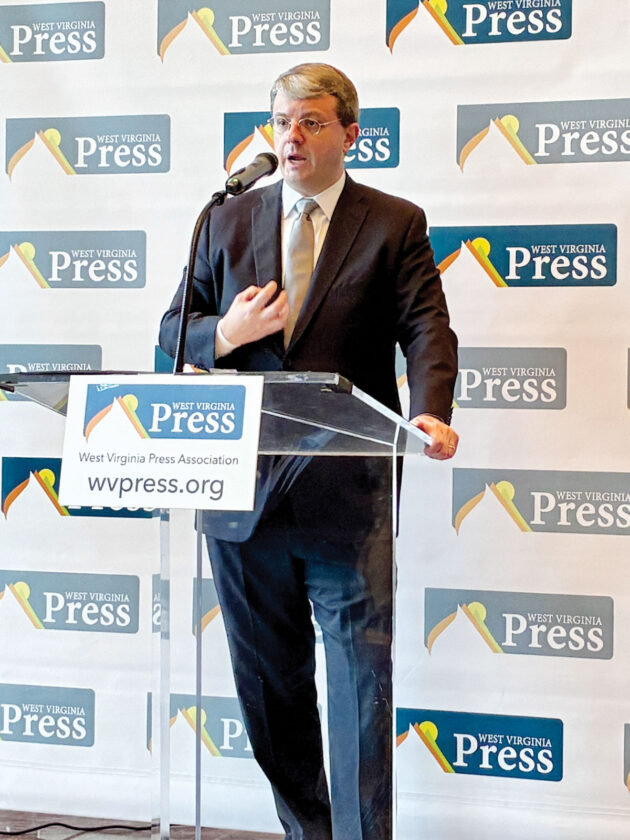
House Speaker Roger Hanshaw presented the House Republican caucus’ economic development proposals Friday during the West Virginia Press Association’s Legislative Lookahead. (Photo by Steven Allen Adams)
CHARLESTON – House Speaker Roger Hanshaw emphasized an economic development plan supported by the Republican caucus in the West Virginia House of Delegates, but one state senator complained that his GOP caucus had yet to meet to lay out priorities ahead of next week’s legislative session. Key leaders in the West Virginia Legislature representing both Republican and Democratic members addressed members of the media Friday during the annual West Virginia Press Association Legislative Lookahead at the Culture Center on the grounds of the State Capitol Complex. The 2026 regular session of the Legislature begins at noon Wednesday, Jan. 14, and continues for 60 days, ending at midnight on Saturday, March 14. Gov. Patrick Morrisey will deliver his second State of the State address the evening of Jan. 14, delivering his general revenue budget bill for fiscal year 2027. Hanshaw, R-Clay, briefed reporters about the House Republican caucus’ “Jobs First – Opportunity Everywhere” legislative agenda first unveiled in December. The Jobs First agenda has three core pillars: workforce-ready education, a job-creating business climate, and responsible economic growth. “We know that if we deal with jobs first, and if we deal with creating a vibrant driving economy first, we can sow a lot of opportunities everywhere for so many other things,” Hanshaw said. “By giving West Virginians good paying jobs, we can solve the problem of educational attainment. We can solve for the problem of substance abuse. We can solve for the problem of housing. We can solve the problem of family unification, the breakdown of the family, and the foster care crisis in West Virginia.” Pillar one focuses on pay raises for teachers and school service personnel, supporting businesses that invest in upskilling their employees, expanding co-ops and hands-on learning for high school juniors and seniors, expansion of aviation employment programs, and increased research funding for higher education. Pillar two focuses on easing certain regulatory processes, taking politics out of economic development decisions, and broader flexibility for tax credits. Pillar three focuses on addressing housing shortages and site development. “We talk and I talk about economic growth and diversifying our economy because getting jobs right, getting the economy right, creates the boulder on which we can build on every other priority that we have in West Virginia,” Hanshaw said. “On those three pillars, we intend to build our Jobs First – Opportunity Everywhere agenda.” State Senate President Randy Smith, R-Preston, was unable to attend Friday’s legislative leadership panel, but state Sen. Eric Tarr joined the panel and criticized his fellow majority caucus members for having yet to meet to develop an agenda ahead of next week’s session. “I’ll tell you that the Senate Republican majority has no consensus on an agenda at all,” said Tarr, R-Putnam, the former chairman of the Senate Finance Committee who was beat out at the end of December 2024 for senate president by Smith. “I expect a bit of a free-for-all, because that’s extremely odd and I’m frustrated by that.” Despite the state Senate having no formal legislative agenda, Senate Education Committee Chairwoman Amy Grady, R-Mason, laid out a specific agenda. Grady wants to focus on re-tooling graduation requirements for high school seniors on those entering the workforce instead of a focus on those going to four-year colleges and universities; reforming the state school aid formula accounting for the higher cost in special education; and providing more support and flexibility for teachers, such as a four-day school week and changing to the total number of instruction days to allow for more time for teacher planning. “We want to provide the best instruction we can for our students, but we need the time to be able to plan to do so,” said Grady, a fourth grade school teacher. “We would like to provide a little more flexibility for counties to decide what their school day looks like. This would also provide places for teachers, allowing them a little more time for prep periods and a little more planning time. Quality instruction is more important than the quantity.” State Senate Minority Leader Mike Woelfel, D-Cabell, announced earlier this week that he would not seek re-election and retire from the Senate at the end of 2026. Woelfel plans to spend his final legislative session advocating for improvements to the state’s overburdened foster care system, term limits for legislators, and creating an elected Public Service Commission. “Our utility bills are rising faster than any state in the country,” Woelfel said. “Our water bills are the highest. I have a bill to elect the members of the Public Service Commission. Is that a panacea? No, but it’s a step in the right direction. Other states do that.” House Minority Leader Sean Hornbuckle, D-Cabell, said his caucus still wants to see legislation for a temporary freeze in electric utility rates to study public policy solutions, a focus by state leaders on all-of-the-above energy production, increased investment in clean drinking water and wastewater infrastructure, incentives for child care, and a ballot initiative to give West Virginians the option to legalize recreational cannabis. “I think Ohio is about as red as you get. Ohio adopted that,” Hornbuckle said. “Let our voters take a look at that and see what they think of it. If they want it, fine, if they don’t want it, that’s fine too.” Earlier this week, Morrisey proposed a cut in personal income tax rates of between 5% and 10% to compete with neighboring states that saw personal income tax rate cuts take effect at the beginning of January. Both Hanshaw and Tarr said they would need to see more information on how Morrisey plans to implement such a cut. But Tarr added that any tax cut would need to not exceed to more than 3% rate in new tax revenue collected each fiscal year, otherwise the state would need to find a way to pay for the lost collections. Tarr said the state should continue to rely on the personal income tax trigger formula put in place in 2023 to slowly phase out the income tax. “I don’t see how you get there without putting yourself at risk,” Tarr said. “If you get out and you spend at a rate greater than 3.6% per year, or you reduce beyond what we’ve done, then you lose that margin at some point and you end up upside-down unless you have revenue increasing somewhere.” Instead, Tarr would like to see another attempt to place a constitutional amendment on the ballot in November to allow lawmakers to amend or eliminate tangible personal property taxes and create a new mechanism for county governments and school systems to be funded. “One of the most responsible things that we could do in West Virginia is to figure out how to run counties with something else besides personal property tax,” Tarr said. “There are opportunities to start working down that personal property tax and re-envision how we fund counties.” Both Hornbuckle and Woelfel said cutting personal income tax rates only benefits the highest earning taxpayers and takes away government funding when there are services that should receive additional tax dollars, such as foster care, health care, and infrastructure. “We know that in a progressive income tax system, the people that are doing the best benefit the most when taxes are cut on that particular tax,” Woelfel said. “I don’t think we get on board a tax cut … We’re going to cut taxes for the donor class? We’re going to cut the taxes for the high earners? Really?” Steven Allen Adams can be reached at sadams@newsandsentinel.comLocal News
West Virginia Legislative Lookahead: House leaders focus on economic development, Senate focus unclear

Iran protests sweep nation despite internet shutdown as state TV warns of ‘casualties’

Movie Review: A real-life ’70s hostage drama crackles in Gus Van Sant’s ‘Dead Man’s Wire’
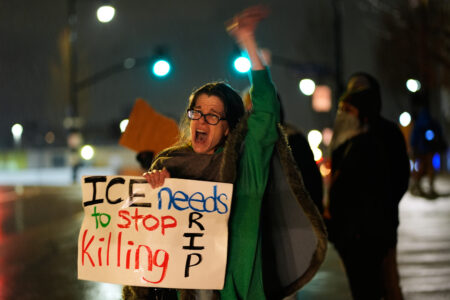
Minnesota shooting videos challenge administration narrative, policing experts question tactics

Family and neighbors mourn woman who was shot by ICE agent and made Minneapolis home