West Virginia Public Broadcasting navigates uncertain waters heading into 2026
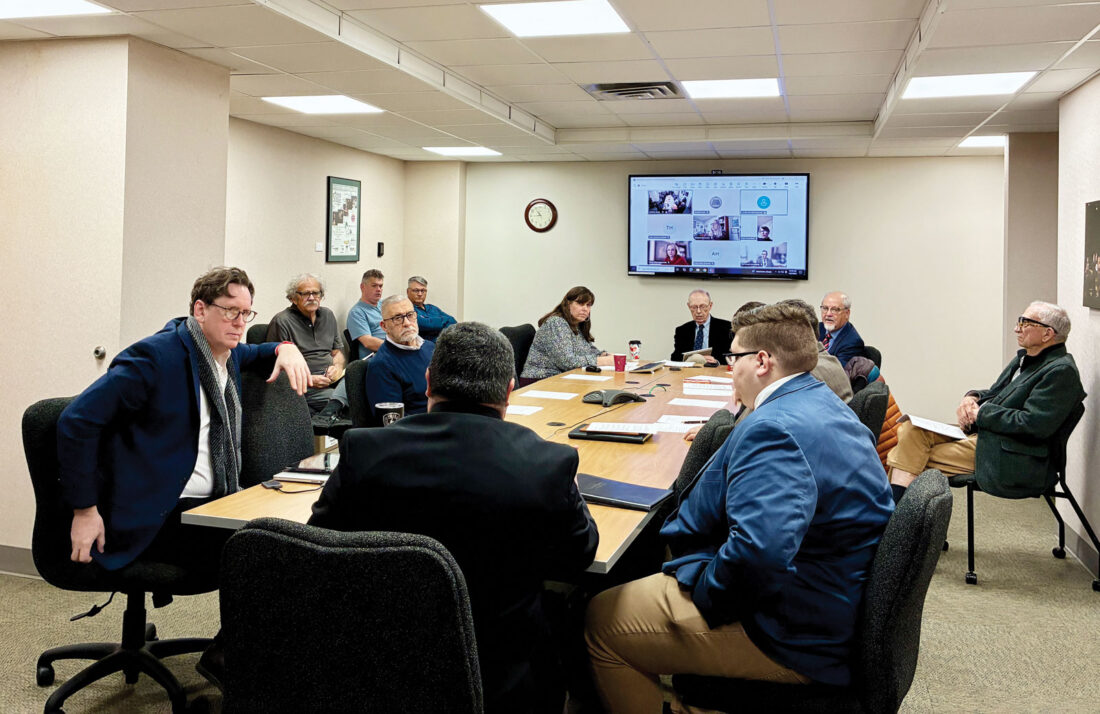
Members of the West Virginia Educational Broadcasting Commission were briefed Wednesday on their annual fiscal year audit during a quarterly meeting in Charleston. (Photo by Steven Allen Adams)
CHARLESTON – With federal funding up in the air and an unclear budget picture for the next fiscal year, the board that manages West Virginia Public Broadcasting will have to rely more on its foundations, local giving, and national philanthropy. The West Virginia Educational Broadcasting Commission held its last quarterly meeting before the end of 2025 at the downtown Charleston headquarters of West Virginia Public Broadcasting (WVPB) Wednesday morning. According to a financial report presented to the commission, WVPB has received some funding from the Corporation for Public Broadcasting during the quarter, as well as $50,000 from National Public Radio. Underwriting is slightly down from this same time last year and WVPB’s cash balance is low. However, both the Friends of West Virginia Public Broadcasting – which solicits private donations through membership – and the Development team at WVPB reported positive momentum, noting significantly increased membership and development revenue of nearly $500,000 over the previous year’s goal. External auditors delivered an unmodified opinion to commission members Wednesday on WVPB’s fiscal year 2025 financial statements but cautioned that the organization faces a significant $1 million funding shortfall and instability within the finance department, urging the commission to seek creative fundraising strategies. “I think your organization obviously has been dealt a tough blow, and I think you know you serve the public in its best interest, and the continuation of you rebranding yourselves and looking for sources of revenue are quintessential to the long-term survival of the organization,” said Ron Adams, an external auditor with Brown Edwards. Despite this $1 million bleed, equal to a 20% shortfall, Adams said that amount can be easily made up in the short-term due to the changes in investment strategy by the West Virginia Public Broadcasting Foundation – which receives major gifts, grants, and bequests. “I think one of the things that the foundation did in changing the mix of investments and being a little bit more aggressive with investment strategy, I think the market right now will pay some dividends on that strategy,” Adams said. “You’re going to be able to make that up in the short term.” Michael J. Farrell, the vice chair of the Educational Broadcasting Commission and chairman of the West Virginia Public Broadcasting Foundation, said the foundation secured two grants – a two-year grant through CPB and a four-year grant through an unnamed national philanthropy organization – that would fund WVPB’s Folkways Reporting Project to the tune of more than $1 million. Yet, Farrell said it might be necessary for the foundation to dip into its accounts to help keep WVPB funded long-term. “We decided to get more aggressive to try to make more money, and we’ve been successful in doing that,” Farrell said. “That said, I think you just heard the forecast from our auditors that while this fund has been very stable and growing, we may have to dip into it depending upon the success of (the Friends of West Virginia Public Broadcasting) and what they’re able to do.” Much of WVPB’s funding woes are due to political uncertainty caused by cuts and recissions of national funding by President Donald Trump and the Republican-led Congress. The July recissions package passed by Congress and signed into law by Trump clawed back more than $1.1 billion in direct funding for the Corporation for Public Broadcasting that was already appropriated for the current federal fiscal year that ended in October. The cuts to CPB left it with barely $30 million, causing CPB to announce in August it was shutting down its operations. The recissions package came after Trump’s May executive order calling for the CPB — the non-profit founded by Congress in 1967 — to cease all direct and indirect funding of National Public Radio (NPR) and the Public Broadcasting Service (PBS). Federal funding through CPB and other grants made up 18.8% of West Virginia Public Broadcasting’s $10.2 million budget in fiscal year 2024, according to its most recent annual report. Fiscal year 2024 federal funding for WVPB was $1.9 million. WVPB has not replaced departing employees with new hires, awaiting more information on funding. Eddie Isom, the executive director of WVPB who first slid into that role as interim leader in August 2023, retired at the end of October after nearly 30 years at the educational broadcaster. He was succeeded by interim executive director Kathleen Brady. The Educational Broadcasting Commission is also unsure of what their agency budget will look like in the fiscal year 2027 general revenue budget that will be presented to the Legislature by Gov. Patrick Morrisey on the first day of the 2026 legislative session on Jan. 14. Sources have confirmed that state departments and agencies are being asked to submit budget requests 2% less than their funding in the current fiscal year budget. The Educational Broadcasting Commission was previously within the Department of Arts, Culture and History, but that department was dissolved, and all of its agencies were transferred to the Department of Tourism earlier this year. Morrisey signed a budget bill earlier this year for fiscal year 2026 beginning on July 1 that reduced West Virginia Public Broadcasting’s budget to $3.9 million – a 10.7% cut from fiscal year 2025. “We have not, because the governor has not released his budget, seen what that budget will have for us, but we are always appreciative that the Legislature recognizes this mission and will continue to support us appropriately and generously,” Farrell said. Commission member Greg Thomas, a Republican political operative and lobbyist, said he has had no conversations with the Governor’s Office about WVPB’s budget, but noted that some lawmakers raise concerns about the news content WVPB produces and whether it includes political bias. “The concern has been over the years, and I’ve communicated this with leadership here, has been the newsroom,” Thomas said. “(Lawmakers) see articles, they see the news…it’s the same thing that happened at the national level that happens at the state level. I haven’t had any communication with the Governor’s Office on it, but in previous communications I’ve had, they always come in and say, ‘what’s that newsroom cost?'” The newsroom at WVPB is down to News Director Eric Douglas and a staff of three. One of WVPB’s popular programs, The Legislature Today, will go from a Monday-Friday program during the 2026 legislative session to a weekly program, staffed in part by students from local high schools and supported by journalism students from West Virginia University. WVPB also plans to launch a podcast focused on the legislative session. Farrell said the focus for WVPB should remain on educational programming and in-school programs, doing whatever it can to survive to maintain access to those programs. “The name of this organization is the West Virginia Educational Broadcasting Commission,” Farrell said. “Education is a significant component of what we do and how we do it, whether it’s in the K-12 segment or the public in general…We have to recognize that in these politically sensitive times it is important that folks understand that we are here for our children. We’re making a difference in the lives of our children, and we need to continue to have that existence and that role.” “it’s a tough, tough time right now,” said William File III, chairman of the Educational Broadcasting Commission. “Some of these issues are a little sensitive. We’re all doing the best we can, and Mike hits it exactly right. We are education focused. Certainly, we do have news. That’s important to us also, but we are the Educational Broadcasting Commission. We need to all continue to remember that and emphasize that when we’re out in the public.” Steven Allen Adams can be reached at sadams@newsandsentinel.comLocal News
West Virginia Public Broadcasting navigates uncertain waters heading into 2026

Belpre Police

Newell pens fourth book about local crime
Annual Hometown Christmas celebration set for Friday at the Smoot Theatre

Man charged with attempted murder in stabbing incident