
Legal watchdog gives guidance on AI
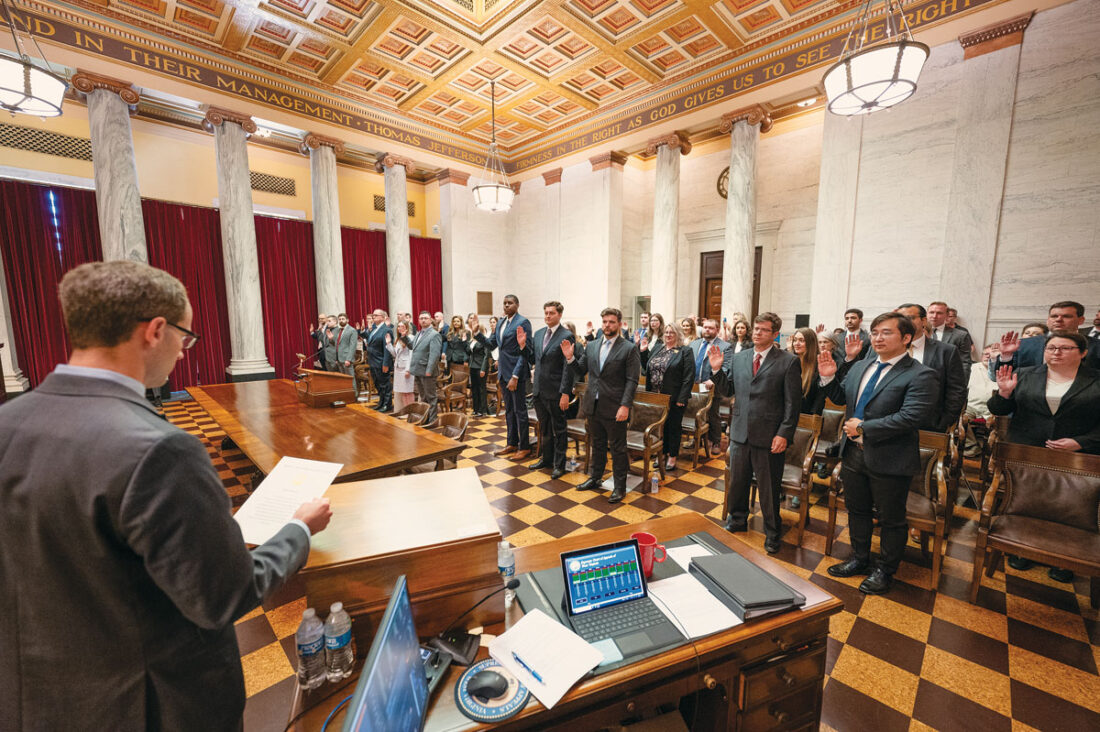
Photo Courtesy/WV Supreme Court of Appeals The West Virginia Supreme Court of Appeals held an admission ceremony earlier this month welcoming new lawyers being admitted to practice law in the state.
CHARLESTON — The use of artificial intelligence – AI – is quickly becoming prevalent in all aspects of life, but attorneys in West Virginia are being urged to exercise caution and engage in transparency when using AI-based tools in their daily work. The West Virginia Office of Disciplinary Counsel (ODC) released a legal ethics opinion regarding the use of AI by lawyers in the state. The ODC upholds the Rules of Professional Conduct that governs the actions of lawyers, conducts investigations, and recommends discipline. “Artificial Intelligence…is an evolving technology, and as it becomes more advanced, AI’s functions and its users will continue to grow, and the legal field is no exception,” wrote Nicole A. Cofer, chairperson of the Lawyer Disciplinary Board, who approved the legal ethics opinion on June 14. The opinion differentiates between non-generative AI, which uses existing data to provide transparent predictions and analysis, and generative AI, whose algorithms are less transparent and creates its own content based on a user’s requests. New content can include text, images, and videos. “Lawyers use non-generative AI without even realizing it, such as in legal research tools or with spelling and grammar tools associated with word processing programs,” Cofer wrote. “Lawyers are increasingly using forms of AI in their practices to improve the efficiency and accuracy of legal services offered to their clients. “However, to remain compliant with their ethical obligations, lawyers must not only be aware of AI’s ability to deliver efficient legal services to clients, but they must also take care to exercise independent judgment, communicate with clients, maintain confidentiality, ensure fees and costs are reasonable, comply with advertising regulations, and supervise the work performed by AI,” Cofer continued. In law, AI is becoming a frequent tool when researching and preparing for cases. In some instances, it can help speed up research for citing past cases and precedents. But in other instances, lawyers have been cited for using generative AI programs to write legal briefs in motions, where sometimes the cases being cited by the AI program do not exist at all. According to the Missouri Independent, an attorney in that state was cited $10,000 after it was discovered that many of the citations he included in a legal brief using AI were fake. The court was forced to spend time using its resources to research the citations to determine whether they were correct or fake. There is also the issue with bias, even in AI-generated content. Amy Cyphert, a lecturer at the West Virginia University College of Law, said during a presentation before members of the West Virginia Press Association last year that lawyers must constantly review information being provided or created by AI. “Machine learning systems are only as good as the data they are trained on,” Cyphert said. “The computer science concept is ‘garbage in, garbage out,’ which means if you’ve got data that’s flawed, whatever output it produces is going to be flawed. In law, and especially in the field of artificial intelligence and law, scholars say, ‘bias in, bias out.’ A system designed to predict how likely someone is to reoffend may have been trained on biased historical criminal justice data.” The legal ethics opinion encourages the use of AI by lawyers, but not to use it to replace their own legal reasonings. Lawyers need to review all AI-generated content for accuracy and errors, receive approval from clients before using generative AI, avoid sharing confidential information with AI programs, be aware of the possible use of copyright-protected material by AI programs, and never use AI as a primary source. “Technology such as AI can be used as a complement to a lawyer’s work and while there is nothing inherently improper in using AI or generative AI, a lawyer’s duties to their clients, the courts, and the profession under the Rules of Professional Conduct remain unaltered,” Cofer wrote. “While AI can streamline time-consuming and mundane tasks, lawyers must still utilize their skills in conjunction with their individual professional and moral judgment and in short, continue to be the lawyer.” Steven Allen Adams can be reached at sadams@newsandsentinel.comLocal News

Actors Guild of Parkersburg opens ‘Sylvia’ on Friday

Parkersburg residents criticize single-item agenda during city council meeting
Authority slates annual Pleasants County electronics recycling day
An annual electronics recycling collection will be held from 8 a.m. to noon Saturday at the Momentive Performance ...

WV Tourism Department names local History Heroes
Sen. Justice’s attorneys respond in state case over Greenbrier’s future
CHARLESTON – Attorneys for U.S. Sen. Jim Justice and his family continue to argue that a Texas-based hotel chain ...
Red Cross appeals for blood donations
PARKERSBURG – The American Red Cross on Monday issued an urgent need for donors of all blood types. Scheduled ...