
High court dissolves injunction over public charter schools in West Virginia
Trending
CHARLESTON - The West Virginia Supreme Court of Appeals ruled Thursday that attorneys for parents seeking to block the state's public charter school pilot program sued the wrong party.
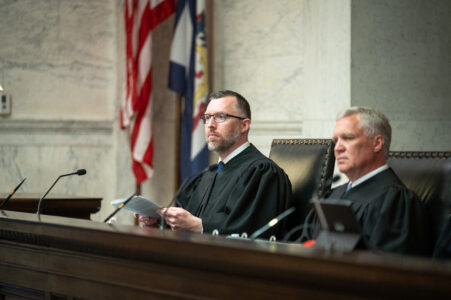
In an opinion released Thursday afternoon, the state Supreme Court determined that Kanawha County Circuit Court Judge Jennifer Baily erred in her 2021 decision granting a motion by two teachers union members for a preliminary injunction to block further implementation of the public charter school pilot program.
The Supreme Court dissolved the preliminary injunction and remanded the case back to Kanawha County Circuit Court for further proceedings. Justice Armstead, penning the majority opinion for the court, said that the plaintiffs filed the lawsuit against the wrong party, filing against Gov. Jim Justice instead of the Public Charter School Board (PCSB).
"Upon thorough review, we conclude that Respondents lack standing to seek the preliminary injunction at issue against Governor Justice because (1) he does not have the ability to authorize public charter schools, and (2) granting injunctive relief against him does not prevent the PCSB, a nonparty in this case, from authorizing public charter schools," Armstead wrote. "Therefore, we reverse the circuit court's order, dissolve the preliminary injunction, and remand for further proceedings."
The Legislature passed House Bill 206 in 2019 and House Bill 2012 in 2020 setting up and tweaking the public charter school pilot program. Sam Brunett and Robert McCloud – both parents and teachers – filed a lawsuit in September 2021 against Justice and legislative leaders asking the court to declare the charter school law unconstitutional and instead allow county residents to vote for proposed charter schools.
Bailey's December 2021 order blocked Justice from further implementation of the public charter school program. But a February 2022 order granted by the Supreme Court stayed that decision, allowing the charter school program to continue. The Supreme Court heard oral arguments in May from attorneys representing Brunett and McCloud, the state, and others.
While the governor appoints PCSB members with the advice and consent of the state Senate and sets the budget for the agency, the governor has no other authority over the PCSB. The PCSB is empowered to approve requests for new public charter schools independent of county boards of education.
"The PCSB is statutorily empowered to approve or reject charter school applications," Armstead wrote. "Governor Justice has no veto authority over the PCSB's decision to approve or reject a charter school application."
Armstead said even if Brunett and McCloud believe that the public charter school program violates the state Constitution, they erred by not bringing a case against the PCSB.
"Even assuming...that such approval were found to be violative of the Constitution, that approval results from decisions and action taken by the PCSB, a nonparty to this action," Armstead wrote. "Because the PCSB has the statutory authority to approve or reject charter school applications, Respondents cannot meet the causation prong of our standing test because their injury is 'the result [of] the independent action of some third party not before the court.'"
Armstead also said it was inappropriate of Burnett and McCloud to ask the courts to require Justice to call a special election for the purpose of the public approving charter schools. Armstead said the charter school law does not call for special elections to approve charter schools and the governor, again, has no statutory authority over charter schools.
"This injunctive relief directs Governor Justice to prevent the further creation of PCSB-authorized schools, and...he does not possess this ability because he does not have the statutory authority to exercise control over, or override, the PCSB's statutory authority to approve or reject charter school applications," Armstead wrote. "Further, HB 2012 does not provide Governor Justice with the authority to hold a special election."
Attorney General Patrick Morrisey represented the state in the case. In a press release Thursday afternoon, Morrisey praised the court for its ruling.
"We have been saying it all along: the senate president, speaker of the house and governor were not the proper parties to the preliminary injunction sought by the plaintiffs," Morrisey said. "Because of that, the plaintiffs lack the jurisdictional standing necessary to pursue relief in court. Even so, the circuit court enjoined the governor. Our office's efforts and the Supreme Court's ruling ensure that the government officials are not enjoined when the statutory authority is actually assigned to other state agencies."
A request for comment from attorneys representing Brunett and McCloud was not immediately available.