
Wood County reports few problems with voting
Trending
PARKERSBURG -- As voters headed to the polls Tuesday in West Virginia's primary election, county officials only had a couple of issues during the day, but they were able to handle them and made sure people had the opportunity to vote.
After a couple months of preparing and having some plans changed at the last minute due to ongoing concerns from the COVID-19 pandemic, Wood County Clerk Mark Rhodes was somewhat surprised by the turnout on Tuesday.
''We have been really busy and we have had a really good turnout,'' he said.
The county sent more than 10,000 absentee ballots for people who wanted to vote that way due to health concerns from the pandemic. On Tuesday night, 9,134 absentee ballots were counted. Early voting numbers have been down with officials contributing that to the number of absentee ballots sent out and with the presidential nominees pretty much determined.
Instead of having around the usual 68 voting precincts, polling places were consolidated into seven locations. Within the last couple of weeks officials were told that each voting precinct would have to be assigned to one of those locations.
Voters went to the Judge Black Annex in downtown Parkersburg, the Vienna Community Building, Williamstown High School, Mineral Wells School, Lubeck Elementary, the Jack Stephens Gym at Parkersburg High School and Kanawha School.
''Both Vienna and PHS had 600 people each (Tuesday), Rhodes said.
He was at PHS at around 4 p.m. and there were around 60 people in line which has been the norm since around 11 a.m. That location had over 700 people total by around 4:30 p.m.
Lines seemed to be moving at a good pace. Rhodes said he talked to some people who had to wait for an hour while others were able to get in and out within 15 minutes.
''It has been busy,'' he said. ''I am happy we have been busy, but it is a little busier than I thought.''
It has been a challenge to make sure everyone gets through the line correctly and efficiently.
''That is always a concern,'' Rhodes said.
Each of the consolidated voting sites had enough poll workers on hand to be able to conduct the election. There were just over 90 poll workers out Tuesday.
Officials worried if there would be enough as many older people who have traditionally worked the polls were in the higher risk groups and they had a number indicate they wouldn't do it this year due to health concerns.
''We only had two that ended up calling off,'' Rhodes said. ''We had enough poll workers.
''That was not really an issue as we looked at that beforehand.''
Plans were made to make sure each of the consolidated sites had enough people to work.
Rhodes ended up using some of his employees to fill in where needed, including sending one out on Tuesday. He had 7-8 employees out in addition to the over 90 poll workers.
The consolidated precincts at Lubeck, PHS, and Vienna were the busiest, he said adding if people were in line at 7:30 p.m. they were brought into the location and allowed to vote.
With COVID-19 concerns still very much on people's minds, Rhodes said he saw a lot of people out with face masks on. Some of the poll workers did and some did not. Officials did not make it a requirement.
People tried to keep space between themselves and others, but the available space in some locations made it difficult, but people tried, Rhodes said.
''There were some that were probably closer than 6-feet while they were standing in line,'' he said adding many people who were outside maintained good distance.
With temperatures up in the 90s, Rhodes said the heat did not present any challenges.
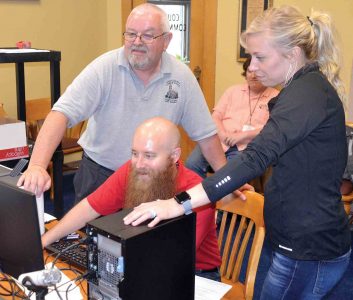
They had some of the usual mechanical issues that seem to happen during most elections. However, it has not impacted anyone's ability to vote, Rhodes said.
People were placed out at the traditional precinct sites to direct people to which of the consolidated voting sites they need to go to.
Rhodes said they did have people who showed up at the traditional voting sites and were directed to where they need to go.
''We have also had several phone calls at the office and we were able to tell people exactly where they needed to go,'' Rhodes said.