
Bipartisanship ends after debate on amendments to community and technical college bill
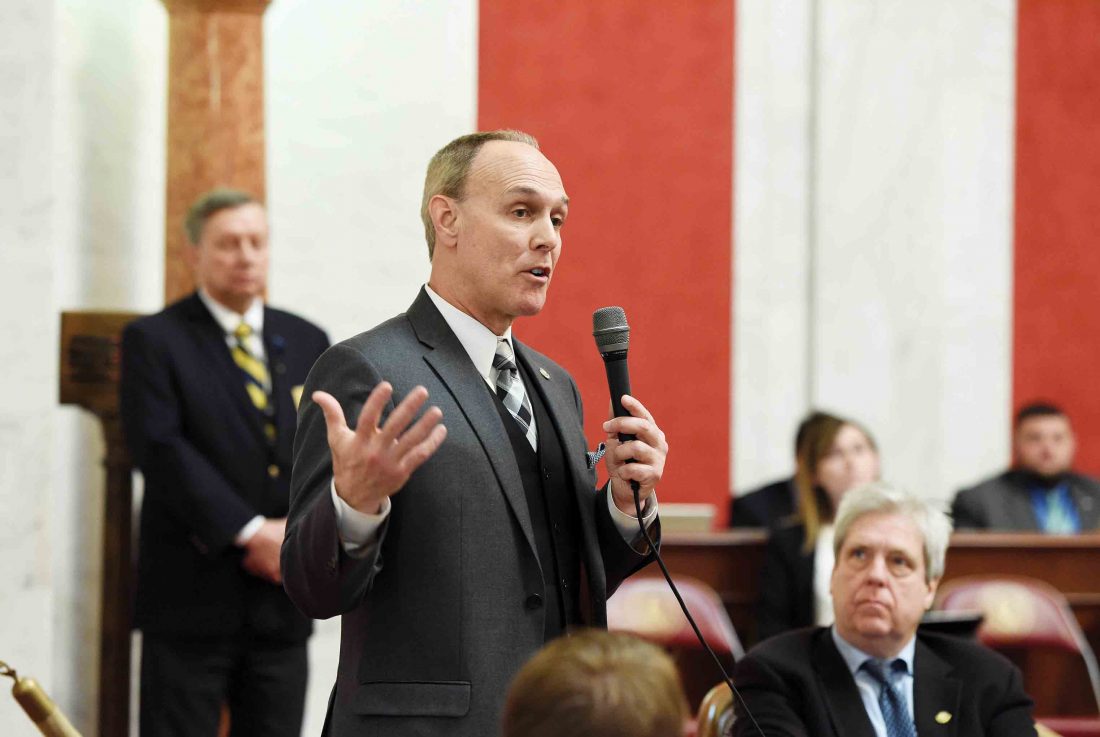
Senate President Mitch Carmichael, R-Jackson, takes to the Senate floor to defend his last-dollar-in community and technical college bill and speak against two amendments. (Photo Courtesy/WV Legislative Photography)
CHARLESTON — Debate on amendments to the Senate president’s last-dollar-in community and technical college program turned heated, becoming the first issue dividing Senate Republicans and Democrats.
Two amendments proposed by the Senate minority to Senate Bill 1 Tuesday were defeated mostly along party lines, with state Sen. Bill Hamilton, R-Upshur, being the lone Republican to cross over. Debate on the two amendments lasted nearly an hour during a two-hour floor session
SB 1, sponsored by Senate President Mitch Carmichael, R-Jackson, increases access of high school students and adults to community and technical college education for specific fields deemed necessary by the state Department of Commerce. It would create a “last-dollar-in” program to cover the remaining costs of attending the two-year schools once other grants and financial aid packages are exhausted.
The first amendment from Senate Minority Leader Roman Prezioso, D-Marion, would have expanded the bill to include four-year colleges and universities that offer two-year associate degrees. Prezioso, whose home county includes a shared campus between Fairmont State University and Pierpont Community and Technical College, said the state shouldn’t pick winners and losers.
“We’ve created a silo,” Prezioso said. “Why should we hamper any student that has the opportunity maybe to go to Concord or Bluefield or Glenville where there is no community college component and give them the same ability to get a skill?”
Senate Education Committee Chairwoman Patricia Rucker, R-Jefferson, encouraged the Senate to reject the amendment. Rucker said the bill was tailored to students who were unlikely to attend a four-year school.
“We have many programs to fund education at four-year institutions,” Rucker said. “This is really geared toward adults whose education was interrupted or they just do not have the funds, or maybe their grades weren’t the greatest — students who really need help to get that degree.”
According to Senate Finance Committee Chairman Craig Blair, R-Berkeley, the fiscal note for SB 1 stands at $7.6 million. Adding the four-year colleges and universities to the bill could cost the state more than $15 million. Blair said adding any more to the cost of the bill would endanger the bill once it crosses over to the House of Delegates.
“There is an opposition over in the House right now that thinks this is an entitlement,” Blair said. “This may not be a bad idea, but is it an affordable idea we can do right now? No. The answer is clear and simple on that.”
After a heated back-and-forth discussion between Blair and Prezioso – also a former finance committee chairman – that resulted in Carmichael trying to maintain order, the Senate president left his podium and took his seat on the floor to make the case for rejecting the amendment.
“This is a targeted that addresses a demographic that’s going to lift a certain socio-economic segment to a higher level to a better place in their lives,” Carmichael said.
While the Senate floor session was going on, Delegate Jim Butler, R-Mason, announced his pre-candidacy for the 4th Senatorial District, which would put him up against Carmichael in the 2020 primary.
“Someone just filed to run against me…because they need a real conservative in the district, not someone who is creating an entitlement program for free college and tuition,” Carmichael said. “That’s what you’re dealing with. To the degree that we continue to escalate the cost of this program, as we do every good idea that comes through over here, there are opportunities for further expansion later as we move through the process.”
Prezioso’s amendment failed 20-14 along party lines.
The second amendment by state Sen. Bob Plymale, D-Wayne, would have required collaboration agreements between community and technical colleges and federally recognized apprenticeship programs. Rucker asked for rejection of the amendment, saying that several two-year colleges already have such agreements without any legislation.
The amendment failed 19-15, with state Sen. Bill Hamilton, R-Upshur, breaking with Senate Republicans to support the amendment. Hamilton, who previously served in the House of Delegates before winning election to the Senate seat in November 2018, was a frequent supporter of pro-union legislation as a delegate.
“I support this amendment,” Hamilton said. “I think it’s important and it only enhances the bill.”
SB 1 is now on third reading and will be voted on this morning.
Local News
Program providing free children’s beds adds Wood to counties served
Miss Morgantown claims Miss West Virginia title, Huntington native wins teen crown
MARTINSBURG - Elizabeth Romanek beamed as she was crowned the winner of the Miss West Virginia Competition at ...
Records – Wood Magistrate
PARKERSBURG – Wood County Magistrate Court recently released the following reports on May 8: * Brandy Dawn ...
Rain didn’t stop the 49th annual Safetytown at Phillips Elementary
Full-award Hope Scholarship applicants double for next school year
Artsbridge Calendar
The Artsbridge Calendar of Community Events for this week: Today: Noah Strickler Photography art exhibit, 9 a.m. ...