PEIA Task Force continues to discuss changes
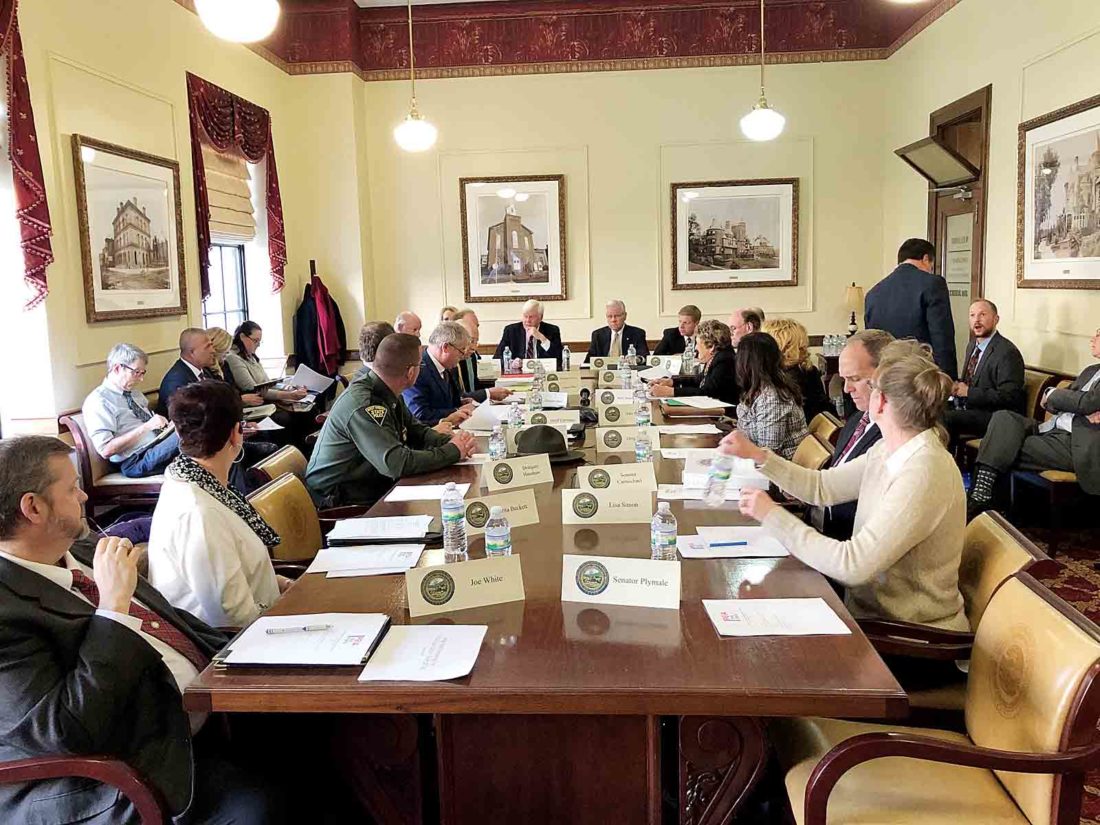
The PEIA Task Force meets to approve recommendations from Gov. Jim Justice. (Photo by Steven Allen Adams)
CHARLESTON — What was supposed to be the final meeting of the task force that has spent the last 10 months looking at ways to stabilize the state’s health insurance program for public employees and retirees will continue.
The Public Employees Insurance Agency Task Force, made up of lawmakers, health care industry representatives, teachers’ unions, public employees, and school system officials, met Monday afternoon and approved and amended recommendations from the governor after a four-hour meeting.
Mike Hall, chief of staff to the governor, said the PEIA Task Force will continue to meet to discuss long-term issues, such as funding issues and cost-savings measures.
“It is the governor’s intention to continue to have a PEIA Task Force,” Hall said. “There are a few lingering issues.”
One of the governor’s recommendations — returning Plan A benefits to an 80/20 co-insurance for participants in border counties only — was amended to include any in-network out-of-state health care provider. The state now pays 70 percent and the participant picks up the tab for the remaining 30 percent.
For Plan B participants, the benefits would return to 70/30 co-insurance for participants in-network out-of-state providers.
The amendment, proposed by West Virginia Education Association President Dale Lee, was opposed by several of the health care providers on the task force. Joe Letnaunchyn, president and CEO of the West Virginia Hospital Association, said he is concerned about taking away reasons for state employees to stay in-state.
“By reducing this co-pay from 70/30 to 80/20, there is no financial incentive for any PEIA participant to stay in-state for the same service,” Letnaunchyn said. “I originally thought we were doing this for services that weren’t available in West Virginia, but it seems we’re doing it for convenience.”
“My concern, particularly in southern West Virginia, you may have a hospital that’s in network but it’s two counties over,” Lee said. “That would remain 70/30, while if it were touching the West Virginia border it would be 80/20.”
Ted Cheatham, director of PEIA, said Lee’s proposal would cost an additional $6.2 million to extend any in-network provider on top of the $16.2 million price tag for all of Justice’s border recommendations. Most of that $6 million would likely go to pay for employee health care at places, such as the Cleveland Clinic, and hospitals in the Cincinnati and Pittsburgh areas.
There remains some confusion regarding the border county recommendations, however. Earlier Monday morning, task force representatives briefed lawmakers in two legislative interim meetings. During the Select Committee on PEIA, Seniors, and Long Term Care, state Sen. Donna Boley, R-Pleasants, expressed frustration that PEIA members in Wood County had to pay full price if going to Marietta Memorial Hospital across the river from Williamstown.
“It’s not fair for an employee in West Virginia to be paying a PEIA premium and not going to the hospital near them,” Boley said.
With these recommendations, Cheatham said the state would need to find another $120 million to fund PEIA in fiscal year 2021, which begins in July 2020. That’s not counting the $50 million per year annual price of health care inflation.
Under Justice’s recommendations approved by the task force, the state also would remove the maximum facility fee limits for out-of-state facilities and remove a $25 copay for out-of-state services. Republican lawmakers on the task force pushed back on eliminating the fee limits, but Christine Campbell, the former president of the West Virginia chapter of the American Federation of Teachers, reminded task force members their focus should be the needs of public employees.
“We’re talking about providers when this whole task force was created to address the needs of its participants,” Campbell said. “We have to keep that in mind when in the Eastern Panhandle that was their biggest concern.”
The task force also recommended putting in place an appeals process for people requiring a third-tier non-preferred drug to allow for reduced copays. PEIA officials said they’re already discussing this with the state’s prescription coverage provider. As part of today’s meeting, the task force will also encourage the state to review wellness programs to help drive down health costs, and review how in-state providers are reimbursed by PEIA.
The full task force took a break to allow the Cost and Revenue Subcommittee to meet to vote on the governor’s recommendation to put $100 million into PEIA for long-term stabilization over the next two fiscal years. The subcommittee hadn’t met since Aug. 23. The full task force passed the recommendation.
Efforts to pass recommendations calling for $50 million to be put into the base budget for PEIA and look at issues involving spousal coverage when the spouse has the ability to get health coverage from their employer either failed for lack of a second or did not get enough votes to pass.
Local News

Picture This: Grilling for Father’s Day at the Belpre Farmers’ Market
Ohio proposed constitutional amendment to ban data centers will not be on this year’s ballot
Ohio voters will not have a chance to vote to ban data centers in the November election. Conserve Ohio, the ...

Picture This: Checking out the petting zoo at the Marietta library

Marietta City Council adopts property donation resolution, tables 2027 tax budget

Mid-Ohio Valley Multi-Cultural Festival draws newcomers, returning residents