How starting early could help Stephen Smith become West Virginia’s next governor
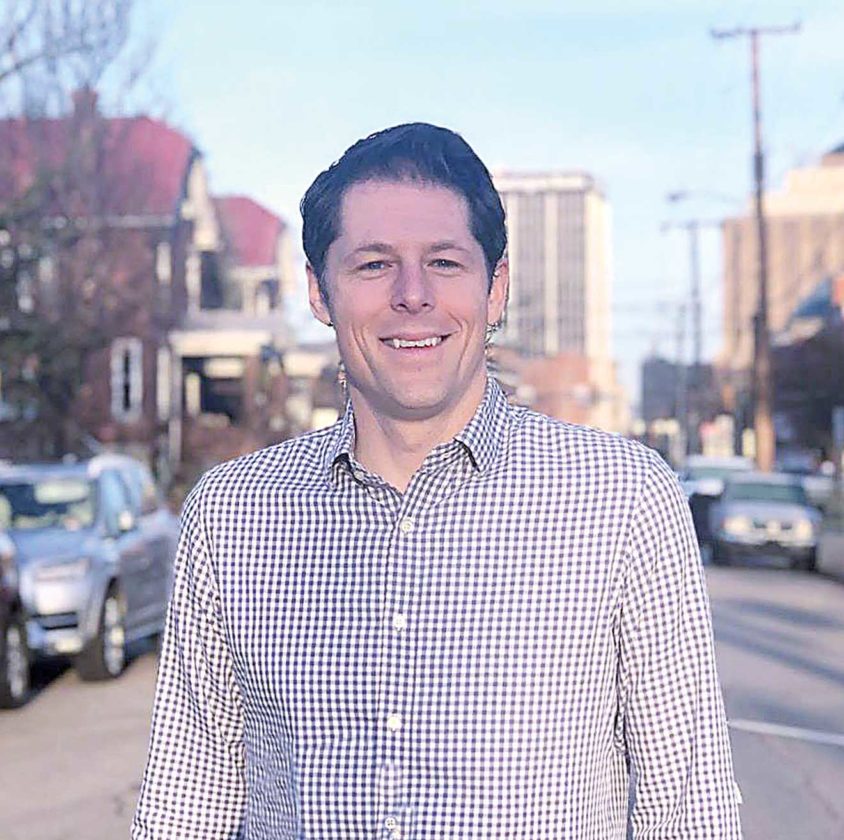
Photo by Steven Allen Adams Stephen Smith
CHARLESTON — Filing for statewide elected office doesn’t take place until January 2020, but Stephen Smith can’t wait, and he is recruiting a broad coalition who also can’t wait.
The 38-year-old Smith filed his pre-candidacy paperwork in July, but it was unknown what he was running for. Then he made a splash at the end of November when he launched his campaign for governor of West Virginia as a Democrat.
Organizing under Smith for West Virginia, the campaign also has another tagline: “WV Can’t Wait.” And waiting is something Smith isn’t doing.
Since Nov. 27 the campaign has held 12 meet-and-greets across the state. The most recent event Dec. 15 in Mercer County saw 33 people come out. According to the campaign, more than 880 people come out for these small campaign events. These events are just warm-ups for the big event, an official campaign kick-off Jan. 5 in Matewan.
Smith’s decision to run for governor is a culmination of his work for the West Virginia Healthy Kids and Families Coalition, which he founded and served as its executive director since 2012.
“In some respects, this has been the story of our work the last six years in West Virginia,” Smith said while enjoying a coffee at Moxxee Coffee in Charleston’s East End. “In neighborhoods –whether it’s in a rural place like Wyoming County or in Morgantown — people are actually more united than ever in part because how much government has failed and how much parties have failed.”
COMING HOME
There’s symbolism in selecting Matewan. According to the West Virginia Encyclopedia, Matewan was the site of shootout in 1920 between Baldwin-Felts detectives sent to evict miners from a coal camp.
The police chief of Matewan, Sid Hatfield, organized a group of men to protect those miners. The famous Battle of Blair Mountain in Logan County — which happened barely a month later — was largely inspired by Hatfield’s actions protecting the miners.
Smith also organized a battle when he returned to West Virginia — a place where he was born but left when he was young — when his wife took a job in Charleston. That battle was against poverty.
According to its website, the Healthy Kids and Families Coalition takes credit for 25 state policy victories over six years of its existence. These victories include advocating for a higher minimum wage, which increased to $8.75 in 2015; expanding Medicaid access, which lowered the uninsured rate from 35 percent to 14 percent in 2015/2016 according to the Rural Health Policy Project; and creating 155 healthy community teams to develop farmers’ markets, walking trails and other health initiatives.
MR. SMITH GOES TO CHARLESTON
Through the Healthy Kids and Families Coalition, Smith helped bring together multiple groups and constituencies to work as one, particularly when lobbying legislators. Smith plans to take these experiences and apply them to how a campaign works.
“We exist in a time when even major constituencies — like veterans, like small business owners, like students, like seniors — that traditionally in American history have fairly significant roles in naming policy, are almost systematically being left out of the equation,” Smith said. “Life for most constituencies of people in West Virginia has gotten steadily worse over the last 30 years under Democrats and Republicans.”
Smith’s plan is ambitious, but time is on his side. The campaign has already recruited county-level captains in 47 out of 55 counties. Smith is also working on visiting all 55 counties early and visiting multiple times between now and the 2020 elections. As opposed to sending instructions down to these county captains, Smith said he wants them pushing ideas up to him.
“People love being invited in,” Smith said. “You’re not just a robot knocking on a door of a stranger. We want you to build relationships in your neighborhoods and churches and schools inside your county. You’re going to have real autonomy in some respects about what matters in that county and what the campaign does in that county and organizing events in that county.”
Another key part of his campaign are his constituency groups, but instead of being called “Blank for Smith,” they’re being called “Blank Can’t Wait.” Smith said he has 27 of these groups, ranging from students, veterans, small business owners, the LGBTQ community, people with disabilities, and more. He hopes these groups can last whether he wins or loses in 2020.
The last part of his campaign coalition includes like-minded candidates for other statewide offices, legislative seats, and county offices. Smith said there are already 24 candidates interested in running as part of WV Can’t Wait, with more expected to join.
“Obviously, no one has declared yet, but the idea is to get to 100-plus candidates we’re running with, and to get to essentially old-fashioned slates,” Smith said. “These are the oldest ideas in politics, right? Let’s work together and if we all stand for the same things, we can help each other and make it not about one personality or celebrity.”
WHAT’S THE HURRY?
The natural question Smith gets from people is why start so early? The 2018 general election was over a month ago and the candidate filing period is 13 months away.
“When you start six weeks ahead of time — and some of them announce it a year ahead of time — they don’t do anything,” Smith said. “They announce six weeks early, and then it becomes a competition of who can scream the loudest. I’m going to unleash the most negative vitriol against you and you’re going to unleash it against me, and it’s a war of attrition and most people get disgusted. If you actually take two years, you have the time to listen and visit.”
Starting early also gives Smith a chance to raise funds. Gov. Jim Justice, a Republican, is likely to run again. Whoever wins the Democratic primary will likely have to contend with the state’s only billionaire should Justice secure the Republican primary nomination in May 2020. It remains to be seen what other Democrats will run for governor. Smith would prefer to raise small dollars instead of large donations from corporations or lobbyists.
“Each one of these little organizations that we’re building allows us to be stronger,” Smith said. “If you add all of that up…for one it will allow us to beat big money and we’ll be able to raise our own money in a way that doesn’t have to be accountable to the powers that be.”
BRINGING VOTERS HOME
One issue for Smith is how do bring voters back to the Democratic Party. For generations, West Virginia voters have registered as Democrats and voted for Democrats, despite an occasional Republican governor, such as Arch Moore or Cecil Underwood.
That began to shift in the early 2000s with the state voting for Republican President George W. Bush in 2000 and 2004. Most of the state opposed Democratic President Barack Obama in 2008 and 2012. By 2014, the state’s congressional delegation was all Republican except for U.S. Sen. Joe Manchin.
By 2017, both chambers of the Legislature were Republican-controlled, only one Democrat — State Treasurer John Perdue — remained on the Board of Public Works, and the Democratic governor — Justice — switched parties to Republican. Still, the Republican legislative majorities took a dent in the 2018 elections, losing a handful of seats.
Smith said he understands why West Virginia voters would try something different after more than 80 years of Democratic Party control. The key for Smith is trying to unite voters and give them a positive message to get behind.
“It’s not left versus the right. It’s the people versus the good-old-boys club,” Smith said. “I’m so tired of how politicians on both side of the aisle treat voters like they’re stupid, because they aren’t. If over the last 30 years both parties have failed, then it’s not irrational to say I want something totally different. We have to run a campaign that is actually for things as opposed to against them.”
Part of this includes collaboratively crafting a campaign platform based on big, bold ideas. Some of these ideas include providing resources to established small businesses instead of constant tax breaks and deals for out-of-state corporations; free or reduced community and technical college education and investment in four-year higher education.
Smith can’t wait to start talking about these ideas, as well as the ideas his coalition comes up with to improve West Virginia.
“That’s the stuff I get excited about,” Smith said. “Allowing ourselves to make the world as it should be and the state as we want it as opposed to what we think we deserve or what we think we can get away with. I think that’s why we’re going to win, because people are tired of this ‘complain about the other guy’ politics.”
Local News
US says Chemours to pay $450M to settle ‘forever chemicals’ case
Registration open for West Virginia 988 and Crisis Intervention Team Summit in Parkersburg
PARKERSBURG — Registration is open for the annual West Virginia 988 & Crisis Intervention Team Summit, ...
Conservation District slates free program
The Washington Soil & Water Conservation District and the Ohio River Valley Woodland Owner Group will present ...
Lions Club setting up Flags for Heroes on Saturday
The Williamstown Lions Club will be setting up Flags for Heroes on Saturday with a noon dedication ceremony at ...
Ace Parsi, local advocates discuss Parkersburg federal job cuts and sanitation issue