Look Back: A journey on the Little Kanawha
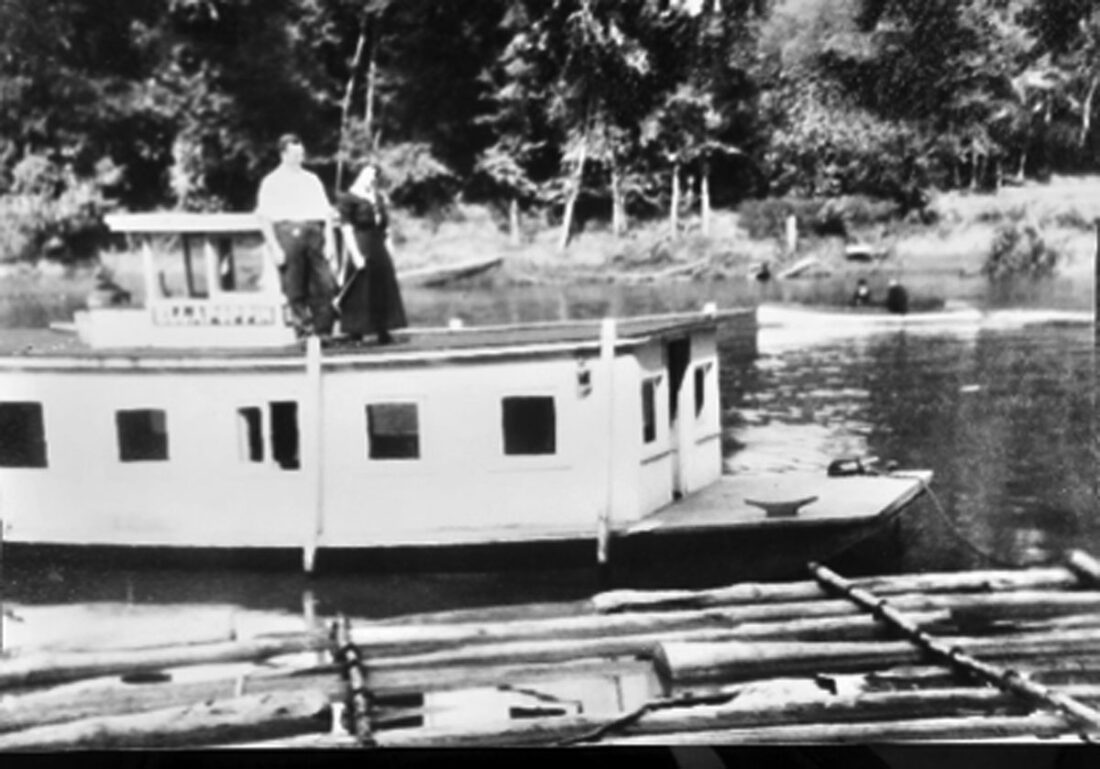
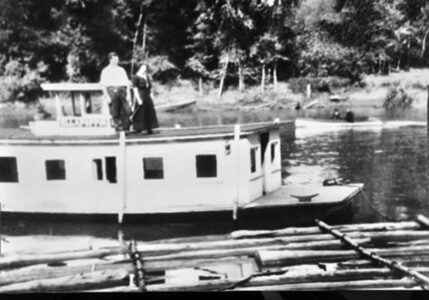
A portion of a log raft can be seen in the foreground of the photo taken near the mill at Nicolette. The boat is the “Ella-Poppin,” built at Nicolette by Junius Radiker, one of the owners of the mill. (Photo from Bob Enoch)
Creston, calliopes and dishes
This item appeared several years ago in H&P, newsletter of the historical society.
Does the title seem like a strange combination? Certainly not! At least not in the early 1920s. In fact, for those who lived along the Little Kanawha River, all were quite common and for many of those folks, thoughts of them hold fond memories.
On a recent quest involving a jaunt to Creston, on the Little Kanawha River, I invited an elderly friend, Howard Bailey, along “just for the ride.” I met Howard some years previous while on a similar quest that involved my childhood home of Nicolette. Howard’s dad worked at the mill in Nicolette in the late 1890s. They then lived in the nearby village of Davisville. In the years since, we’ve become close friends; he sharing stories of the past, and me providing an attentive ear.
Heading east from Cedar Grove at 8:30 a.m., we quickly passed the old “seven-mile house,” the first stop out of Parkersburg on the Staunton-Parkersburg Turnpike, and the intersection that led to Howard’s boyhood village of Davisville.
Wanting to again put my absorbing ears to use, I asked Howard if he’d ever traveled on any of the several boats that used to ply the Little Kanawha. “No,” he replied, “but I did go on the showboat.” Showboat! Immediately visions of dancing girls and slap-stick humor leaped to my mind. Wrong! He was speaking of picture showboats; floating movie houses; complete with popcorn. To board the boat and see the movie cost ten cents’ popcorn was extra. He remembered most the bright notes of the boat’s calliope, announcing its arrival as it neared the village.
Continuing to travel east on Rt. #47, Howard shared his father’s work for the Nicolette Lumber Company. Most of their saw logs came through a log boom located at the mouth of the West Fork River where it joins the Little Kanawha at Creston. Thousands of logs were gathered at the boom and placed side by side, forming rafts. The rafts were banded together using small saplings and short sections of chain called “rafting dogs.” His father rode the rafts from the boom at Creston to the mill at Nicolette. At times the rafts were over 1/2 mile long and the few men traveling with them would sometimes build a small shelter on the rafts. Navigating the many bends of the river and locking the rafts through the three of four locks was tiring, dangerous, and often times a wet experience. Howard recalls his dad once coming home after one of these “dunkings,” with a catfish caught in his bib overalls. Sometimes in the winter, the pant legs would be stiff, frozen by the icy water.
Passing near the river at Newark, we noticed how thick and muddy it looked, now swollen by recent rains. Howard commented about the ferry that years ago operated there. Today the river looks so narrow. It seemed a strange place for a ferry.
Finally, we approach Creston. A trip that would have taken my grandparents well over a day’s journey, we completed in just over forty minutes. The area teems with history. At one time this entire region was alive with important figures of the oil and timber business. Today, only relics, stories, and remnants of the people remain.
To be concluded next week…
***
Bob Enoch is president of the Wood County Historical and Preservation Society. If you have comments or questions about Look Back items, please contact him at: roberteenoch@gmail.com, or by mail at WCHPS, PO Box 565, Parkersburg, WV 26102.