Raylee’s Law amendment divides West Virginia Senate
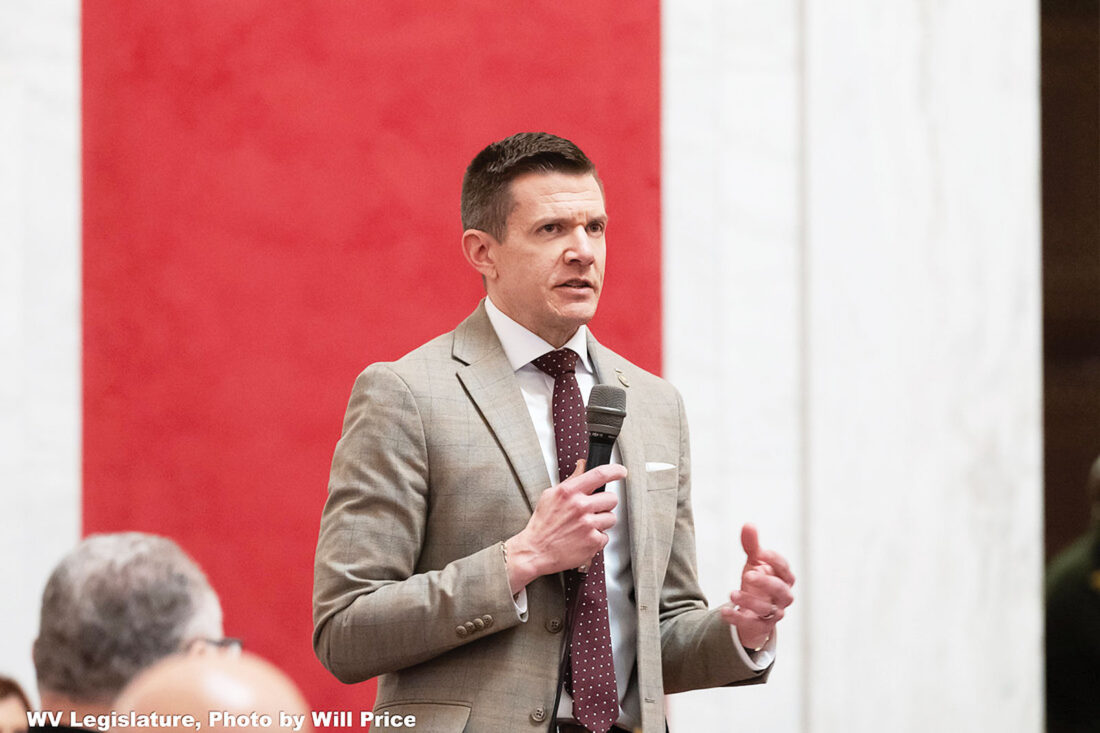
West Virginia Sen. Ryan Weld said Friday that an amendment to a House bill to include provisions of Raylee’s law was not to punish home school families but to focus on those who choose to abuse the home school system. (Photo Courtesy/WV Legislative Photography)
CHARLESTON — Divisions within the Republican caucus of the West Virginia Senate were on full display Friday with members backing an amendment to support Raylee’s Law and voting to repeal the student transfer rule. An amendment to a committee amendment to House Bill 5537, repealing obsolete and outdated sections of the education code, was adopted Friday afternoon by voice vote after Senate President Randy Smith, R-Preston, ruled the amendment germane to the committee amendment. The bill was passed in a 24-7 vote with three absent or not voting. The amendment provides that a county board of education may not approve a request for home instruction for an enrolled student if there is a pending child abuse or neglect investigation. The amendment outlines a schedule for inter-agency communication to ensure that home instruction requests are not indefinitely delayed, while protecting child safety. A teacher or staff member must inform the county superintendent within 24 hours of making a child abuse/neglect report. Superintendents must inquire with the Department of Human Services about the investigation status within 24 hours of receiving notice. The department must provide confirmation of the investigation to the superintendent within 48 hours of the request. A county school board must approve home instruction if the investigation is determined to be “unfounded” or “unsubstantiated,” or if the department fails to provide substantiation within 10 days of the report. “This is not meant at all as a punishment towards a person or a group but is instead meant to protect children that are in our school system,” said state Sen. Ryan Weld, R-Brooke. The amendment to the amendment was sponsored by 15 senators: Weld; Ann Charnock, R-Kanawha; Charles Clements, R-Wetzel; Vince Deeds, R-Greenbrier; Joey Garcia, D-Marion; Amy Grady, R-Mason; Bill Hamilton, R-Upshur; Glenn Jeffries, R-Putnam; Zach Maynard, R-Lincoln; Rupie Phillips, R-Logan; Ben Queen, R-Harrison; Tom Takubo, R-Kanawha; Eric Tarr, R-Putnam; Mike Woelfel, D-Cabell; and Jack Woodrum, R-Summers. The amendment is the latest version of Raylee’s Law: named for Raylee Jolynn Browning, a child in Oak Hill who died in 2018 due to abuse by her father, Marty Browning. According to press reports, Raylee had been pulled from public school by her father, who was sentenced, along with his girlfriend and girlfriend’s sister, in 2022 after being convicted of child neglect causing death. A standalone bill for Raylee’s Law, House Bill 5669, made it out of the House Education Committee at the beginning of March, but an effort to suspend rules to get the bill out by the crossover day deadline failed. The Senate’s standalone Raylee’s Law bill, Senate Bill 972, never left the Senate Health and Human Resources Committee. “I want us to focus on something that should unite every single one of us in this chamber, and that’s protecting children,” said Grady, the chairwoman of the Senate Education Committee and lead sponsor of SB 972. “Homeschool families are not the problem. And this is not about punishing or targeting them. But sadly … there are rare and tragic cases where the homeschooling system has been misused to hide abuse.” “This is not an indictment of all parents,” said Garcia, the Senate’s assistant minority leader and co-sponsor of SB 972. “This is an imperative duty to protect all children, a solemn responsibility to verify their safety where that red flag appears at school so they do not stay hidden from our sight.” Senate Assistant Majority Whip Patricia Rucker, R-Jefferson, asked for a ruling from Smith on whether the amendment by the 15-member cohort was germane to the Senate Education Committee’s amendment to the bill, but Smith ruled it could be considered. However, when asked if the now-amended committee amendment was germane to the bill itself, Smith ruled against it. That prompted Weld to challenge Smith’s ruling, with 18 members voting to reject it and 12 members voting to sustain. “This is trying to find a way to ensure that we are respecting the parents’ rights and their wishes without protecting the children,” Weld said. “If I was someone who homeschooled my children … I would want something like this because this is not an attack on the homeschooling community. This is an attack on those who purport to be homeschoolers, the pretenders. Those who are taking their child out of school simply to hide the abuse that they give to them.” The Senate also had a divided vote on House Bill 4425, repealing the provision allowing for students to transfer from one school to another without losing athletic eligibility. The bill passed in a 20-14 vote, sending the bill to the desk of Gov. Patrick Morrisey. HB 4425 would repeal a section of state code requiring the West Virginia Secondary School Activities Commission to allow multiple transfers. Upon repeal, the SSAC, governed by member school principals and athletic directors, would be responsible for drafting a new transfer rule with approval by the state Board of Education. “High school athletics should be about participation, about discipline and representing that place you call home,” Grady said. “We’ve turned something meant to build character into a system that mirrors college free agency. Protecting fair competition and the integrity of school communities should remain the priority. This helps promote the culture that makes our State of West Virginia so great.” Prior SSAC rules required a student transferring from one high school to another to sit out one year, though waivers could be sought. However, a Senate bill was amended in 2023 requiring the SSAC to modify rules for the 2023-24 school year to allow students to transfer schools and retain their athletic eligibility one time during a student’s four years in high school. Weld, the author of the 2023 amendment that allowed students to transfer and maintain athletic eligibility, opposed HB 4425, raising issues about putting rulemaking authority back into the hands of the SSAC. “I rise in opposition to the bill that restores the authority back to a group of unelected bureaucrats to make the decisions for your children,” Weld said. “I never thought that I would see this body put up a bill that takes a step backwards and takes away that parental choice, but here we are today.” Rucker, the chairwoman of the Senate Select Committee on School Choice, said the bill was a step backward for decisions being made by parents in the best interests of their children. “If you support this legislation, you are punishing kids,” Rucker said. “You are taking away their dreams. You are limiting their options. And you’re not fixing the problem.” But several lawmakers rose in support of the legislation, saying the bill would restore fairness to high school sports across the state and limit attempts at recruiting student-athletes. “I’ve spent a lot of time around the schools, and I found out from small communities what high school athletics means,” Clements said. “What has happened over the last few years with the migration of their students to bigger schools, even though they may feel they have a better opportunity to gain recognition, has destroyed the community.” “The Legislature stepped into this issue a few years ago because the confidence in the system began to erode … Today, we’re giving the SSAC the opportunity to do the right thing,” said Senate Majority Whip Ben Queen, R-Harrison. “This bill allows the SSAC to restore fair and thoughtful transfer policy.” Steven Allen Adams can be reached at sadams@newsandsentinel.comLocal News

Mid-Ohio Valley Faith Calendar

Son’s drug death prompts Belpre man to write about faith

Washington County Job and Family Services assisting employees laid off from Energizer plant

Huffman joins West Virginia Polymer Alliance Zone

Picture This: On the Prowl