West Virginia officials outline strategic roadmap to help at-risk children
State education officials say they are in the dark on Star Academy plan
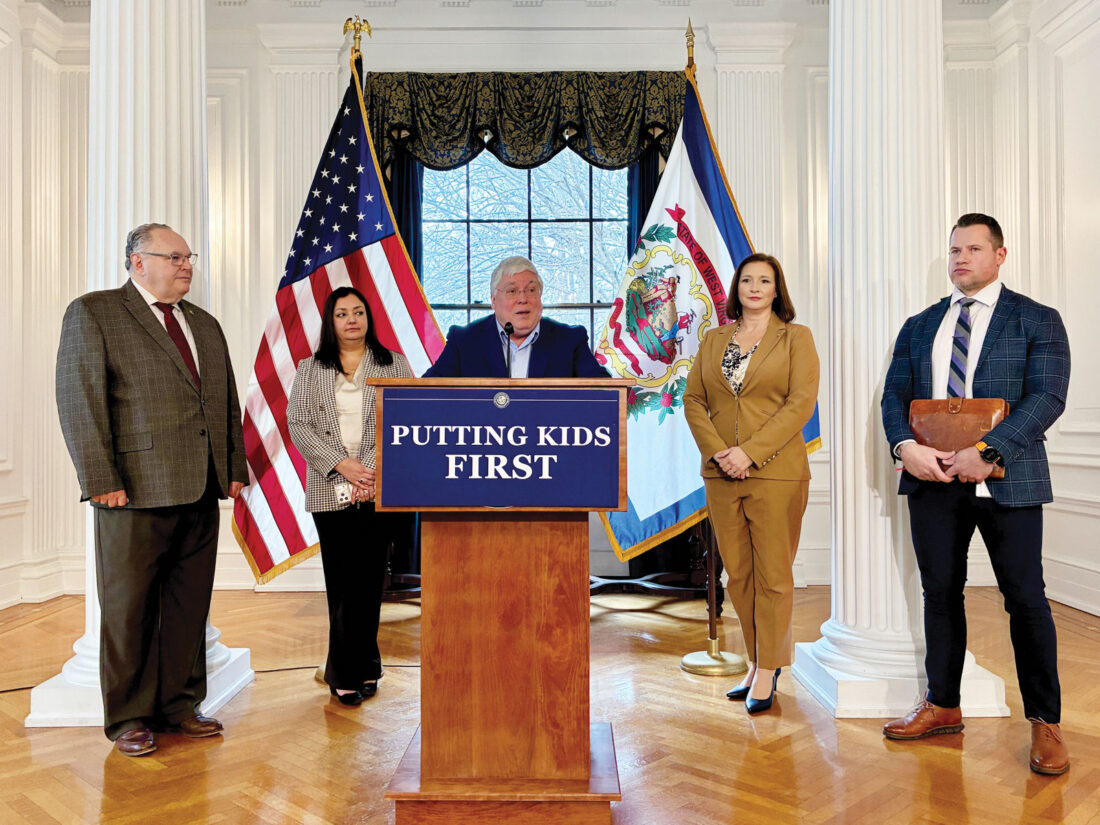
Gov. Patrick Morrisey unveiled several initiatives related to helping at-risk children during a press conference Tuesday at the State Capitol Building. Pictured from left are state Senate Workforce Committee Chairman Rollan Roberts, R-Raleigh, Senate Health Committee Chairwoman Laura Wakim Chapman, R-Ohio, Morrisey, Del. Sarah Drennan, R-Putnam, and Department of Human Services Secretary Alex Mayer. (Photo by Steven Allen Adams)
CHARLESTON — Gov. Patrick Morrisey laid out a multi-faceted strategy to help at-risk children before they become just another child welfare case. But one of those plans involving expansion of a pilot education program came as news to state education officials. Morrisey, joined by Department of Human Services Secretary Alex Mayer and several lawmakers in a press conference Tuesday afternoon, laid out several reforms he wants to present to lawmakers to West Virginia’s child welfare system next week when the annual regular legislative session begins. Morrisey said his initiatives are grounded in a philosophy of proactive, preventative intervention, moving away from reactive measures to focus on addressing challenges early, stabilizing family situations, and preventing unneeded interventions by Child Protective Services. “I think we have to be proactive,” Morrisey said. “We have to address challenges ahead of time. We have to, in the child welfare system, help people earlier. We have to stabilize situations sooner. And we have to prevent unnecessary involvement whenever possible of system involvement.” “There’s also things that we can do up front — upstream as we often say in the child welfare system — that we can do to start reducing the impact in the involvement of child welfare later on when folks leave school,” Mayer said. “These efforts are in a continued effort to reduce that involvement (and) provide better support to families and children.” Morrisey laid out four initiatives aimed at providing help to children and families in order to prevent worsening child welfare issues down the road. The first initiative is expansion of the Star Academy program. The Star Academy was founded in 2004 in South Carolina and has since expanded to 20 states, including West Virginia, serving more than 20,000 students in more than 100 school systems. Called a “school within a school,” the Star Academy works with at-risk students to improve their educational attainment. “There’s a small number of classrooms that are transformed into immersive learning environments, where these students can receive core academic instruction, and they can be paired with hands-on, career-connected project-based learning,” Morrisey said. According to pre-COVID-19 educational data made available by the Star Academy, students in the program saw a 95% improvement in standardized test scores, with 84% of students promoted by two grade levels. Participating schools saw a 72% reduction in behavior referrals and a 75% reduction in absenteeism for students in the program. Morrisey said that more recent data he has seen from the Star Academy showed an 88% decrease in behavior referrals and an 89% decrease in absenteeism by participating students in Mississippi, Louisiana and South Carolina. “Good statistics, better than what we’ve had in West Virginia and certainly, we think, something that could be very beneficial for our state,” Morrisey said. In West Virginia, the Star Academy began pilot programs in Logan, Kanawha, Barbour and Berkeley counties. Morrisey said he wants to see the Star Academy expand in the state to eight new programs at a cost of $8 million, broken down to four new programs in one year and another four programs in the next year. Morrisey said funding for the expansion will come from existing federal Temporary Assistance for Needy Families (TANF) dollars, requiring no new state monies. The Legislature would likely still have to approve the use of the funds through spending authority. “Each Star Academy we know could serve up to 80 students per year, and it generally operates on a three-year to five-year cycle,” Morrisey said. “We think it’s important to intervene early and connect learning to opportunities … I think it’s going to help kids, keep kids engaged in school and reduce some of the risks that lead to foster care involvement.” Expansion of the Star Academy could help counties meet the requirements of Senate Bill 199 passed during the 2025 legislative session. The new law signed by Morrisey last year requires students in grades kindergarten through sixth whose behavior is deemed violent, threatening or intimidating to be referred to certain specialists and placed on a two-week behavioral plan. If the student shows no improvement after four weeks, the student is to be placed in a behavioral intervention program. The law allows for the creation of alternative learning centers in counties or expansion of existing centers, subject to funding, to address the behaviors of chronically disruptive students. It allows multiple counties to share use of an alternative learning center. Morrisey said Tuesday that his administration has had conversations with the state Department of Education about the initiative. “I know there’s been a lot of enthusiasm about Star Academies as playing a broader role in the process because people at the Department of Ed were encouraged by the data that we saw, and not just what we’re seeing in West Virginia, but what we’re seeing in other states,” Morrisey said. “I think there are ongoing conversations between Department of Ed and our team.” However, two sources within the Department of Education and state Board of Education who spoke on background said that no conversations regarding expansion of the Star Academy program have taken place between state education officials and the Morrisey administration, with officials only finding out about Tuesday’s announcement 10 minutes beforehand. Also, out of the four Star Academy pilot programs in West Virginia, only the Logan County program is still in operation. The Star Academy is operated by NOLA Education LLC. The lobbyist for NOLA Education is Conrad Lucas, an informal advisor to Morrisey and co-leader of Morrisey’s gubernatorial transition team, as well as a former chairman of the West Virginia Republican Party. Other initiatives Morrisey talked about included the evolving investment fund to renovate state-owned foster care facilities and enhance in-state treatment capacity in order to bring out-of-state foster children back to West Virginia. Morrisey unveiled the proposal in December, which he now called the “Bring Them Home Fund,” requiring a $6 million appropriation. Initiatives three and four include leveraging the resources and community presence of churches and other faith-based organizations to support the child welfare system, and creating better systems for distinguishing between types of truancy. State Senate Health Committee Chairwoman Laura Wakim Chapman, R-Ohio, said she was ready to get to work during the regular 60-day legislative session beginning Wednesday, Jan. 14, to help Morrisey get his initiatives passed. “I am so excited today that Governor Morrisey and Secretary Mayer are going to continue this work because for about a decade, we have been failing our children,” Chapman said. “I believe that every child in West Virginia should stay in West Virginia, and the secretary and the governor have made great strides to keep our children in West Virginia and out of hotel rooms. So, I’m very excited for these initiatives.” Steven Allen Adams can be reached at sadams@newsandsentinel.comLocal News
Parkersburg City Council approves trash contract on first reading, tables recycling

Hunter’s retreat through West Virginia subject of roundtable presentation

Homeless Project seeking shelter permission from Marietta officials

Gasoline prices continuing to drop throughout much of the US

Picture This: Brightly Shining