
WVU explains proposed program cuts to lawmakers
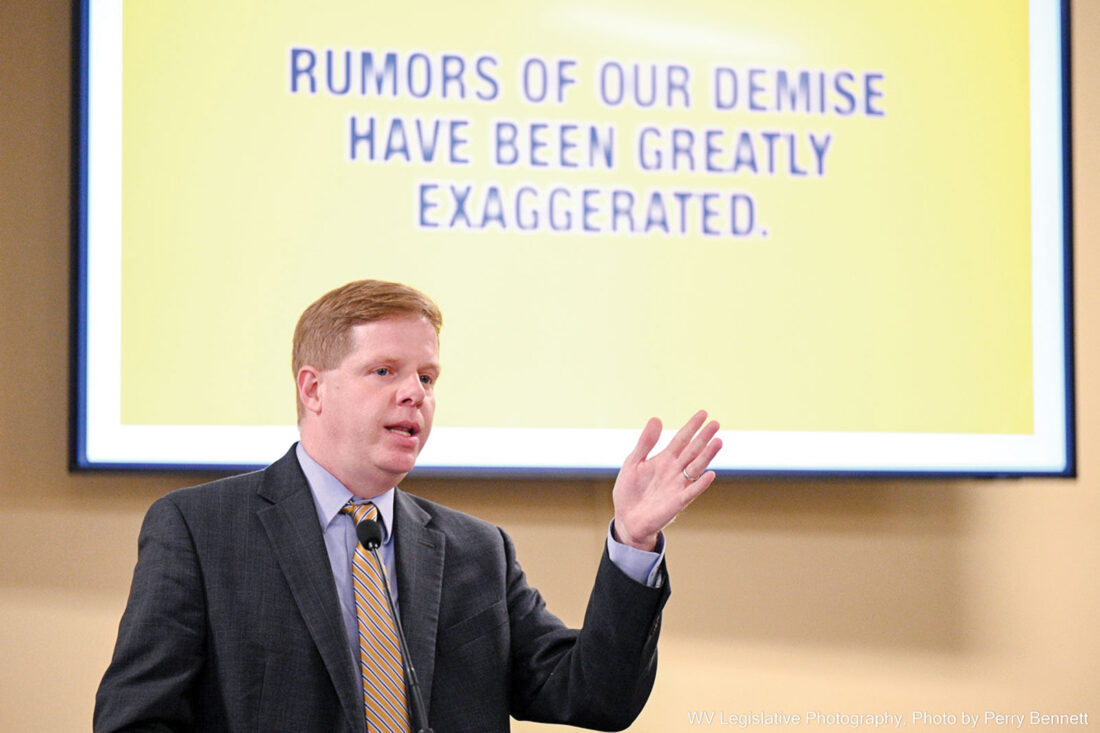
WVU Vice President Rob Alsop explained WVU’s final proposals for program eliminations and faculty cuts to lawmakers Monday. (Photo Provided)
CHARLESTON — As West Virginia University’s Board of Governors prepares to take action on recommended program and faculty cuts later this week, the university explained those cuts to lawmakers Monday morning.
The West Virginia Legislature’s Joint Standing Committee on Finance received a briefing from Rob Alsop, vice president for strategic initiatives at WVU, on the university’s academic transformation program and budget woes. WVU President E. Gordon Gee, who was also scheduled to speak, was unable to attend.
“There are jobs that are being impacted and programs that are being impacted and I know there are a lot of faculty who are upset and we are subject to that criticism. I will take every bit of that. I know change is hard,” Alsop said. “But I also want you to know there is a huge portion of WVU that is remaining and that we can all be proud of and that we can all do to move forward as an institution … there is a thought plan that we’ve tried to follow.”
A combination of years of decreased enrollment, a decade of decreased state funding, and an increase in the base budget and tuition rates over that same time has resulted in a $45 million hole in WVU’s fiscal year 2024 budget, a hole that could grow to $75 million by 2028 if left unchecked. The university has already cut 135 positions, including 38 faculty members.
WVU was undergoing a review of its academic offerings, called the Academic Transformation. But the COVID-19 pandemic and WVU’s recent budget issues caused the university to fast-track that program.
After weeks of reviews and appeals, the WVU Provost’s Office has recommended the elimination of 10 undergraduate programs affecting less than 1% of single and double majors, and 19 graduate-level programs affecting more than 4% of graduate students.
If approved by the WVU Board of Governors, the eliminations and program reductions could affect as many as 143 faculty positions at WVU. The Board of Governors meets Thursday and Friday to hear public comments regarding the proposed faculty cuts and program eliminations. Affected faculty will be notified Oct. 16, with positions being eliminated in April and faculty being offered 12 weeks of severance.
“Our board, when they saw the financial challenges, directed us to go through this academic transformation,” Alsop said. “I know there are a lot of faculty upset with those specific recommendations, but the fact is our board asked us to go through this process. If you look at the recommendations we made, we focused on lower enrollment programs. The board may disagree moving forward, but no one has come forward and said this enrollment loss is not real or these deficits are something that do not need to be addressed.”
WVU’s combined enrollment across its three campuses last fall was 27,367, a 14% decrease from 31,976 students enrolled in the fall of 2014. WVU’s total budget increased by 37% between fiscal years 2013 and 2024. Per-semester undergraduate tuition for West Virginia residents at WVU rose by 58% during that same period.
State funding for WVU from the general revenue budget has dropped nearly 12% since sitting at a high of $129 million in fiscal year 2013. State funding in the fiscal year 2024 general revenue budget is $114.8 million, or just 9% of WVU’s $1.26 billion budget for FY24, returning to levels not seen since fiscal year 2015 when state funding dropped to $102 million.
According to officials with the Department of Revenue, West Virginia has an estimated unappropriated balance of more than $157.6 million in the general revenue fund. During the August special session, an attempt to amend a bill providing Marshall University $45 million for its new Institute for Cyber Security was made to also provide $45 million to WVU to fill its budget hole. However, the amendment was ruled as not germane.
Delegate Larry Rowe, D-Kanawha, asked Alsop why the university was not seeking funding from the state to cover the $45 million hole. Alsop explained that the university’s bond rating had been reaffirmed and that the university was not at risk of defaulting on its debt obligations. But simply handing WVU a blank check would not solve its immediate problems.
“If the Legislature would decide in its infinite wisdom to provide funding to West Virginia University, we would take it,” Alsop said. “I’ll just say that one-time money is not going to fix the enrollment challenges long-term. It’s not going to address the challenges we are facing. A one-time infusion of money would be great, but in a year we would have to go through this process again.”
Last week, WVU’s University Assembly, consisting of most of the university’s full-time faculty, voted 797-100 in favor of a no confidence resolution against Gee, as well as a resolution calling for a freeze of the academic transformation.
“We love and value the First Amendment,” Alsop said. “We have people on our campus all the time that I very well might disagree with. It is not my job as a WVU administrator to pick sides. It is my job to facilitate a robust debate on a college campus regardless of the point of view. Some people have asked us why we haven’t defended ourselves. Well, our faculty have the right to speak. They have the right to say ‘this is our institution too and you ought to consider things differently.”
Gee recently announced that he will step down as WVU President in 2025 after his contract was extended by a year. Alsop said the university would conduct a nationwide search for Gee’s successor in the near future.
Local News

Parkersburg Art Center bringing Tastes and Tunes back to Market Street
Documents show recent history of violations at Peoples Cartage sister site near airport
CHARLESTON – As multiple local and state emergency responders work to keep a fire at the Peoples Cartage facility ...

Wood County groups provide meals, supplies and support during Peoples Cartage warehouse fire in Parkersburg

Wood Commission briefed about efforts to fight the Peoples Cartage fire

Men’s health fair planned Friday
Artsbridge calendar of community events
The Artsbridge calendar of community events: Today: (Check ahead for any scheduling updates due to evolving ...