Willow Island’s main lock drained for inspection, repair
-
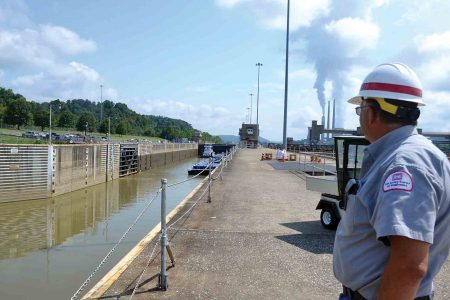
- Photo by Michael Kelly Willow Island lockmaster Bill Collins watches as a benzene barge moves through the auxiliary lock Wednesday.
-
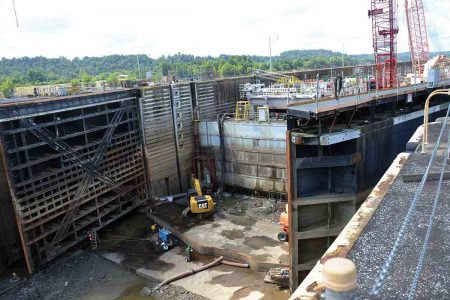
- Photo by Michael Kelly The gates and bottom of the main lock at Willow Island sit dry on Wednesday as a weeks-long maintenance procedure continues.
-
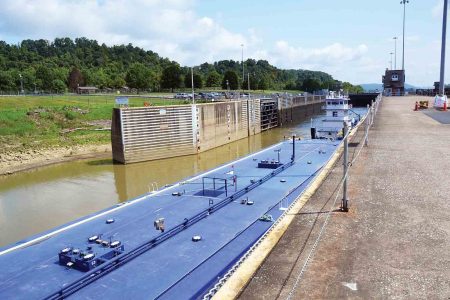
- Photo by Michael Kelly A benzene barge emerges from the auxiliary lock at Willow Island, headed downstream on Wednesday. Transport companies are cooperating by assisting each other by using their towboats to chain and unchain strings of barges on each side of the locks while the main lock is dewatered for maintenance and inspection.
-
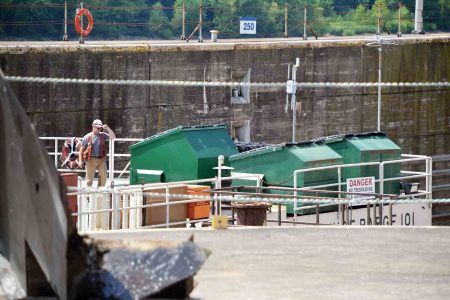
- Photo by Michael Kelly A worker with the Army Corps of Engineers walks along the top of the drained main lock at the Willow Island Locks and Dam complex near Newport Wednesday. The lock is getting a full maintenance and inspection procedure, and for several weeks long barge chains need to be broken up to get through.
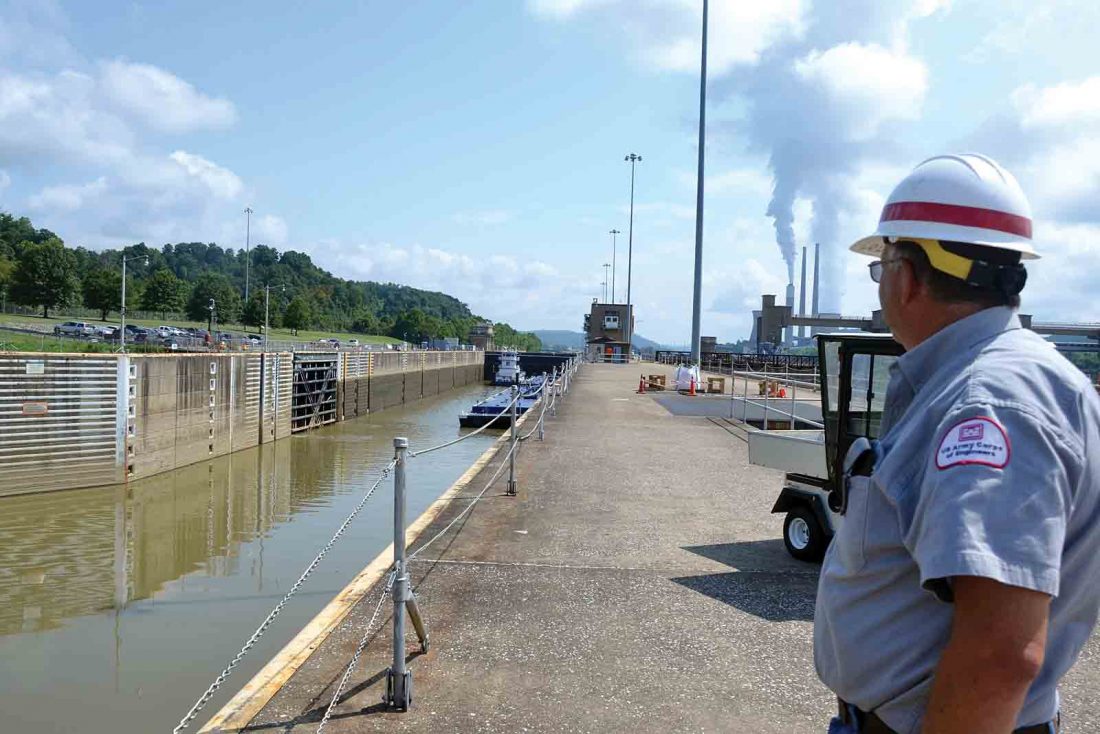
Photo by Michael Kelly Willow Island lockmaster Bill Collins watches as a benzene barge moves through the auxiliary lock Wednesday.
NEWPORT, Ohio — Until a couple of weeks ago, it had been 20 years since the bottom of the main lock at Willow Island had seen the light of day.
The Army Corps of Engineers began maintenance work on the lock earlier in July and it is expected to continue through the end of October, lockmaster Bill Collins said Wednesday. The work starts with setting up temporary gates at either end of the 1,200-foot chamber and expelling the water to expose the walls and floor, then cleaning up two decades of accumulated mud and debris. Collins said the work includes inspecting all the structural concrete and steel and replacing the seals around the gates.
“It looks pretty good for being nearly 50 years old,” he said Wednesday, looking down into the vast, empty chamber. At the bottom of the downstream wall holding back the river, a small waterfall shimmered, and next to it a pump sent the water up a pair of large hoses and back into the river. Cranes spiked up in every direction, an indication of the enormous machinery and weights involved in controlling the Ohio.
“It’s taken two weeks just to get to this, to get it cleaned out,” he said.
Willow Island is one in a chain of 21 lock-and-dam complexes built on the Ohio River from Pittsburgh to the Mississippi River during a massive public works effort decades ago to ease the pathway for riverborne commercial traffic.
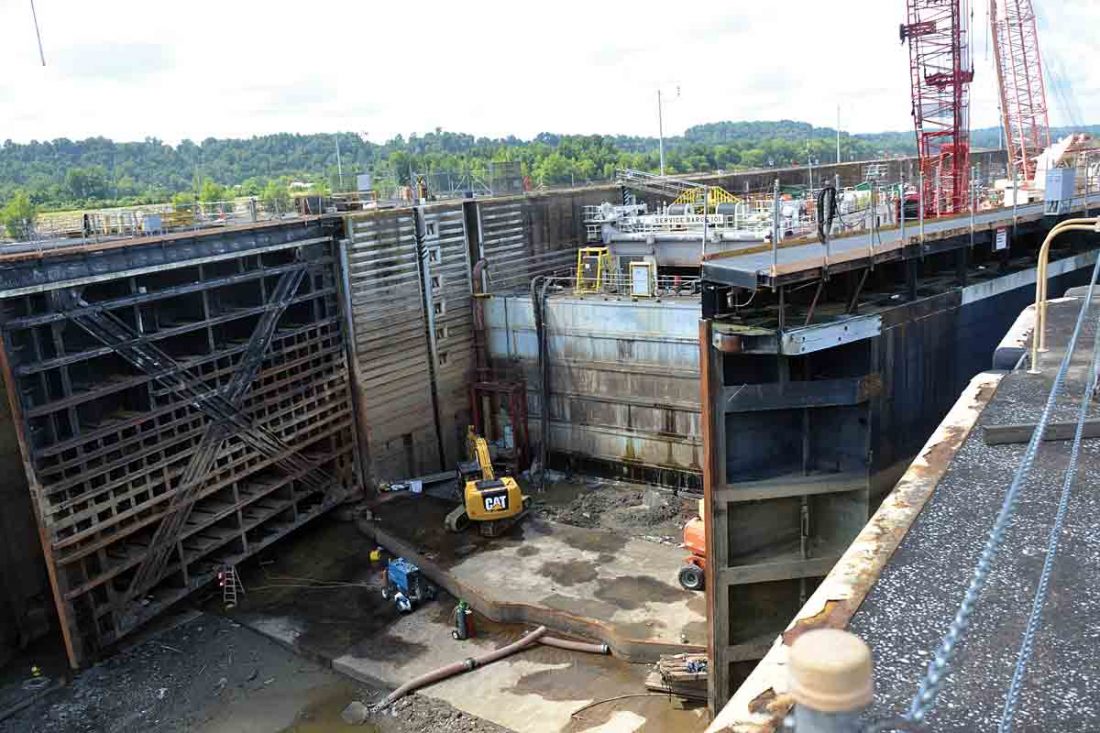
Photo by Michael Kelly The gates and bottom of the main lock at Willow Island sit dry on Wednesday as a weeks-long maintenance procedure continues.
“People think it’s flood control, but that’s not what it is,” Collins said. “It’s navigation.”
Willow Island, completed in 1972 by the Army Corps of Engineers at a cost of $76 million, has two locks, the main lock now closed for maintenance, and a smaller auxiliary lock about half the length of the main lock, which is now being used for all traffic up and down the river.
The locks raise or lower barges and boats 20 feet, depending on which direction they are going. The dam maintains a pool extending upstream 35 miles to Hannibal, at a level of about 602 feet above sea level; below the dam, the level is 582 feet for the 42 miles downstream to the Belleville Locks and Dam at Reedsville.
The river moves more than 200 million tons of commodities a year, according to the Ohio Department of Transportation.
Restricting passage of vessels to the smaller lock causes particular headaches for the river’s primary traffic, freight barges, which often are chained together in strands which have to be broken up to get through the smaller, 600-foot lock. The main lock can accommodate a 15-barge tow — three barges wide and five long — plus the towboat, but such tows have to be split in two to go through the auxiliary lock.
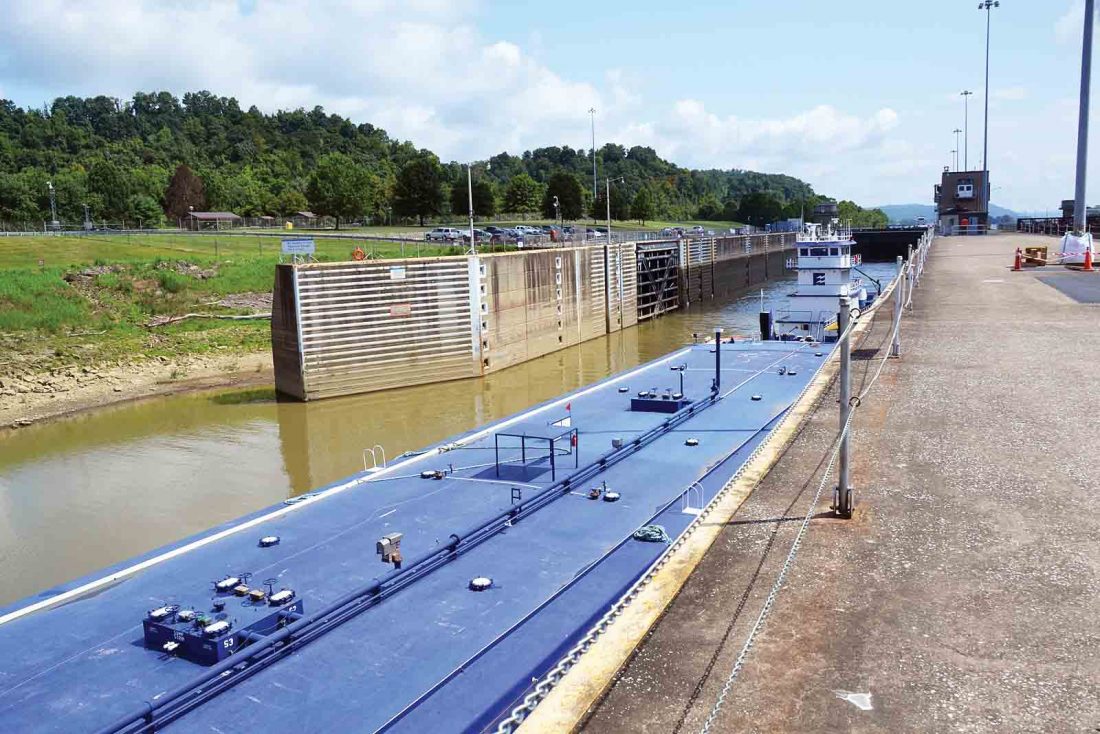
Photo by Michael Kelly A benzene barge emerges from the auxiliary lock at Willow Island, headed downstream on Wednesday. Transport companies are cooperating by assisting each other by using their towboats to chain and unchain strings of barges on each side of the locks while the main lock is dewatered for maintenance and inspection.
Collins said an average of 350 to 400 lock passages occur per month at Willow Island, and a process that normally takes less than an hour can now require substantially longer, in part because waiting lines develop.
Randy Chapman, manger of line haul vessel operations for Campbell Transportation Company, said the maintenance at Willow Island has affected operations for the 55 vessels the company operates on the Ohio, but it’s something that can’t be helped.
“We’ve got quite a few boats out there, and it slows down the process quite a bit; the delay time is 24 to 48 hours,” he said. “We are having to double-lock (break down the barge chains into sections), and that’s causing some delays. But the marine industry is unique; even though we’re fiercely competitive, we also work together to help each other out; we share tips and work side-by-side. There are guidelines set for these locking procedures; it’s an orchestrated event between the companies and the Corps.”
Chapman was philosophical about the disruption.
“Any time you slow down, it’s time-consuming and costly, but that’s part of getting our infrastructure refurbished; it’s better than a breakdown. It’s just like getting a highway repaved, you know it’s going to happen and you just have to deal with it,” he said.
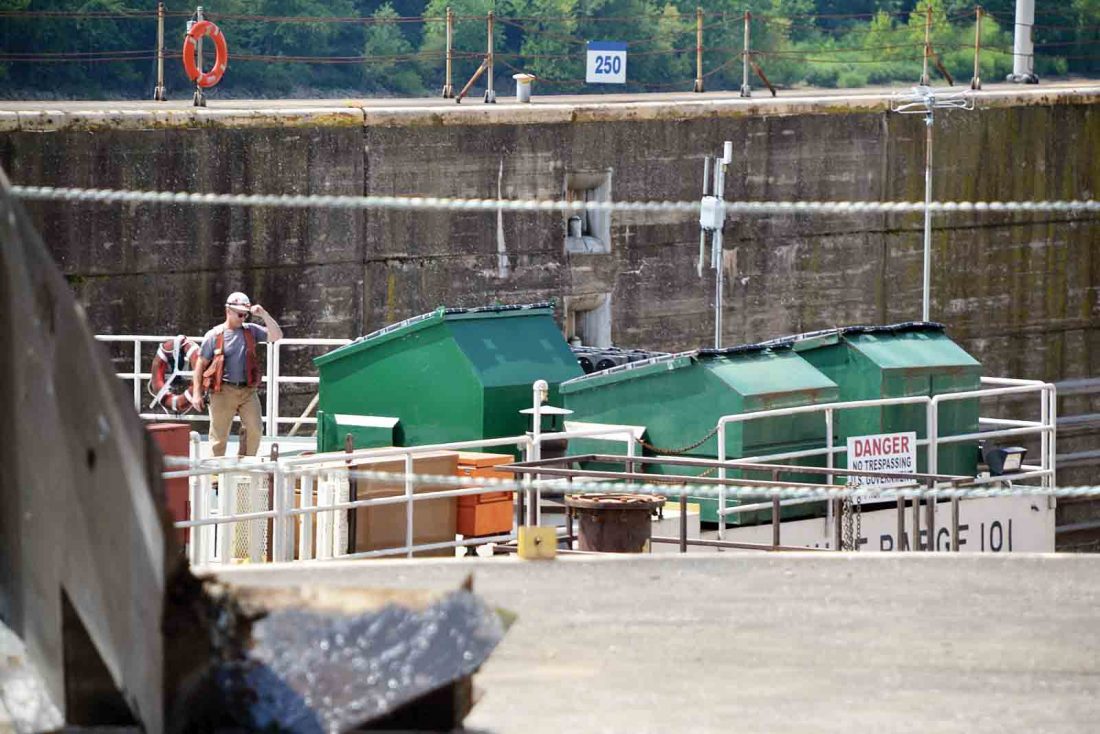
Photo by Michael Kelly A worker with the Army Corps of Engineers walks along the top of the drained main lock at the Willow Island Locks and Dam complex near Newport Wednesday. The lock is getting a full maintenance and inspection procedure, and for several weeks long barge chains need to be broken up to get through.
The work is being done, Corps spokesman Chuck Minsker said, by a Corps crew from Pittsburgh, one of three on the Ohio River that do this kind of heavy maintenance.
“Changing out the gates like this, it’s not something we do every year; it’s a little unusual, but it’s what we do to keep the locks operating smoothly,” he said.
Even at more than 50 years of age, Collins said, Willow Island is the newest of the locks on the Ohio.
“I believe it’s worked this long because it’s simple, it’s 1940s technology,” he said. The locks and their massive, movable gates are entirely mechanical and hydraulic.
“There’s miles of hydraulic piping in this. We just changed to electronic controls a couple of years ago,” he said.
The operation is staffed by about 20 people, who are either lock operators or maintenance workers. Becoming a lock operator requires months of study and hands-on work, leading to certification.
“Most of our staff are veterans. I like that because they have discipline and take pride in their work,” said Collins, a 28-year Army veteran.
He’s getting ready to retire within the next two years, he said, and spend his time running his farm near Coolville. He’s been the Willow Island lockmaster for 10 years.
“It’s been a blessing, a very rewarding job,” he said.
Michael Kelly can be reached at mkelly@mariettatimes.com
Local News

Early voting period in West Virginia exceeds 2022 midterm numbers

Morrisey defends religious vaccine exemptions in W.Va. Supreme Court filing

West Virginia Symphony League Parkersburg closes season, holds geranium sale
Growing potatoes subject of class
The Waverly Activity Center, 422 Virginia St. in Waverly, will hold a hands-on gardening class on growing potatoes ...
Grantsville resident involved in fatal crash
ELIZABETH — On Sunday, at approximately 2:50 p.m., Trooper T. C. Winters responded to a single vehicle crash, on ...