Traveling Constitution banner to be signed by residents expected to arrive in Marietta
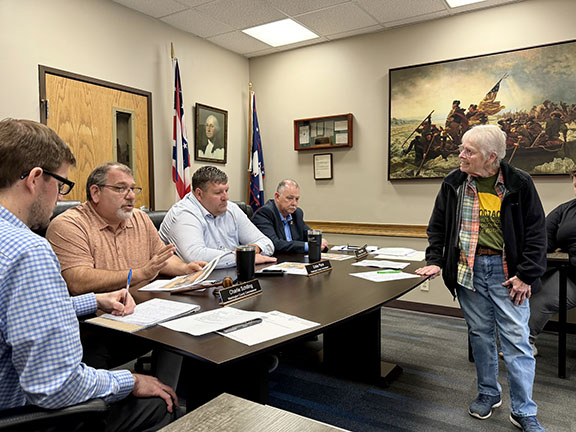
Betsy Cook with Living Democracy asks the Washington County Commissioners if they will approve a traveling Constitution banner to be in front of the courthouse April 25. Photo by Amber Phipps
MARIETTA – Upon the contingency of the approval of Prosecutor Nicole Coil, the Washington County Commissioners approved for an 18-by-18 ft. banner of the Constitution to be in front of the courthouse for Marietta residents to sign.
Betsy Cook with the group Living Democracy presented the idea to the commissioners and said the banner has traveled across the nation for people to be sign in honor of America 250.
“It would give the community a chance to sign the Constitution and then it would go on all around the United States and it’ll go to Washington D.C. on July 4,” said Cook. “The entire banner will be about 700 ft. long.”
Cook said if approved, they will schedule for the banner to be at the courthouse from 10 a.m. to 4 p.m. April 25.
Coil said there shouldn’t be a problem unless the courthouse itself had restrictions that wouldn’t allow the banner to be there.
The commissioners approved the initiative but the details would need to be finalized and approved upon Coil’s determination.
“I don’t think there’s going to be a problem … I just need to clear something with them in terms of the courthouse and if there’s any restrictions related to the courthouse,” said Coil.
Marietta resident with Washington County for Safe Drinking Water, Dee Arnold asked the commissioners why they wouldn’t sign a moratorium asking for a three-year pause on class one and two injection wells.
“The audacity of a company to have daily access to dumping thousands of gallons of radioactive waste into our ground next to our aquifers for personal gain is unconscionable,” said Arnold.
Commissioner Charlie Schilling referred to his past statements from prior meetings that the commissioners are supportive of how things are regulated.
“Obviously we’re all for clean water,” said Commissioner Eddie Place. “That’s our number one priority but that’s not a decision that we get to make and we have no control over that.”
Place said the commissioners have continually expressed the same concerns the public has about the injection wells to the Ohio Environmental Protection Agency and the Ohio Department of Natural Resources.
Arnold said the Athens County Commissioners were able to halt the progression of injection wells in the county.
“What the board of commissioners can’t do is make a ruling with the Ohio EPA or the state, they control those entities and decide what goes in the ground or not,” said Commissioner Greg Nohe. “If we had that authority, we might be having a different conversation.”
Place said when he and Nohe attended the most recent public meeting with the Washington County for Safe Drinking Water, none of the experts that spoke said there had been evidence of migration as a result of the injection wells.
“Yet,” said Arnold.
Washington County Job and Family Services Director Flite Freimann said when he practiced as a private attorney years ago, he represented the Washington County Career Center when DeepRock Disposal Solutions was working on an injection well at the career center.
“The U.S. EPA under both the Biden administration and the Trump administration states that the safest way to dispose of brine is through underground injections,” said Freimann. “These are experts at the federal and state level who have looked at every possible way of doing this.”
He said in the past, regulation only required injection at 3,000 ft. which did end up migrating with ground water because it wasn’t deep enough. Current regulation requires injection wells to injection brine 6,000 ft. below the surface.
“The rules were changed and now mandated that you have to be below something called a cap rock-50 ft. of solid rock that they have to drill through,” said Freimann. “There are no orphan wells at that depth because it was only recently we had the technology to get there.”
Freimann said there is 6,000 ft. of rock between the injection brine and the water aquifers.
“There’s not a single instance of brine water contaminating an aquifer,” he said.
Marietta resident George Banziger argued that the pressure of the injection well could force the brine back up to the water aquifers.
“When these injection wells are pressured at 900 psi … it doesn’t go up but it migrates and it has been shown to migrate,” he said. “Our geology is like Swiss cheese.”
Arnold said the ODNR has data that injection well brine migrated up to five miles. “It was never intended to be a permanent solution,” she said.
“There are many different ways to do business,” said Place. “We trust that they’re doing their due diligence to protect the people, we trust that process.”
Arnold asked about the Ohio EPA DuPont settlement and where the money would go. She asked how much money Washington County would be receiving from the settlement of $65 million. Gov. Mike DeWine announced the $65 million settlement with DuPont on April 6.
“Not that I’m against getting this money to activate millions of dollars to clean PFOA (perfluorooctanoic acid) from our water but simultaneously we allow active class two injection wells within two miles or our aquifers,” she said.
Schilling said the settlement money isn’t dispersed to the county but rather to the different water organizations who were impacted by the PFOAs.
“That is strictly a settlement between the state of Ohio and DuPont,” he said. “It’ll be for the water entities within the county and it will be dispersed by the Ohio EPA.”
Schilling said the Ohio EPA would work with the entities about what their needs are and how that can be met.
“The people that had the PFOAs problem at DuPont, should we have trusted them?” asked Arnold.
In other meeting business, county officials involved with the OhioMeansJobs Career Connect Job Fair recognized each other for their work on the event Tuesday.
Washington County Veterans Service Commission Executive Director Darren Shearlock said the event was life changing for many residents.
“It gives those individuals a chance to get a job or to get a better job with career progression,” said Shearlock. “It’s changing the lives for those individuals that level-up their career but it also increases the economic well-being of everybody else in the county.”
Amber Phipps can be reached at aphipps@newsandsentinel.com
Local News
GoPacks to host Top Chef Challenge
GoPacks will host a Top Chef Challenge from 5:30 to 9 p.m. Friday, April 24, at the Marietta Shrine Club. The ...
GoPacks to host Top Chef Challenge
GoPacks will host a Top Chef Challenge from 5:30 to 9 p.m. Friday, April 24, at the Marietta Shrine Club. The ...

North Hills council meets
Morrisey talks about opportunities in energy

Traveling Constitution banner to be signed by residents expected to arrive in Marietta