
West Virginia House Finance Committee begins first look at Morrisey’s tax cut bill
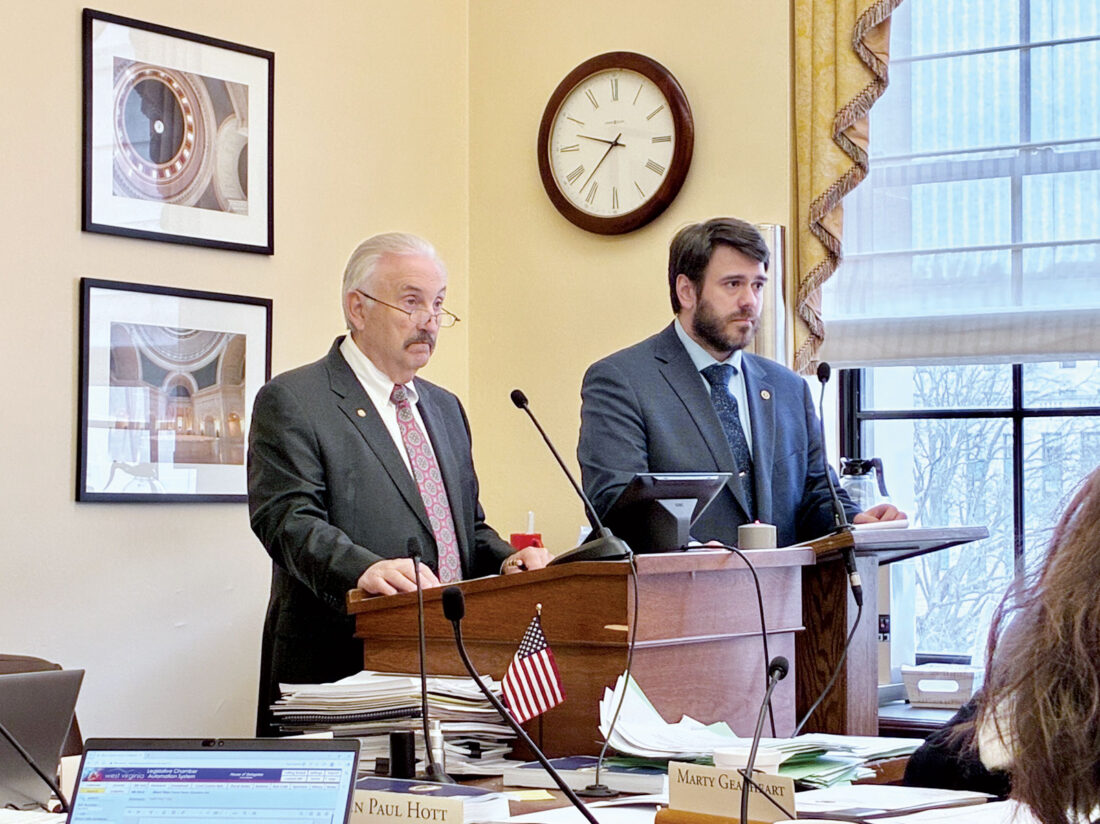
Department of Revenue Deputy Secretary Pete Shirley, right, fielded questions Tuesday from members of the House Finance Committee regarding Gov. Patrick Morrisey’s request for an across-the-board 10% personal income tax cut as House Finance Committee Chairman Vernon Criss, R-Wood, listens. (Photo by Steven Allen Adams)
CHARLESTON — The House Finance Committee is likely to make changes to Gov. Patrick Morrisey’s bill enacting a 10% cut in personal income tax rates. The House Finance Committee held a hearing Tuesday morning on Senate Bill 392 and will consider a strike-and-insert amendment to the bill on Thursday. SB 392 would cut personal income tax rates by approximately 10% retroactive to Jan. 1, returning $250 million to taxpayers when fully implemented. Morrisey first proposed the cut during his State of the State address at the start of the 2026 legislative session. The revenue estimate for Senate Bill 250, with Morrisey’s proposal for the general revenue budget for fiscal year 2027 beginning on July 1, only contemplates 5% of the proposed 10% cut in part through departments and agencies reducing their budget requests by 2%, freeing up around $120 million. The Senate amended SB 392, paying for the 10% personal income tax in part with increased taxes on vape and e-cigarette products, raising an additional $22 million in tax revenue. The bill modifies the excise tax of 7.5 cents per milliliter to a tiered system based on the type of vaping device. Closed-system vapes, such as cartridge or pods, would be taxed at $1.20 per cartridge. Open system, or refillable vapes, would be taxed at 25 cents per milliliter. SB 250, as amended by the House of Delegates last week, does not contemplate any cut in personal income tax rates. But the Legislature is required by law to abide by the $5.493 billion revenue estimate set by the Department of Revenue, which also includes the Legislature agreeing to a 5% personal income tax cut within Morrisey’s budget bill. During Tuesday’s committee meeting, Department of Revenue Deputy Secretary Pete Shirley said because lawmakers did not agree to cut personal income tax rates by at least 5%, they would be unable to reappropriate the $125 million that would be collected if the cut has not gone into effect. “There was not a tax bill that the House had passed. But because the governor’s official revenue estimates had a 5% cut built into them, the House wouldn’t be able to appropriate anything in that 5% to zero range,” Shirley said. During a ceremonial bill signing Monday for two annual bills that conform West Virginia’s tax code with the federal tax code, Morrisey once again made a plea for the House of Delegates to join with their Senate colleagues and support a 10% personal income tax cut. “I still want to get to 10%. The Senate got to 10%, and I’m telling you I’m going to work with everyone … but it is unacceptable to have zero for the hardworking men and women of our state,” he said. According to the Department of Revenue, West Virginia collected $379 million in general revenue tax dollars in February, which was $50 million above the $329 million revenue estimate for the month. Personal income tax collections for February of $109 million were $31 million above estimates. Fiscal year-to-date tax collections of $3.612 billion are $159 million above estimates with four months left in the current fiscal year. Fiscal year-to-date personal income tax collections of $1.404 billion remain above estimates, providing $73 million towards the $159 million available surplus. “When I travel all across West Virginia, (people) say ‘how can you have a big surplus like that, Governor, and not try to return that?’ We’re trying, but we need the House to step forward. We need that,” Morrisey said. “This is going to be a big issue over the next few months. I’m asking (delegates) to work with me, work with the Senate, and work together to make this happen.”Local News

US sinks Iranian warship as Iran warns of widespread destruction in the Middle East
US and Ecuador launch military operation against organized crime groups
QUITO, Ecuador (AP) — Ecuador and the United States have begun joint military operations against organized crime ...
West Virginia House Finance Committee begins first look at Morrisey’s tax cut bill

Woodyard issues statement on sleeper cells
Picture This: Great view
