Kelly: West Virginia Legislature’s failure to address correctional officer vacancies ‘unconscionable’

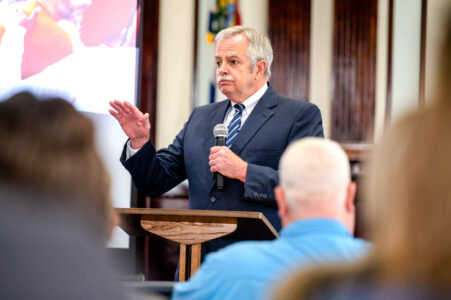
Delegate David Kelly said Gov. Jim Justice and lawmakers need to return to Charleston and address the correctional officer vacancy crisis. (Photo courtesy of WV Legislative Photography)
CHARLESTON — With vacancies of officers and staff at West Virginia’s correctional facilities and regional jails remaining at an all-time high, Delegate David Kelly said Gov. Jim Justice and lawmakers need a special session to fix the issue. Kelly, R-Tyler, is chairman of the House Jails and Prisons Committee. In a Facebook post Thursday, Kelly criticized lawmakers for ending the 2023 legislative session March 11 with no bills to recruit or retain correctional officers and staff. “We have to do something. We cannot keep ignoring the problem and think it’s going to change,” Kelly said. “We cannot pretend it doesn’t exist. The numbers don’t lie.” According to the Division of Corrections and Rehabilitation, the overall vacancy rate for the division is 1,037, with 28% of positions unfilled as of March 31. That’s up slightly from 27% around March 9. The correctional officer vacancy rate alone is 748. The 33% vacancy rate for officers has remained static from earlier in March. More than 10,100 inmates are in the state’s correctional system, spread out in 11 prisons, 10 regional jails, 10 juvenile centers and three work-release sites. Justice has declared a state of emergency twice over the past six years for the prisons and regional jails due to severe staffing shortages, including in August 2022. The West Virginia National Guard was ordered to assist with staffing needs until this August. Since last August, the vacancy rates have only increased. The state of emergency beacon on top of the Capitol remains lit. “The light above the Capitol dome remains on today to remind us that we are in a state of emergency for one reason: We have failed to come through for the brave men and women in our jails and prisons,” Kelly said. “They are being forced to work 60, 70, or 80 hours a week because we failed them. Is this the message we really want to send? Can we hold our heads high and take a victory lap knowing that we have done nothing to stop this madness?” Several bills were recommended for passage by Kelly’s House Jails and Prisons Committee. But none of the bills were taken up by other committees or considered by the full House of Delegates. House Bill 2879 would have given corrections employees with three years of service a $6,000 bonus beginning July 1. New jail and corrections employees hired on or after July 1 would have received a $3,000 sign-on bonus, as well as a $3,000 bonus once they accumulate three years of service. House Bill 2895 would have granted a cost-of-living stipend to correctional officers employed by the Division of Corrections and Rehabilitation of up to $10,000 per year at the discretion of the commissioner. “We looked at measures that would address recruitment and retention as well as attempting to deal with the need to address higher costs of living in certain areas of the state. Nothing happened during the session,” Kelly said. “We left the Capitol at the end of 60 days and did nothing to provide relief. “It is unconscionable that we as a state would place such a low level of importance on the men and women that are charged with protecting us from the worst of our society,” Kelly continued. “Our failure to come through for them in their time of greatest need can leave little doubt in their minds as to what the government thinks of them.” Justice has been a vocal supporter of locality pay for correctional officers, increasing pay in areas of the state seeing the highest vacancy rates. The Senate Government Organization Committee recommended Senate Bill 464 for passage during the session, authorizing locality pay to correctional officers working at facilities having critical staffing shortages, but that bill also didn’t make it to the Senate floor. Justice has said he is willing to call a special session on correctional officer pay, but is waiting to hear from legislative leaders as to whether there is consensus around a bill or multiple bills to address the issue. “I challenge the governor and both houses of the Legislature to begin the work of coming to the aid of these heroes,” Kelly said. “Let’s roll up our sleeves and work together to fix the problem and turn the light off.” Steven Allen Adams can be reached at sadams@newsandsentinel.com.Local News
The Buck Stops Here: Judge Sweeney defends public advocacy for abused children against ethics charges

Picture This: Wood County Commissioners view Parkersburg High School planetarium

Teen of the Week: Frontier graduate Avery Powell seeks outdoorsy career in environmental engineering

Former WVUP teacher set to keep 250th party promise

Red, White & Bruised wrestling rings in start to Freedom Festival