
Trump vows action after shootings, offers few details
Ball in U.S. Senate’s court; House-passed bills await action
Trending
CHARLESTON -- President Donald Trump on Monday laid out broad ideas for curbing mass shootings such as what happened over the weekend, but the U.S. Senate is already sitting on two bills sent by the House of Representatives to tighten background checks.
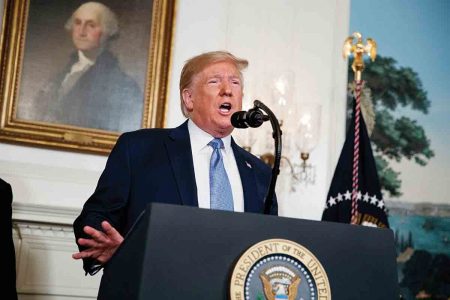
Trump, during a public address Monday morning at the White House, called mass shootings in Texas and Ohio Saturday and Sunday "evil" and the deaths of 30 people at both a "crime against all humanity."
"We are outraged and sickened by this monstrous evil, the cruelty, the hatred, the malice, the bloodshed, and the terror," Trump said with Vice President Mike Pence by his side. "Our hearts are shattered for every family whose parents, children, husbands and wives were ripped from their arms and their lives. America weeps for the fallen."
The president called for updates to mental health laws to more quickly identify people who need treatment and allow law enforcement to indefinitely hold them if necessary. He called for updated hate crime statutes to include the death penalty for hate crimes that result in mass shootings. Trump also directed the Department of Justice and the FBI to take steps to curtail domestic terrorism.
"In one voice, our nation must condemn racism, bigotry and white supremacy," Trump said. "These sinister ideologies must be defeated. Hate has no place in America. Hatred warps the mind, ravages the heart, and devours the soul. We have asked the FBI to identify all further resources they need to investigate and disrupt hate crimes and domestic terrorism – whatever they need."
While offering no specifics, Trump directed federal law enforcement agencies to work with local law enforcement and social media companies to develop tools to detect mass shooters before they go of on rampages. He also placed blame for mass shootings at the feet of video games and other media that glorifies violence.
Trump also offered only one idea for improved background checks, calling for a national red flag law, whereby law enforcement can petition to have firearms removed from a person who may pose a risk to themselves or the public.
"We must make sure that those judged to pose a grave risk to public safety do not have access to firearms, and that, if they do, those firearms can be taken through rapid due process," Trump said. "That is why I have called for red flag laws."
In a statement, U.S. Sen. Shelley Moore Capito, R-W.Va., decried the mass shootings in El Paso and Dayton.
"The details coming from Texas and Ohio have been horrifying and heartbreaking," Capito said. "There is absolutely no place in America-or anywhere-for this kind of hate, bigotry, and racism. Charlie and I are continuing to pray for comfort for all the families affected."
Capito did not address specifically the comments by Trump Monday morning, but broadly agreed that changes to the nation's mental health system and efforts to identify shooters before they strike were needed.
"There are steps we can take to address this kind of violence, and it's important that we seriously address these issues--particularly regarding reforms to improve our mental health system, identify threats, and help make our communities safer," Capito said.
U.S. Sen. Joe Manchin, D-W.Va., released a joint statement with U.S. Sen. Pat Toomey, R-Pa. The two said they spoke with Trump Monday morning about bipartisan efforts to strengthen background checks.
"This morning, we both separately discussed with President Trump our support for passing our bipartisan legislation to strengthen background checks to keep guns out of the hands of criminals, the dangerously mentally ill, and terrorists while respecting the Second Amendment rights of law-abiding gun owners and all Americans," Manchin and Toomey said. "The president showed a willingness to work with us on the issue of strengthening background checks."
In 2013, Manchin and Toomey co-sponsored an amendment that would have required background checks for all gun purchases with certain exemptions. It would have required background checks at gun shows and for all sales over the internet. Manchin and Toomey were unable to gather enough support in the senate. Another attempt to revive the amendment in 2015 failed.
"Mass shootings and violent gun crimes are tragic American problems," Manchin and Toomey said. "It is past time for Congress to take action and the Manchin-Toomey background check legislation represents an opportunity to make actual bipartisan progress to help keep Americans safe."
There are already two background check bills awaiting passage in the U.S. Senate. In February, the U.S. House of Representatives passed a bill very similar to the Manchin-Toomey amendment of 2013.
House Resolution 8 would require universal background checks for all gun purchases. While gifts of guns to family members and select transfers would be exempt, all other gun transactions would require a background check --something that currently done by licensed gun dealers.
Another bill passed by the house in February, HR 1112, would require firearms dealers to wait at least 10 days for the national background check system before moving ahead with a gun sale. The law currently allows for a minimum of three days.
Both bills passed 240-190. Senate Minority Leader Chuck Schumer, D-N.Y., called on Senate Majority Leader Mitch McConnell to call the senate back from recess for an emergency session to take up the bills and other legislation.
"Stop blocking gun safety reforms that more than 90 percent of Americans have long sought passed," Schumer said. "The Majority Leader should, once-and-for-all, do the right thing and gavel the Senate into an emergency session so we can take immediate action on the bipartisan, already-passed gun safety legislation the House sent to the Senate in February,"