
Men discuss cardiac care at Senior Health Expo
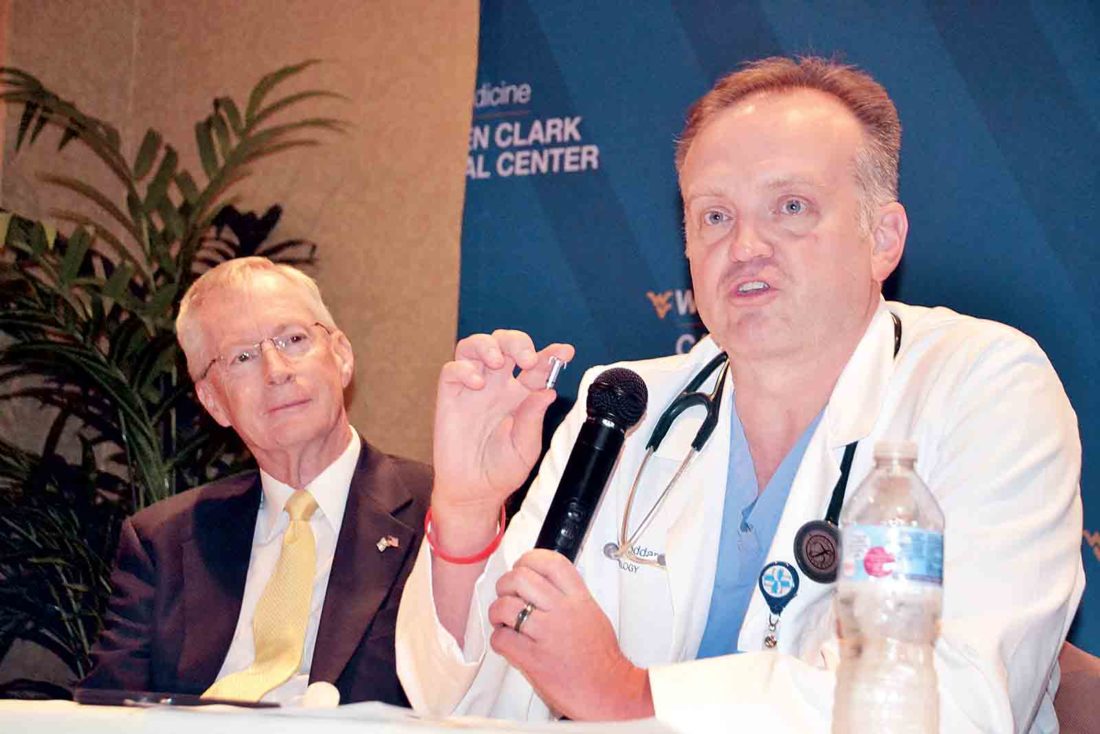
Heart patient Tom McCullough of Ritchie County listens to interventional cardiologist Dr. Chip Goddard describe a new kind of pacemaker that can be inserted into a heart through a small incision in the groin for certain patients, during a roundtable discussion hosted by Parkersburg Cardiology Associates Tuesday during the Senior Health Expo at Grand Pointe Conference Center in Vienna. (Photo by Brett Dunlap)
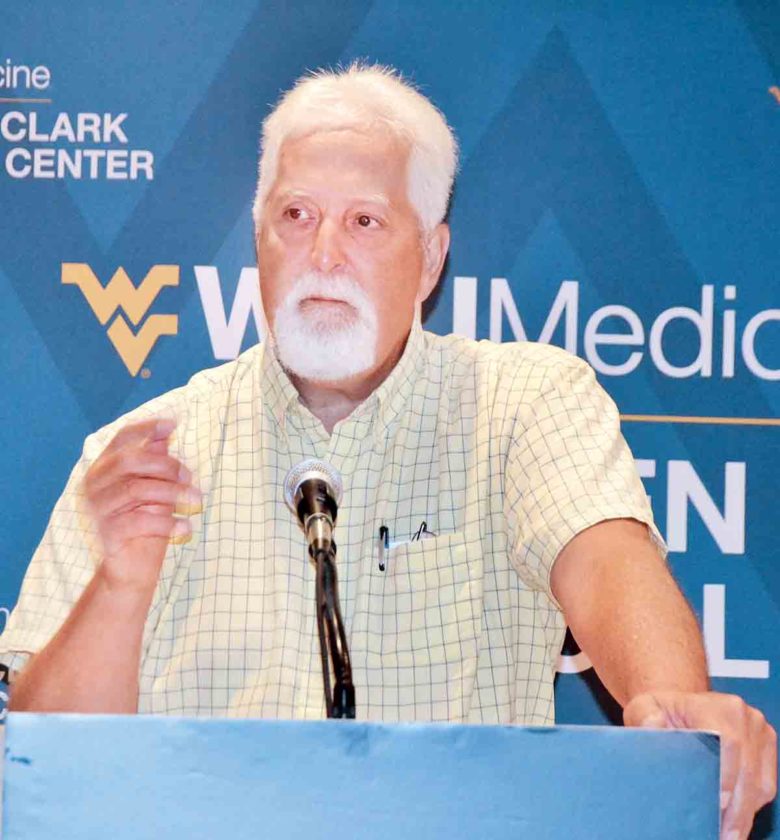
Heart patient Tom Yencha of Parkersburg shares his experience of being a heart patient during a roundtable discussion hosted by Parkersburg Cardiology Associates Tuesday during the Senior Health Expo at Grand Pointe Conference Center in Vienna. (Photo by Brett Dunlap)
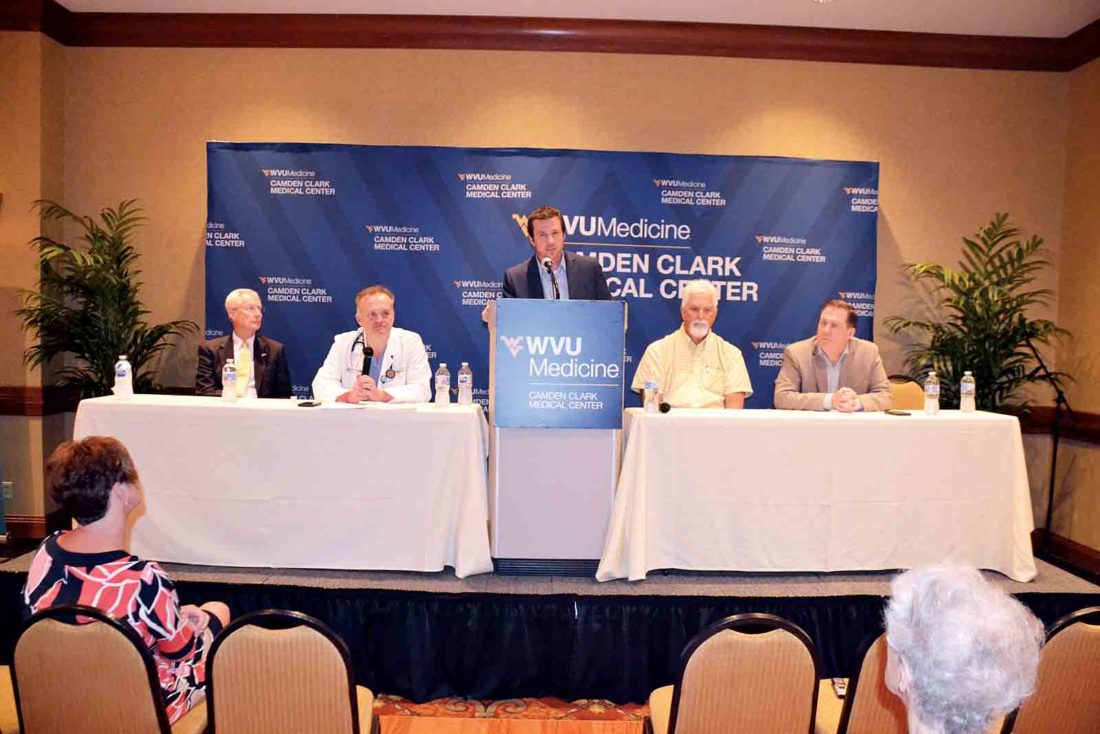
A roundtable discussion hosted by Parkersburg Cardiology Associates was held Tuesday during the Senior Health Expo at Grand Pointe Conference Center in Vienna. From left are heart patient Tom McCullough, interventional cardiologist Dr. Chip Goddard, Parkersburg Cardiology Associates CEO John Vickers, heart patient Tom Yencha and invasive cardiologist Dr. David Gnegy. Interventional cardiologist Dr. Chris Miller joined the discussion a short time later. (Photo by Brett Dunlap)
Heart patient Tom McCullough of Ritchie County listens to interventional cardiologist Dr. Chip Goddard describe a new kind of pacemaker that can be inserted into a heart through a small incision in the groin for certain patients, during a roundtable discussion hosted by Parkersburg Cardiology Associates Tuesday during the Senior Health Expo at Grand Pointe Conference Center in Vienna. (Photo by Brett Dunlap)
Heart patient Tom Yencha of Parkersburg shares his experience of being a heart patient during a roundtable discussion hosted by Parkersburg Cardiology Associates Tuesday during the Senior Health Expo at Grand Pointe Conference Center in Vienna. (Photo by Brett Dunlap)
A roundtable discussion hosted by Parkersburg Cardiology Associates was held Tuesday during the Senior Health Expo at Grand Pointe Conference Center in Vienna. From left are heart patient Tom McCullough, interventional cardiologist Dr. Chip Goddard, Parkersburg Cardiology Associates CEO John Vickers, heart patient Tom Yencha and invasive cardiologist Dr. David Gnegy. Interventional cardiologist Dr. Chris Miller joined the discussion a short time later. (Photo by Brett Dunlap)
Trending
VIENNA -- A feeling of indestructibility is how two men described how they always felt before having to be treated for serious heart problems.
Tom McCullough of Ritchie County and Tom Yencha of Parkersburg talked about how they never thought they would ever have to be treated for heart conditions, dismissing the warning signs for something else less serious.
Both men were part of a roundtable discussion hosted by Parkersburg Cardiology Associates Tuesday during the Senior Health Expo at Grand Pointe Conference Center in Vienna.
McCullough said on a trip with his wife, Diane, to Florida a short time ago he felt a slight burning sensation in his chest during a walk. He dismissed it as something he ate. However, it persisted.
''I'm bulletproof,'' he said of his mindset at the time. ''I have never had health problems. I have never taken any 'pills.'''
However, the burning persisted.
He knew enough about the signs of heart trouble, but what he was feeling did not line up with what he knew.
''This was an atypical symptom that gave no indication that I was having a problem with my heart,'' McCullough said.
He knew something wasn't right and went to the hospital.
''I needed something more than just a stent,'' he said of having to have an open-heart procedure.
''I told the physicians, 'Do whatever needs to be done,''' he said. '''I am placing my life in your hands.'
''I looked at the surgeon and told him, 'You do the best you can do and I will do the best I can.'''
McCullough said he was treated like a person at Camden Clark Medical Center, not just a number, during his entire time there.
''They gave me the attention, care, love and confidence I needed,'' he said. ''I cannot thank the hospital enough. A simple 'thank you' is all I can offer, but it is from the heart.''
Yencha told people to listen to their bodies.
He has been active, involved in sports, especially tennis and pickleball.
A year ago, he was playing pickleball when he had a "dead feeling" in his left arm that made him feel sick. He had rotator cuff surgery so he thought it was something related to that. He had an EKG that didn't show anything.
On McCullough's comment of believing he was "bulletproof," Yencha said he felt the same way.
Six months later, he was playing pickleball again and finished up three hours of play. On the drive home, he passed out. He somehow made it into a parking lot and stopped, running into a pole.
People responded to help him and an off-duty paramedic stopped and began CPR on him.
Yencha coded three times and they had to use the electric paddles to get his heart going again.
The emergency responders got him to the point where the doctors could help him, Yencha said of discussions with his doctor, interventional cardiologist Dr. Chris Miller.
Once at the hospital, they took good care of him, Yencha said.
While Yencha was walking into Grand Pointe on Tuesday, a woman he had never met walked up to him and gave him a big hug and began weeping.
''She was the emergency room nurse that day and she recognized me,'' he said. ''We are talking 7-8 months later and she has probably had hundreds of patents come through that hospital since. Just the outpouring of that emotion shows how much they care.''
Since then he has dropped 40 pounds and is playing pickleball again.
Yencha told people to pay attention to what their bodies are telling them.
''If you are thinking of ignoring it, think of your family,'' he said. ''It was a tough day that day, not for me because I passed out and woke up three days later. I know it was a tough time for my wife and kids. I can't imagine the phone call they got and anyone wanting to put their family through that situation.''
His wife was told he was in an accident and he has no pulse.
''I can't imagine what they went through,'' Yencha said.
The roundtable discussion also featured interventional cardiologist Dr. Chip Goddard, invasive cardiologist Dr. David Gnegy and Miller, who talked about Yencha's case. Parkersburg Cardiology Associates CEO John Vickers acted as the moderator.
With Camden Clark being part of the WVU Medicine system of hospitals statewide, local patients have access to the best doctors and heart procedures which allow patients to stay in West Virginia for treatment, Gnegy said.
''It is always good when people can stay in their home state to get advanced care that they can get anywhere else in this country,'' he said. ''Anytime you have that level of commitment by physicians in your state it improves care for the whole state.''
Goddard explained new procedures available locally, including a new kind of pacemaker that is extremely small and can be inserted directly into the heart through the groin so a patient's chest does not have to be opened up. There are procedures to put catheters through the leg which can administer small doses of blood clot buster medication directly to the clot. It uses vibrations as opposed to giving large doses to the patients which might cause other problems.
''I have seen some drastic improvements in some really sick patients,'' Goddard said of some of the new procedures Camden Clark is using.
Parkersburg Cardiology Associates, which is housed at St. Joseph Landing, is building a facility on the campus of Camden Clark Medical Center. Vickers said the expected move-in date is late 2018 or early 2019.
''It is going to give us the ability to grow tremendously,'' Vickers said. ''We are going to try and consolidate almost everything, cardiac-wise, into one facility (with the cath lab remaining in the hospital).''
They have 50 employees, seven cardiologists and four nurse practitioners.
''Among our cardiologists, we have a total 109 years of experience with the physicians alone,'' Vickers said. ''We have a really good group to take care of people.''