
Survivor of Big Bottom Massacre remembered
BELPRE – A surviving captive of the 1791 Big Bottom Massacre will soon be immortalized thanks to the efforts of a former Belpre resident and in cooperation with the Belpre Historical Society.
James Patten, along with four other men, was taken captive by Delaware and Wyandot Indians when the settlement at Big Bottom was attacked on Jan. 2, 1791.
Patten spent four years in captivity until being released in a trade.
In August 1794, General Anthony Wayne ordered construction of Fort Defiance and on Jan. 29, 1795 an Indian peace envoy went to the fort. The envoy included Patten and other captives. Patten, who was born in 1753 in Bedford, New Hampshire, was released as part of an exchange for Indian prisoners.
His fate came as a surprise to his New England family and Ohio Company leaders in Marietta who had originally given him a deed for property at Big Bottom. After Congress ordered a bailout of the Ohio Co. they set aside 100,000 acres to bring settlers to the Muskingum Valley, but because Patten was presumed dead, the company had given away his land.
Patten was the only one of the captives to return to the Belpre area, according to research by Richard Walker.
Walker, formerly of Stockport and Belpre, is retired and lives in Springfield, Illinois. He has been on Patten’s trail for some time and has provided the fruits of his research to the Belpre Historical Society.
“We are planning a dedication of a marker for James Patten in Cedarville Cemetery; he is the only captive from the massacre that returned to the Belpre area, but there is no record of his burial here. If he was buried here it would have been at Cedarville so that’s why that location was chosen,” said Charlotte Powell, with the historical society. Patten died Jan. 31, 1827 in Belpre.
For Walker, tracking down Patten and his story was an effort well worth the time.
“I was born and reared in Stockport. Big Bottom is just a mile from there, so those are my roots. I graduated from Belpre High School, so I have a foot both in Morgan and Washington counties. I’ve always been interested in the history of the area. I’ve published many books and articles on the local history,” Walker said.
The Indians attacked Big Bottom in retaliation for the loss of their land, according to Walker’s research.
The Indians were fighting for their culture, rights, hunting grounds, livelihoods, families, children’s futures, and one another and against an army of invaders, according to Walker’s research.
In 1793, George Washington would say that an error was made in denying the Indians land in the Northwest Territory.
“The Indians owned all the soil in the Northwest Territory and could continue to own it as long as they desired.”
Ohio Company officials, in 1791, four days after the attack said “several chiefs among the tribes who had a treaty with Gov. St. Clair were not present and never consented to what was done” relating to the purchase of the lands.
The four other men taken captive by the Indians at Big Bottom were Thomas Shaw, Philemon “Philip” Stacy, and brothers Francis and Isaac Choate Jr.
The youngest died a few months in captivity; one was a woodchopper, hired into Niagara; the two brothers went back to their home in Massachusetts and worked in the family business, Powell said.
According to Walker’s research, on the night of Jan. 2, 1791, a war party of about two dozen Wyandot and Delaware warriors crossed the Muskingum and attacked the settlement at Big Bottom. The outpost was “undermanned, unguarded, unfinished,” according to research. Twelve were killed, including one woman and two children. Five men were taken captive, cabins were plundered and the blockhouse set on fire.
“Several ransom attempts were made to get James Patten back, but they failed. Everybody lost track of him. After Gen. Anthony Wayne at Fallen Timbers, he shows up, when they bring in the white captives. His dad had died while he was in captivity and everyone thought he was dead. The Ohio Company gave away his land,” Walker said.
Walker’s research shows Patten returned to the Belpre/Marietta area. Letters written by him were preserved. In March 1797 the Ohio Company granted Patten, who was then 42, and a Revolutionary War veteran, 100 acres of land.
“But most of his remaining years were spent subsistence farming near Belpre. He never married,” according to Walker’s research. “I just felt he deserved recognition,” Walker said.
Sammye Jonas, of Little Hocking, said Walker is a longtime friend and has provided marker stones for others who have been left in the dust of history.
“He’s all about the little guy and giving them recognition,” she said.
“There’s not a large volume of materials, but there are some letters,” Walker said of his research on Patten.
“He mentions at the time of the attack he was in a cabin with the others were eating supper. They were taken captive before the others were attacked. They were taken across the Muskingum River and held while the warriors came back and attacked the block house where the rest of the settlers were – so they were really out of harm’s way at the time of the attack,” Walker said.
After being taken prisoner, Patten, at the age of 37, was adopted into an Indian family and labored as a slave, hoeing corn and chopping world.
Based on information from one of the captives that was released, Patten’s father tried to ransom his son. He ran advertisements asking for help and after raising nearly all the money, it was given in trust to someone who was to deliver it to the Indians but that did not happen, nor did the individual return the money.
The historical society said a date and time for the public dedication ceremony at Cedarville Cemetery will be announced once the stone and site have been prepared.
Local News

Trump says Pam Bondi, a loyalist who oversaw Justice Department upheaval, is out as attorney general

Rotating exhibit space aims to boost learning at Discovery World

No Joke: Personal income tax collections down in March but W.Va. revenues remain in black
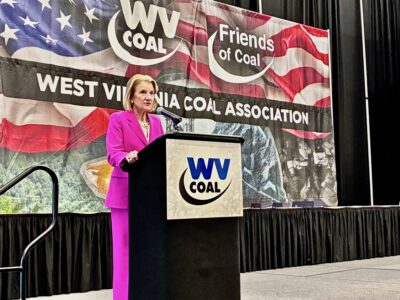
Capito speaks at final day of W.Va. Coal Association Mining Symposium
Multiple fire departments respond to two fires Tuesday
PARKERSBURG – Multiple local fire departments responded to a brush fire and structure fire Tuesday evening. The ...
Parkersburg mayor offers way for petitioners to remove signatures
PARKERSBURG – As a committee seeking to repeal or place on the ballot an ordinance authorizing a trash service ...