
Mountaineer Pride: Keeping Cook healthy key for West Virginia
Trending
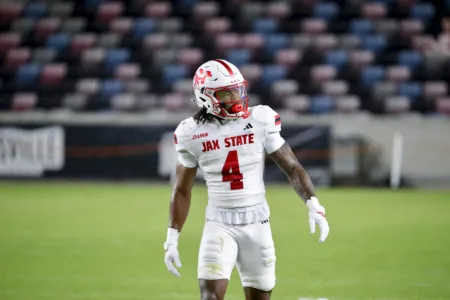
Rich Rodriguez's biggest offseason move this fall for West Virginia was adding Jacksonville State running back Cam Cook. But that's not how to address him. He's last year's nation-leading rusher Cam Cook. Cook carried the ball for 1,659 yards, leading the FBS.
Cook knows that's how he's known around campus and in college football.
"That's something that I've really appreciated," Cook said to 3 Guys Before the Game. "I worked hard to do that. I'm glad to get the recognition."
Cook was on Rodriguez's radar ever since he entered the transfer portal. Rodriguez was the coach at Jacksonville State the years before Cook arrived from TCU, and Rodriguez still watched games from time to time.
After watching the tape, Rodriguez knew he had to have him, especially in his run-heavy offense.
"He was a target," Rodriguez said. "Cam Cook was the first guy, and fortunately we got him. He played in a similar system at Jax State last year. Has played in the Big 12 before. He’s a complete player. He can run, obviously. He’s a great pass protector, a smart guy. Got great ball skills. So he’s kind of the bell cow in that room, and I'm really pleased. He had an outstanding spring."
Rodriguez said multiple times Cook is the alpha in the room. He'll be the workhorse back, with occasional breaks as true freshman Amari Latimer and other backs get reps. Cook was brought in to improve the rushing attack that had its ups and downs last year.
The only problem is whether or not Cook can stay on the field. He carried the ball 295 times -- the third most in the FBS -- and he should carry it even more in Rodriguez's offense. The Mountaineers, even being down double digits for most of the season, ran the ball the fifth most in the Big 12, behind teams that put up a lot of points and had better offensive lines.
"I definitely felt the carries," Cook said.
Keeping Cook on the field is going to be essential, and that's where WVU strength and conditioning coaches Mike Joseph and Parker Whiteman come into play.
The two started preparing Cook for a big workload in January when he first stepped on campus. Cook came in around 190 pounds, according to Joseph, and before the season started, they'd like him to be around 200 pounds before the first game, where he is now.
"Cam keeps himself in great shape all year round," Whiteman said. "He is very professional in his approach and very mature, knowing what he needs to do to play at this level."
The biggest part of his offseason training was getting conditioned to play in a tempo offense and not be tired, so he can get the ball as much as possible.
During the offseason, Cook would do conditioning with the rest of the team, and then, four times a week, he'll do football-related conditioning, meaning training specific to him, according to Joseph. The workload started at a lower level early on and was slowly ramped up. Now, Cook trains at 90% twice a week to prevent injury, while still getting work in.
When WVU is in the weight room, they're doing conditioning, too. It's similar to Rodriguez's practices, where there's no standing around, so at all times everyone is always doing something.
"Very minimal time to stand around and rest," Whiteman said. "There is a constant stimulus of work for a certain amount of time and the body adapts and you only know that way to work. The hope is that he is running that same level of intensity and output during the game as in practice to achieve his goals and be successful."
Along with the strength and conditioning, Cook also does speed training to raise his top speed. He does what's called overspeed training, which is having an athlete do assisted running, usually on a machine.
Before coming to WVU, Cook had never done a type of training like this before.
"Adding overspeed training is allowing athletes to touch higher speeds that maybe they don't normally do and make sure their body is able to adapt to the physical demands of the higher speed," Joseph said. "So in a game, they’re more comfortable and more explosive touching that higher rate speed."
Through all this offseason work, Cook said this is the heaviest and fastest he's ever been in his career. Cook is running at 22.6 miles per hour, a 4.46 40-yard dash and a 3.98 5-10-5 (an agility drill). The fastest NFL player, running back Jonathan Taylor, clocked 22.38 miles per hour last year, and Cook's 40-yard dash would've been the sixth-fastest time among running backs.
Recovering is a big part of keeping Cook on the field, too. At Jacksonville State, Cook said he'd be back to feeling 100% by Tuesday after a Saturday game. Tuesday is the goal once again at WVU, but it might be even sooner. The Mountaineers lift on Sunday, the day after the game, which regulates blood flow to help the players feel even better sooner. The schedule might change slightly based on travel and if it's a Friday game like against Utah to close out the season.
"It's a process," Joseph said. "It's a long year in terms of the season. Once we start camp and go to January when we end the season, the goal is that it’s kind of mundane and boring, but we do the same process weekly to make sure they are in a good place on Tuesday."
It's a whole lot that goes into keeping Cook on the field, and Whiteman and Joseph have their work cut out for them still as the season goes on. It's a long season, and both coaches prepare with the intent of playing into January.
It's still up to the player to eat right, recover properly and put the work in to make sure they’re in top shape during the season. Cook's done everything that's been asked and more, setting up for another big year.
"I think he's improved dramatically in terms of his overall conditioning," Joseph said. "He's hungry to work, hungry to show up every day and take care of his body, and is very competitive in the weight room."