Rich Rod has new approach to spring practice
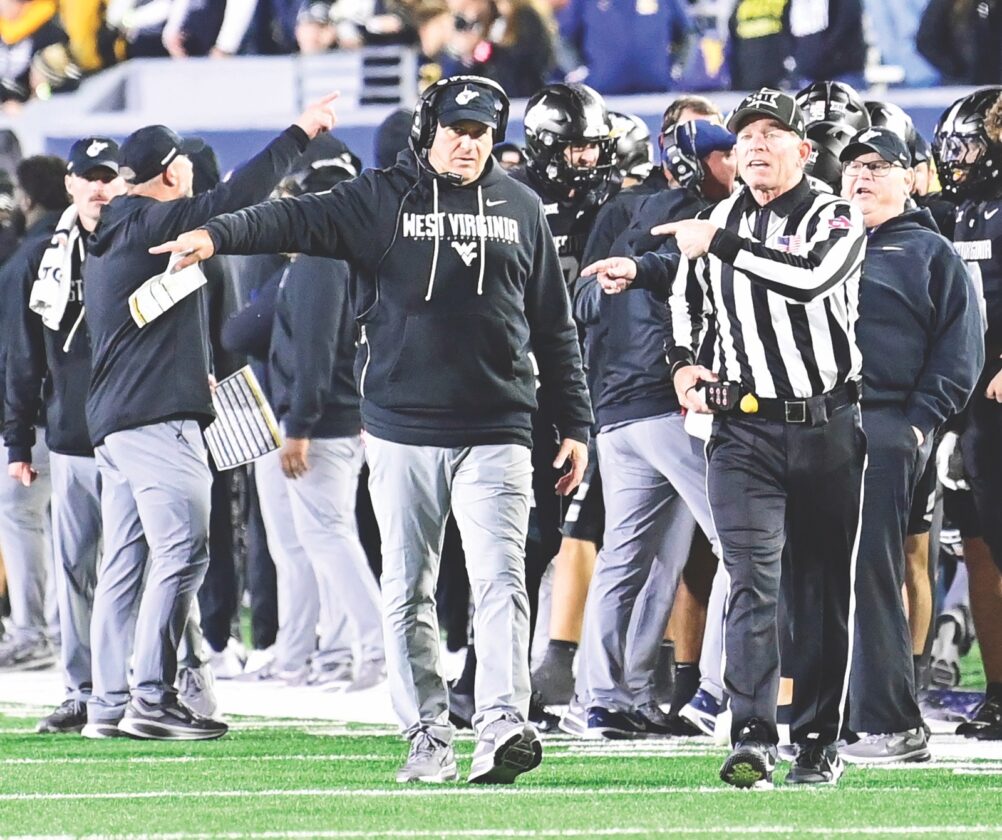
West Virginia football coach Rich Rodriguez talks to an official during a game last season. (Photo by David Pennock)
MORGANTOWN — Last year, West Virginia football’s Rich Rodriguez had to keep a lot of cards close to his chest. Rodriguez couldn’t release a depth chart or say one player was starting over another because there was a second portal period in the middle of April. If Rodriguez revealed too much, players would leave, or other schools would poach his players.
It was Rodriguez’s biggest gripe with spring ball. He could coach a player all winter and spring, just for the player to transfer and play for another team.
That’s not the case anymore because there isn’t a spring portal, just the one that’s already past in January. Rodriguez can approach this spring differently because the 100-plus players who have signed letters of intent or enrolled are what he’ll have for the summer.
Unlike last year, when the depth chart came out in the middle of the summer, Rodriguez will have a depth chart by the end of the spring.
“We’re a long way from finding out who the guys are going to be, and that’s okay,” Rodriguez said. “Usually tell you, listen, I ain’t got to know until end of August. No, I gotta know at the end of spring. Not that we can fix it. It’s not like we can. Can’t go in the portal now, right? You get in trouble.”
The depth chart will be fluid. Players can move up and down it throughout the spring and summer. It won’t be set in stone.
To develop the depth chart and figure out what he has, Rodriguez is having a draft. On April 7, Rodriguez is going to split the roster in half and have a game. The unofficial gold and blue game. It won’t be open to fans and will be at practice.
“I’m trying to have our first game with our guys, ain’t our first game,” Rodriguez said. “We don’t have any preseason scrimmage games against somebody else. We can’t really compare what we have to somebody else until we play them. I usually wasn’t worried about it until now. We got to find out now some semblance of a depth chart… Having a true game, and a draft, and the competitiveness of that, I think, is going to accelerate that process.”
This is all dependent on another team not tampering with his players, meaning a player unenrolls and heads somewhere else.
There are multiple initiatives to stop tampering. There is the SCORE Act that will set regulations regarding NIL, transfers and recruiting, along with student-athletes’ rights, and there’s also the College Sports Commission’s proposed agreement that came back in the fall.
Rodriguez said the CSC’s proposal is out of the question because it puts restrictions on teams’ NIL spending, so the richer schools won’t sign it because that’ll hinder them. It’s like the MLB’s issue. Why would the Los Angeles Dodgers sign a document to put a cap on how much they spend on their roster to win championships if they have the money?
Rodriguez thinks that no matter what the document is, the only way to eliminate tampering is to focus everything on eligibility.
“You break the rules, you can’t play,” Rodriguez said. “Forfeit, can’t play, whatever. That’s the only thing they can hold on to.”
The SCORE Act is stalled in the U.S. House of Representatives. President Donald Trump led a roundtable with multiple college football representatives, including Big 12 commissioner Brett Yormark, and West Virginia’s own Nick Saban. Yorkmark said he thought progress was being made, but it might be a long time until action is taken. Even if the Act is passed, it won’t fix everything.
Rodriguez is happy with the current changes regarding the portal, allowing him to approach the spring differently, but knows there is a long way to go.
“It’ll get fixed eventually,” Rodriguez said. “Everybody’s got a frustration with it. But I’m not, coaches sit back there and are frustrated and are like, ‘Well, heck with today, I’m going to go play pickleball.’ What’s the rules? The rules are the rules. Let’s do as well as we can within the rules to try and win a championship.”
Local Sports

3 Big Reds, South’s Logston make 1st team all-state
Rich Rod has new approach to spring practice

Mid-Ohio Valley Sports Announcement
Greenbrier East’s Stewart captains triple-A all-state team

Coming off state title, Chris Murray to lead PHS seniors in annual BACF All-Star Classic