
Expect WVU to be Battle-tested
Trending
MORGANTOWN -- When the University of Massachusetts takes the floor in Saturday's Basketball Hall of Fame Classic against West Virginia, the Minutemen better be ready for Battle.
Battle, RaeQuan Battle, that is, to steal the line that screamed out to moviegoers around the world that "Bond, James Bond" was no ordinary spy.
It turns out that U.S. District Judge John Preston Bailey of northern West Virginia was no Dr. No as he said yes and granted a 14-day temporary restraining order Wednesday that will allow all college athletes who were denied a chance to compete after transferring under a second-time without graduating.
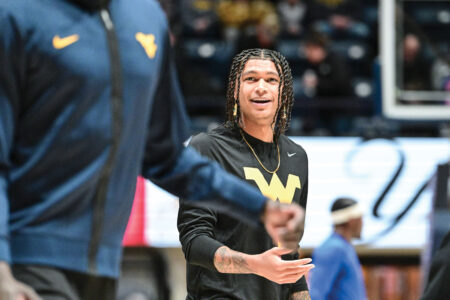
Battle, a key to the fortunes of West Virginia's 2023-24 basketball team, falls into that group of athletes, and may play on Saturday although no decision on his availability for the game has been made.
The WVU athletic department put out a response in late afternoon but it was carefully worded and did not address the availability of Battle. It was attributed only to the athletic department.
"We are aware of the ruling today handed down by Judge John P. Bailey of the United States District Court for Northern West Virginia. We are consulting with WVU's General Counsel along with outside counsel prior to making a determination on the eligibility status of any of our student-athletes. We will discuss this with our student-athletes to make the best decision possible taking into consideration the potential consequences of our decision."
Bailey set a hearing on the temporary restraining order on Dec. 27. There was no immediate indication the NCAA would appeal the ruling.
Battle did testify during the hearing that was held in Wheeling.
"I'm in the gym every single day with the team, with the blood, sweat and tears with them," Battle told the court Wednesday, according to Associated Press reports. "When the ball is thrown up and that tipoff starts, I'm not suited up. That's what hurts me the most."
The NCAA rules in this new age of college sport that grew out of a court ruling on a case filed by former WVU running back Shawne Alston to allow athletes to benefit financially from their name, image and likeness (NIL) and grew into the creation of transfer portal after the COVID -19 pandemic played havoc with eligibility rules became a maze which players, attorneys, school executives and the NCAA have been weaving their way through.
As it stands now, the NCAA allows an undergraduate athlete to transfer once from a school without sitting out a year. A second transfer, unless that athlete has a degree or fits certain exceptions, requires the player to sit out a season.
Attorney generals from seven states, including West Virginia's AG Patrick Morrisey filed a lawsuit seeking a restraining order charging the NCAA of violating federal antitrust laws. The other six states involved were Colorado, Illinois, New York, North Carolina, Ohio and Tennessee.
Morrisey put out a statement saying that the ruling "paves the way for student athletes like RaeQuan Battle to play in the sport they love and continue improving themselves. We are looking forward to proving definitively that the NCAA has violated the Sherman Act by bailing to maintain a consistent and defensible transfer rule and by denying these student-athletes the chance to play."
Battle's case stood front and center. He transferred to WVU after his coach left Montana State. He played there two years after having played two years at Washington.
Upon transferring, a waiver of the rule was requested despite the coaching change, and an appeal of that decision was filed on grounds of it was damaging to his mental well-being, which was a legitimate exception and large concern on the part of WVU and Battle.
Battle went public with his unique situation, being one of the few Native American athletes playing college basketball, having grown up on a reservation and having had tragedy invade his life on numerous occasions.
The coach who left Montana State, Danny Sprinkle, had grown extremely close to him.
"I kind of saw [Sprinkle] as, like, a personal therapist," Battle said in a social media video he put out to explain his situation.
"I never wanted to leave Montana State," he said, claiming that it was his departure that forced him to enter the transfer portal.
The video went viral, claiming more that 2.5 million views, one coming from former Duke player and ESPN analyst Jay Bilas, who wrote: "There is no legitimate reason to deny a waiver to [Battle]. None. The NCAA set the conditions for the waiver, Battle met them and it's still denied. For what, NCAA? For what?"
A 6-5 guard, Battle had a spectacular senior season at Montana State when he averaged 17.9 points, which brought WVU into the picture with him after having had coach Bob Huggins leave after a pair of embarrassing incidents that included a homophobic slur on a Cincinnati radio show and a DUI arrest in Pittsburgh.
A number of his players transferred as assistant Josh Eilert was named interim coach and had to rebuild his roster. Battle was a key acquisition.
"It's dragging on him," Eilert said after the second denial. "It's a huge drag on him, and I feel like he's starting to lose that hope. I worry like hell for RaeQuan and his mindset. It's sad. It's really sad, especially considering he was the only Native American to play in the NCAA tournament last year.
"It's just a shame. It's a complete shame when we talk about the wellness of a student-athlete. I don't think at one point they denied the fact that we have a mental-health situation in this regard and the fact that the NCAA denied it twice is a crying shame.
West Virginia is 4-5 at present but has done so without both Battle and point guard Kerr Kriisa, who returns Saturday from a nine-game NCAA suspension for taking improper benefits while playing at Arizona. He will be making his season debut.