
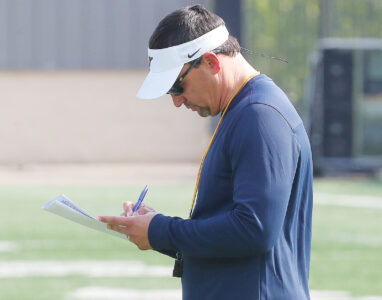
WVU head coach Neal Brown running the offense in pivotal season
Trending
MORGANTOWN -- One would think, in the first week of preseason camp, less than a month away from the season-opener for West Virginia at Penn State, most of the talk would center upon whether Garrett Greene or Nicco Marchiol would line up as starting quarterback or if the receiving corps had been adequately rebuilt or the secondary could improve with an infusion of transfers or if the defensive line could hold up for the first time in Neal Brown's tenure without one of the Stills brothers to anchor it.
Not so.
Instead, much of the focus in tradition and social media has centered upon Brown's decision to regrasp the play-calling duties that he ceded last year to his then offensive coordinator -- but not play caller -- Graham Harrell, replacing him at offensive coordinator with running back coach Chad Scott.
It is understandable why Brown, in a season where his future as Mountaineer coach may rest in the play-calling, would want to see such life-changing decisions in his own hands. He offered up the explanation that play-calling has been his strength, an explanation that many fans disagree with after seeing him in action when he was calling plays for WVU.
"(Not calling plays last year) is not something I necessarily regret because I think it was good for me from a growth standpoint," Brown said. "It was beneficial because it gave me some time to think about, 'Okay, who do we need to be here for us to be successful offensively? What are my weeks and days looking like as a play caller?' For me, it just came back to the most success I've had as a head coach is doing it.
"The reason I have this job is because I was a really good offensive coordinator."
It's one thing to be an offensive coordinator and quite another to head coach/offensive coordinator in big time football. He no more would ask his quarterback to play safety, too, and in a way that's how he has to adjust his approach to each game and his preparation for it.
To be honest, Scott has shown no real desire to call plays, being something of a man of action over sitting with play sheets in the press box calling plays.
"First of all," he said following Thursday's workout, "I got to be down on the football field. I kind of get in a zone."
Indeed, as running back coach, he worked the sidelines, sometimes running down the sideline and beating a running back to the end zone.
Now, his offensive coordinator duties, mixed in with running back coach, will center upon pregame planning.
"Mostly, I'll do in-game adjustments," he said. "I see the running game really well and know how to get guys in position to call the plays we call. It will be more the organization behind the game plan, putting the ideas to the pad so Coach Brown can call the game and be calm, cool and collected."
It could be, too, however, that Scott's approach may not be in sync with Brown's play calling ideas, that idea coming up on Thursday when showed this side of himself when asked about how they ready themself and set up the plays to be used on Thursdays before a game Saturday:
"Everyone is different," Scott said when asked if he likes to plot out the game or likes to rely on analytics. "Everybody game plans differently. You break it down during the week and see how you would make decisions when a situation comes up during the game.
"You got guys that look at cutups of certain games and see how things set up. I'm a little different, I like to look at games and get a feel for how defenses attack and what teams do to hurt them and what to do to stop them, then look at the cutups."
Scott was then asked about how looking at a fictional third and 4 and seeing what the analytics tell him would affect his play call.
"They tell you what the defense figures to do and what is best to do to attack them," Scott said. "You got to make a decision, whether you go with the analytics or go with what you saw on film during the week. Sometimes it's tough. In my mind, I like to take risks. I like to trust the game plan and all you studied during the week. We are talented enough to do that."
Brown is more analytically oriented. He sees advantages in the head coach calling the games.
"You can control the tempo of the game and there's advantages in that," he said. "An example is when we played Oklahoma two years ago, we got beat on a walk off field goal but we really controlled that game.
"They were potent on offense coming into that game but we huddled more, controlled the time of possession and if not for an error there we would have won that game. The offensive play caller has more effect on the tempo of the game than anyone else."
Brown will have a lot of support to lean on, beginning with offensive analyst Randy Wilkins.
"Randy is kind of my point guy on data analytics, so we really make a lot of these decisions Thursdays before the game; when are you going to go for it on fourth down; when are you going for touchdowns or field goals?
"There are always ebbs and flows to the game, but if the head coach is not the play caller, basically what you do is on first or second down at the latest, you let the guy who is calling the play that you plan to go for it on fourth down."
Brown offered up that he felt play calling during the game can be overrated.
"It's more about getting your game plan set early in the week and being able to rep those plays and then having answers within the game," he said. "Answers within the game, a lot of times, come from those guys that aren't necessarily the play caller because as a play caller you're thinking ahead, and in between series, those guys can really help you because they're not necessarily focused on the ball as much. They are focused on other things.
"My trust level in those guys ... we've been through a lot of battles," he continued. "I listen to them. They are not just giving suggestions that are like, 'Hey, try this.' They have really good reasons behind it. When they tell me things, whether it's practice, games or planning purposes, I listen."