
WVU baseball coach Randy Mazey to retire following 2024 season
Trending
MORGANTOWN -- It's a gift, really, this thing that allows a person to be a successful coach.
You have to be a father, a mother, a teacher and a policeman. You must be strong enough to fill a room with your presence, yet soft enough to address another person in times of need.
You are the boss and you are the co-worker. You create an atmosphere where strangers from all parts of the country, each of different backgrounds, abilities, intelligence, and build a team on the field, and a family off of it.
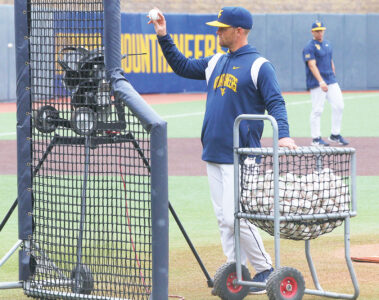
It's a gift Randy Mazey brought with him from TCU to West Virginia 11 years ago to lead the West Virginia baseball team into big-time prominence.
Now, he's ready to give it up … slowly.
On Monday, at age 57, Mazey and WVU announced that a succession plan has been put into place with Mazey coaching one more year -- wouldn't you with JJ Wetherholt coming back for one season? -- before his assistant, Steve Sabins, becomes the new coach.
This, of course, is to keep things on track and moving in the same direction without the difficulties that came about when Gale Catler, Bob Huggins and Rich Rodriguez left their jobs.
Too often, you are judged on wins and losses. That is what you are paid for, but wins and losses are really just numbers. They are, of course, as important as the numbers on anyone's paycheck for they are a measure of your success, but the final goal really isn't creating championships.
There's only one of those a year, depending on the venue.
It's creating solid individuals and strong teams that can compete on a regular basis.
Sports have been broken down into logarithms and analytics, but you find the great ones are the ones who know the numbers in their sport and can teach them, but who also know the men playing the game.
Randy Mazey is one of them. He masters the game, and he masters the psychology of the team concept of building men, not ballplayers.
He was hired at West Virginia to bring it into Big 12 baseball, to lead into a sparkling new ballpark, and to increase its talent level. He was to the sport what Nikki Izzo-Brown was to women's soccer, two-of-a-kind, really.
He was an old-school person in a new-breed profession. No longer did you have to be nicknamed Bear or Woody to coach. Huggins, the now deposed (or not) WVU basketball coach, was one of those who was able to hold on to old-school values and methods while molding himself into a new-wave coach.
Baseball was going nowhere on a conference or national level when Mazey arrived. It had a proud history, but on a much lower level than WVU athletics had reached. It wasn't winning championships, wasn't going to postseason play, and wasn't bringing in talent that could make it into the major leagues.
He changed that by dynamiting the past, including old Hawley Field. The new Mon County Ballpark stood as a shrine to what Mazey was trying to create … a winning team in a winning place with winning fans enjoying an atmosphere that was part yesterday, when baseball was kind, and part tomorrow, where the game is considered more entertainment than competition.
Little was expected at the time. The Mountaineers were picked to finish last in the Big 12, but it turned into a magical season with a 33-26 record, just the fifth 30-win season in 14 years, wound up third in the conference and began building a following that has mushroomed until it exploded this year.
"When we joined the (Big 12) 11 years ago, everybody in our circle said, 'Yeah, football, they'll be fine and Coach Huggins in basketball, he'll be fine. But poor baseball. What's going to happen to the baseball program?' Mazey remembered after this past regular season with WVU tied for the Big 12 Championship.
"And 10 years later, here we are going to three regionals, played in the Big 12 championship twice, and have a trophy in our trophy case now for winning the (regular season) Big 12 championship."
He did it on a personal basis with his players and his coaches, by creating that family atmosphere in which his wife and children could be part of it all.
Even a frightening head injury suffered by his son, Weston, who had grown before our eyes as Mazey's batboy over the years, was turned into a positive.
Mazey left the team for a while, saw him through the early stages where the future was unclear, and turned it into a charity that was adopted by the North Central West Virginia community and that goes on today.
At the same time, when NIL posed a challenge to WVU's athletic future, Mazey's wife, Amanda Ross Mazey, took an active role in the cooperative that is Country Roads Trust, which is the financial lifeline to the school's athletes in this pay-for-play era.
"You love all the kids," Mazey said. "There's not a guy in uniform I wouldn't do anything for, but I don't ever try to like these kids because they're good players. I like them because they are good people.
"So, the last 10 years have been really, really good," Mazey continued. "We've been ranked in the top 25 now in parts of seven consecutive seasons. And for West Virginia, the outlier in the Big 12, with all of our challenges geographically and weather-wise and travel-wise, for us to do what we've done over the past 10 years is literally nothing but a tribute to the coaches that I've had, the culture that we have in our program, the blue-collar mentality we have in our program, the play-with-a-chip-on-your-shoulder mentality. That's how we've done it.
"The 10 years have been really good for us. I think the next 10 years can even be better. We've put ourselves in a position now that if you're a high school baseball player or somebody going to think about playing college baseball somewhere, West Virginia's been in the top 25 for seven straight seasons. Why wouldn't I look at the Mountaineers? We've gotten this program to that point and I'm proud of the people who are responsible for it."