
The Way I See It: When bridges go BOOM, it is a major event
Trending
Once a bridge over a waterway outlives its usefulness, there are just a few ways to get rid of it. You can take it apart piece by piece; you can leave it in place, like a variety of railroad spans in the area; or you can use a bunch of explosives to blow it to smithereens.
I have seen three major bridges in the area brought down with mighty booms.
The first explosion I attended was when the Belpre Bridge was brought down. The bridge was a suspension bridge slightly downstream of the four-lane bridge linking Belpre and Parkersburg today. I was in college and working at The Marietta Times on the weekend. Workers had removed most of the bridge. What was left were the two towers, and the giant cables that had once held the two-lane roadway.
I remember that the detonation was running behind schedule, and it was nearly evening before they blew the bridge up. I recruited a reporter to take a wide-angle photo of the bridge while I focused on one of the two towers. Like all bridge explosions the whole thing was over in seconds. In 1982 we of course still used film, so I wasn't sure what we had until the photos were processed.
The next two explosions were in Marietta, with the first being the removal of the Williamstown Bridge.
The bridge, which started on Second Street and curved twice before it got over the Ohio River, was brought down in sections in 1988. The approach over Ohio was brought down piece by piece. This left the span over the river ready to be blasted. The first section to be removed was the part over the river channel. The plan was for the explosives to cut the section into pieces so that it could be easily removed from the river. The entire river would have to be closed for this short amount of time.
I was a few blocks away when the explosion dropped the span into the river.
As far as breaking it into easy to manage sections, things did not go as planned. The explosives did not cut all the way through the steel and workers struggled for a while to get the pieces out of the water as towboats waited on each side to pass Marietta and Williamstown.
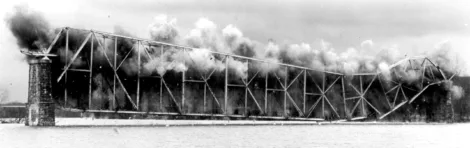
The rest of the bridge was brought down with several follow-up explosions. The most spectacular one being the one that dropped a six-hundred-foot section between Williamstown and the center of the river. The photo on this page is of it hitting the water.
I took it from around Front and Greene streets. The Ohio River under the bridge was fairly shallow, so most of the bridge was above water after it fell. This fact caused a woman standing near to loudly exclaim that it was floating. It wasn't. A few other explosions finished the old bridge off and allowed the new bridge to be constructed in the same location. Two of the piers that supported the old bridge were reused with some of the new ones, including the one in the center of the river built to look like stone even though they are solid concrete. The pier on the Ohio side of the bridge is "vintage," the one in the center and on the West Virginia side of the bridge were constructed in the 1980s. One pier under the bridge approach in Williamstown was also reused from the 1903 bridge.
The last bridge to be removed locally was the Putnam Street Bridge. We had several people photographing it and I chose a spot on Harmar Hill that I thought would be good. It was not. The best shots came from an airborne camera and a photographer that had hitched a ride with the Washington County Sheriff's Department and their helicopter.
Photos from river level also proved to be better than what I got from the top of the hill.
The bridges that now serve the Mid-Ohio Valley are all in good shape and likely still have decades of use. I doubt we will see any of them sharing the fate that the 1903 Williamstown Bridge, the 1913 Putnam Street Bridge, or the 1914 Parkersburg-Belpre Bridge did anytime soon.
Art Smith is online manager of The Parkersburg News and Sentinel. He can be reached at asmith@newsandsentinel.com.