
Look Back: Roosevelt, New Deal and WPA: What did they mean to Wood County?
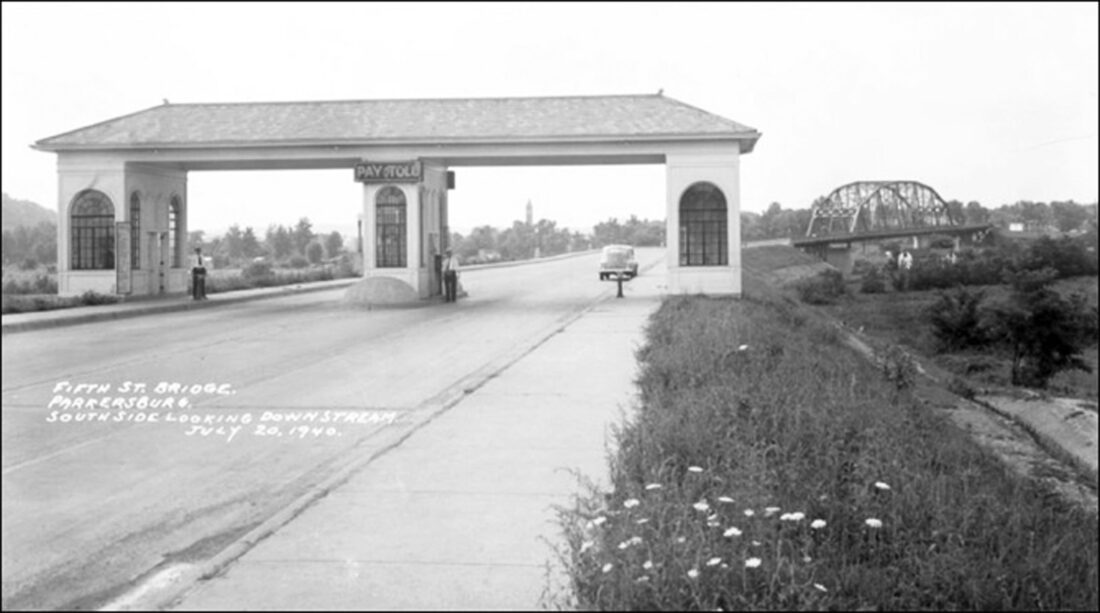
Fifth Street Bridge Toll Booth. This toll bridge across the Little Kanawha River at Parkersburg was opened to traffic May 7, 1937. The view is from the south looking west. (Photo provided by Dan Kemper)
“Public Money Flowing Like Water!”
Sound familiar? This is part of a headline from a Parkersburg newspaper in August of 1934. While this particular headline was for an article about the beginnings of Arthurdale, Eleanor Roosevelt’s pet project near Kingwood, West Virginia, other New Deal and WPA projects used lots of public money in an effort to put the public to work.
West Virginia, Wood County and Parkersburg all shared in the windfalls. Thus far our listing of New Deal projects has included out-door privies and Roosevelt School in South Parkersburg. Two more projects will now be highlighted. Both involve water. The first is water where one plays and the second involves the crossing of water.
Thanks to a WPA project in 1936, the kids of Wood County had a new option of places to cool-off and swim. They could still swim in the local rivers and creeks, or they could use the recently completed pool at City Park.
A June 1939 news article chronicles that throughout the state, WPA projects constructed twelve municipal swimming pools. The pool at Parkersburg was one of the largest, finest and first completed. The main pool was 105×75 feet with a wading pool that measured 16×30 feet. Both pools were lighted. The main pool had a large fountain that was surrounded by a diving ledge. The news article stated that a sand beach adjoined the main pool.
The new facility was complete in every detail, including modern sanitary facilities, showers, lockers and dressing rooms.
The federal construction grant for the pool was in the amount of $34,553.
Another Crossing for the Little Kanawha.
The crossing of our rivers has often created controversy over who can operate a ferry, where will a bridge be located and will there be tolls.
In 1934 crossing the Little Kanawha River at Parkersburg wasn’t easy. The Juliana Street bridge had been closed for repairs, and many felt that the East Street bridge, built for street car use and owned by the Marietta and Parkersburg Bridge Company, was inconvenient.
In July of 1934 it was announced that a new bridge would be built, crossing the river at the end of Fifth Street, at a cost of $570,000. This too would be a WPA project.
However, soon after work began on the piers, the project was shut down. A petition had been received by the governor, signed by over 4,000 South Parkersburg residents, protesting a toll that had been established on the East Street bridge. It had been planned that the debt of the new bridge would be liquidated through the charging of tolls on the new bridge plus a toll to cross the East Street bridge. People were upset!
It was finally decided that the proposed toll, 5 cents for cars and 1 cent for pedestrians, wasn’t excessive. The issue was resolved and construction continued.
Bridge Day in Parkersburg – Friday, May 7, 1937.
What was intended to be one of Parkersburg’s grandest celebrations was somewhat overshadowed by the Hindenburg disaster that occurred the evening of Thursday, May 6.
Still, at 2:00 in the afternoon of May 7, the gala ribbon cutting took place on the highest part of the bridge. First to cross the new span were the four white, Arabian horses of Wig Bickel. Riders of the horses were Miss Kathryn Huffman, Everett Finch, Mary Ann Bickel (daughter of Wig) and of course, the great showman, Wig Bickel.
Tolls for the new half-million-dollar span were waived for opening day!
***
The item above, by Bob Enoch, appeared in the July-August-September 2009 edition of History & Preservation, newsletter of the Wood County Historical and Preservation Society.
***
Bob Enoch is president of the Wood County Historical and Preservation Society. If you have comments or questions about Look Back items, please contact him at: roberteenoch@gmail.com, or by mail at WCHPS, PO Box 565, Parkersburg, WV 26102.
Local columns
Look Back: Roosevelt, New Deal and WPA: What did they mean to Wood County?
Reporter’s Notebook: To the moon
If you're reading this today, I am in George Town, the capital city of the Cayman Islands in the middle of my third ...
Mid-Ohio Valley Climate Corner: Public lands need protection
For the first eight years of my life, our family lived in a small rented house in Steubenville, Ohio. We had a tiny ...
Editor’s Notes: We can’t cling to a fictional past
Population loss is a problem plaguing almost all of the Mountain State. (The Eastern Panhandle and part of North ...
Cracking the Code: Good thoughts to ponder
As I write this, we are leaving Puerto Plata, Dominican Republic, after a pleasant visit. Lynnda and I left Easter ...
Kiki’s Corner: Celebrating Orthodox Easter
I hope all of you had a wonderful Easter like we did with family. Like I tell everyone, we live in this awesome ...