The Way I See It: Beer helped lift the U.S. out of the Great Depression
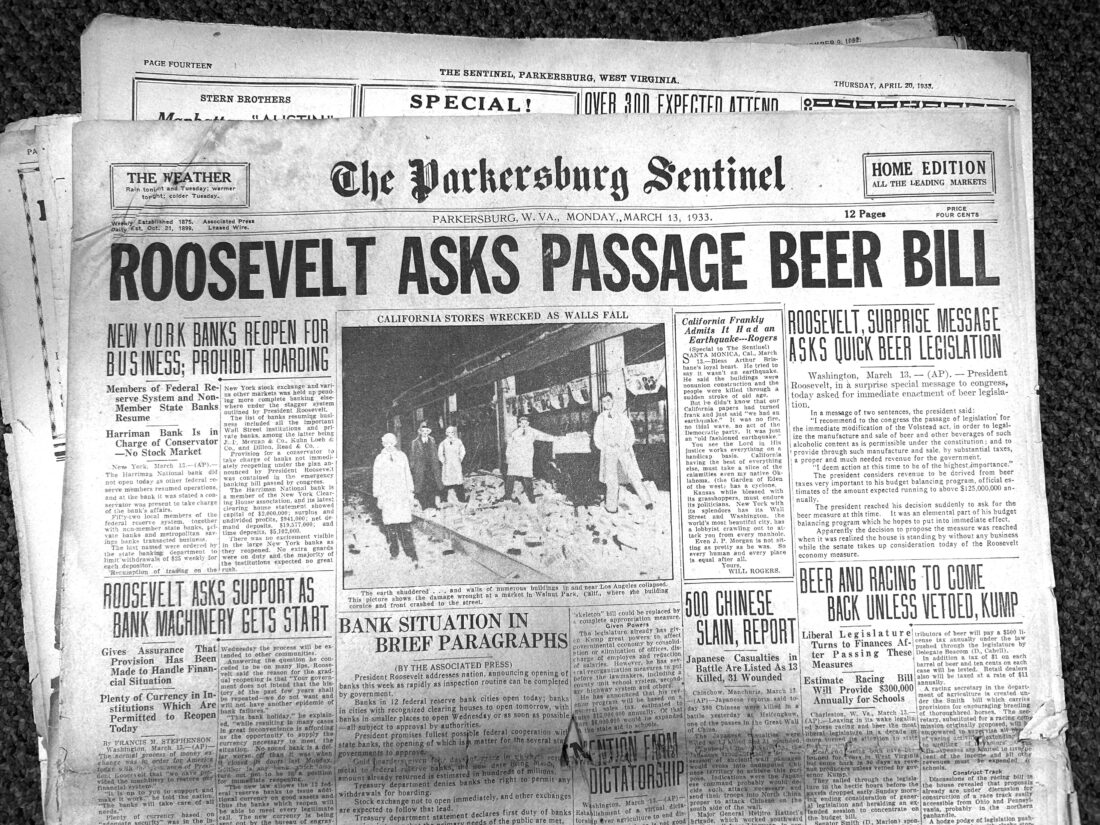
The front page of The Parkersburg Sentinel from March 13,1933. (Photo Provided)
When Franklin Roosevelt took office on March 4, 1933, he wasted little time getting down to business. The sweeping changes he made would help steer the country out of the Depression and back to work.
He also made sure they could drink a beer if they wanted to.
The country had been dry since the passage of prohibition in 1920. People drank of course, but they could not legally do so.
If beer and other “adult beverages” were not legal, they were also not taxable, and that appears to be the main reason Roosevelt was pushing to put a bottle in the hands of Americans.
The front page from The Parkersburg Sentinel of March 13, 1933, has the remarkable headline ROSEVELT ASKS PASSAGE BEER BILL across the top of the front page. This wasn’t a slow news day. There was also a story about the plan to reopen the banks that had been closed to stop an ongoing run on the bank.
Roosevelt wanted to reopen the bars not so everyone could enjoy a nice stout or pilsner, but so that everyone could pay taxes on that stout or pilsner.
In his surprise statement Roosevelt said:
“I recommend to the Congress the passage of legislation for the immediate modification of the Volstead Act. In order to legalize the manufacture and sale of beer and other beverages of such alcoholic content as is permissible under the constitution; and to provide through such manufacture and sale, by substantial taxes, a proper and much needed revenue for the government.
“I deem action at this time to be of the highest importance.”
It was estimated in The Sentinel that the move would raise $125 million annually in taxes. In West Virginia, state legislators were set to begin taxing beer in the Mountain State.
The plan was to sell beer in West Virginia that was 3.05% alcohol and be taxed at a rate of 10%.
The Cullen-Harrison Act was signed by Roosevelt nine days later that legalized the sale of the low-powered beer. It was believed that the beer was too “low” to get intoxicated by. In fact the long name of the bill was “An Act to provide revenue by the taxation of certain nonintoxicating liquor, and for other purposes.” Upon signing the bill Roosevelt was reported to have said, “I think this would be a good time for a beer.”
There was, by all accounts, rejoicing in the streets. By December, enough states had passed the 21st Amendment to the United States Constitution which allowed production to return to pre-Prohibition levels. The Marietta Times reported on Dec. 5 how the final state, Utah, was set to vote at 7 p.m. that evening. Ohio had ratified the amendment that day as well. West Virginia passed it on July 25.
The paper also printed a recipe to be used if a person had a little too much to drink that evening.
Some states would continue to sell the 3.2 beer long after probation ended.
The drinking age was lowered to 18 in many states when the voting age dropped in 1971. In Ohio the beer available to people 18-21 was the 3.2 beer. However, it was later raised back to 21 after wrecks caused by teens who had been drinking the supposedly “nonintoxicating liquor” and in fact gotten drunk off of it. Having attended Ohio University during this period I personally witnessed plenty of people consuming too much “nonintoxicating liquor.”
Excise tax on all alcohol raised $11.1 billion in 2023, and the industry has become a giant in the U.S. economy. From a budgetary standpoint, Roosevelt’s plan has helped to raise money for the country for nine decades.
Art Smith is online manager of the Marietta Times and The Parkersburg News and Sentinel. He can be reached at asmith@newsandsentinel.com.
Local columns

Life Through the Lens: How do you fight?
The Way I See It: Beer helped lift the U.S. out of the Great Depression
Look Back: On the road back then

Reporter’s Notebook: The ides of March

Op-ed: Capitol Connection – the home stretch