
Trending
Two new cookbooks focus on creating lavish flavors.
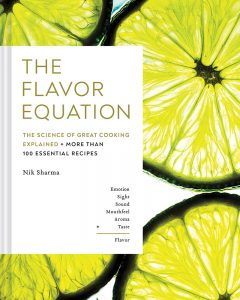
First is "The Flavor Equation" by Nik Sharma.
With an equation of "emotion, sight, sound, mouthfeel, aroma and taste equals flavor" Sharma takes home cooks on a flavorful journey with his recipes. He explains the science of food in over 100 recipes meant to be essential classics that you will keep coming back to. Using the essential elements of recipes as a starting point, Sharma explores brightness, bitterness, sweetness, savoriness, fieriness and richness through the recipes enclosed in the book.
Examples include Pomegranate and Poppy Seed Wings for brightness, Vegetable Pakoras for bitterness, Raspberry and Stone Fruit Crisp for sweetness, Roasted Broccolini and Chickpea Pancakes for savoriness, Garlic and Ginger Dal for fieriness and Roasted Eggplant Riata for richness. A lot of the dishes also have a distinctly Indian flare, which is not a bad thing for me at all as I love Indian food.
These are recipes for adults to try, as they might be a little more out of kids' comfort zones, although my youngest loves Indian food too, and tried a dish with myself and my husband, Roasted Cauliflower in Turmeric Kefir. She's not a big cauliflower fan, though in truth, neither am I, but I loved the way the curry transformed it. Really, curry makes everything better.
You can also try the dish at home with the recipe, which follows.
For adults who want to try some science-based flavor, this is the book for them!
"The Flavor Equation" is published by Chronicle Books.
Another book that looks to complex flavor is "Flavor" by Yotam Ottolenghi, a New York Times bestselling author. Ottolenghi collects more than 100 recipes that amplify flavor that are plant-based. He breaks down the fundamentals of cooking into three elements: process, pairing and produce to get the most flavor out of these dishes. He explores how to pair vegetables with sweetness, fat, acidity and chili heat to really explore the flavor.
The book is broken down by the three elements: process, pairing and produce, in order to further explore the flavors.
Process further breaks down into charring with recipes like Calvin's Grilled Peaches and Runner Beans, browning with Cabbage "Tacos" with Celery Root and Date Barbecue Sauce, infusing with Melon and Buffalo Mozzarella Salad with Kasha and Curry Leaves, and aging with the Ultimate Roasting-Pan Ragu while pairing looks at sweetness with Butternut, Orange and Sage Galette, fat with Stuffed Eggplant in Curry and Coconut Dal, acidity with Asparagus Salad with Tamarind and Lime and chili heat with Cabbage and Ginger Cream and Numbing Oil, and produce further goes into mushrooms with Noodle Salad with Mushroom and Peanut Laab, alliums with Eggplant with Herbs and Crispy Garlic, nuts and seeds with Tomato and Plum Salad with Nori and Sesame and sugar with Coconut Ice Cream with Lychee and Passion Fruit.
I tried Sweet Potato in Tomato, Lime and Cardamom Sauce. My dish, for a change, turned out looking exactly like the picture, which I appreciated. I liked the complex flavors, my husband did not, and was especially not fond of the lime in it. But to each his own.
You can be our tie-breaker and try out the recipe as it follows below.
"Flavor" is published by Ten Speed Press.
***
Reprinted from "The Flavor Equation" by Nik Sharma with permission by Chronicle Books, 2020
ROASTED CAULIFLOWER IN TURMERIC KEFIR
This recipe takes advantage of kefir (buttermilk can be substituted) for its bright acidity. I prefer to use a bottle of freshly opened kefir or buttermilk here, because as these liquids age, the lactic acid increases, which not only leaves a strong tart taste but also causes the milk proteins to curdle quickly on heating. If you have leftover kefir, use it to make the Blueberry + Omani Lime Ice Cream.
The Flavor Approach
Using the acidity of fermented dairy such as kefir and the Maillard reaction creates a bittersweet taste and new aroma molecules in vegetables.
Chickpea flour, which contains starch, acts as a thickener for the base of the sauce.
The sound of the seeds sizzling is a good indicator of how hot your oil is; if the oil is hot enough, they will sizzle immediately and brown quickly.
SERVES 4
2 lb [910 g] cauliflower, broken into bite-size florets
1 tsp garam masala, homemade (recipe follows) or store-bought
Fine sea salt
4 Tbsp [60 ml] grapeseed or other neutral oil
5 1/4 oz [150 g] minced red onion
1/2 tsp ground turmeric
1/2 tsp red chili powder (optional)
1/4 cup [30 g] chickpea flour
2 cups [480 ml] fresh kefir or buttermilk
1/2 tsp cumin seeds
1/2 tsp black or brown mustard seeds
1 tsp red chili flakes
2 Tbsp chopped cilantro or flat-leaf parsley
Preheat the oven to 400∂F [204∂C].
Place the cauliflower in a roasting pan or baking dish. Sprinkle with the garam masala, season with salt, and toss to coat. Drizzle with 1 Tbsp of the oil and toss to coat evenly. Roast the cauliflower for 20 to 30 minutes, until golden brown and slightly charred. Stir the florets halfway through roasting.
While the cauliflower is roasting, place a deep, medium saucepan or Dutch oven over medium-high heat. Add 1 Tbsp of the oil to the pan. Add the onions and saute until they just start to turn translucent, 4 to 5 minutes. Add the turmeric and chili powder and cook for 30 seconds. Lower the heat to low and add the chickpea flour. Cook, stirring constantly, for 2 to 3 minutes. Lower the heat to a gentle simmer and fold in the kefir, stirring constantly. Watch the liquid carefully as it cooks until it thickens slightly, 2 to 3 minutes. Fold the roasted cauliflower into the liquid and remove from the heat. Taste and add salt if necessary.
Heat a small, dry saucepan over medium-high heat. Add the remaining 2 Tbsp of oil. Once the oil is hot, add the cumin and black mustard seeds and cook until they start to pop and the cumin starts to brown, 30 to 45 seconds. Remove from the heat and add the chili flakes, swirling the oil in the pan until the oil turns red. Quickly pour the hot oil with the seeds over the cauliflower in the saucepan. Garnish with the chopped cilantro and serve warm with rice or parathas.
***
MY GARAM MASALA
This is my regular garam masala; note the absence of a few aromatic spices such as fennel and a smaller amount of green cardamom in this version.
MAKES ABOUT 1/4 CUP [25 G]
2 Tbsp cumin seeds
2 Tbsp coriander seeds
1 Tbsp black peppercorns
2 dried bay leaves
One 2 in [5 cm] cinnamon stick
12 whole cloves
1 whole black cardamom pod
3 or 4 green cardamom pods
1 tsp freshly grated nutmeg
Heat a small, dry stainless-steel or cast-iron skillet over medium-high heat. Turn the heat to medium-low and add the cumin seeds, coriander seeds, fennel seeds, black peppercorns, bay leaves, cinnamon, cloves, green and black cardamom pods, and star anise. Toast gently by rotating the pan to circulate the spices until the spices become fragrant, 30 to 45 seconds. Be careful not to burn them; if they do burn, discard them and start fresh.
Transfer the toasted spices to a small plate and let cool completely. Transfer the cooled spices to a mortar or spice grinder. Add the nutmeg and grind to a fine powder. Store the spice mix in an airtight container in a cool, dark place for up to 6 months.
Amy Phelps can be reached at aphelps@newsandsentinel.com