
Trending
The world is too much with us; late and soon,
Getting and spending, we lay waste our powers;--
Millie Stanley, voracious reader that she was, quoted these lines by Wordsworth several times near the end of her long life. She regretted that she hadn't allowed herself more joy or vacationed while she was able to travel. She had her guilty pleasures, of course-- the all-you-can-eat Jumbo Buffet, ice cream cake from DQ, one strawberry daiquiri during the holidays--but the poverty of the Depression years was seared into her memory. She lived an austere existence; no matter how hard she worked or how much she achieved, she was haunted by the fear that she wouldn't be able to guarantee her future security.
Mildred Ruth Stanley was born in Jackson County, WV, the eldest child of Charles W. and Anna B. Stanley, on July 10, 1921. She never liked the name Mildred--having been named after a woman struck dead by a bolt of lightning--and preferred to be called Millie. Her remarkable memory and intelligence were evident from a tender age; family members recounted how she would strain to listen for boats going up and down the Ohio River, identifying them by the sounds of their whistles.
Millie's parents packed up the family and moved to Vienna in search of work in the late 1920s. Those first years in Wood County were bleak in their rented house against the hillside. Buddy, Millie's beloved little brother, succumbed to a severe case of measles in June 1930. She never forgot how they'd had to run an electric line into their home from a neighbor's house so that they could place a fan on the tiny casket. She firmly believed that Buddy would've survived if the family had been able to afford better medical care.
As her parents struggled with their grief, Millie took over more of the household responsibilities. Among other things, she walked down to Universal Glass each payday to collect her father's wages. She was still in elementary school, yet was already managing her family's finances. She took care of the grocery orders, paid bills, and put aside whatever could be saved. By the time she graduated from Parkersburg High School in 1940, she had a position waiting for her at Mountain State Steel. With World War II looming, she became responsible for verifying materials and purchases; she also prepared the foundry's statistical reports for the Departments of Labor and War. It wasn't long before she bought her parents the first house and first car, a Studebaker Diplomat, they'd ever owned.
Millie was very protective of her little sister, Clara. When Clara's husband was deployed, Millie moved to North Carolina and got a job alongside her sister at Fort Bragg. In their spare time, Millie made a point of teaching Clara to drive. They loved each other but, as is often the case with siblings, got on each other's nerves.
Just as Millie was considering her career options, some recruiters from the Department of the Army happened to be at Fort Bragg. Millie signed up for a two-year stint in Japan and headed overseas in May 1952. On her way south to the island of Kyushu from Tokyo, the train passed through Hiroshima. Millie stood up in the compartment and looked out at the devastation. A Japanese man beside her said, "Hiroshima, very bad." Without even looking at him, she retorted, "Pearl Harbor, VERY bad!"
Millie didn't realize it at the time, but she was about to become a part of U.S. history. She was assigned to work alongside civilian and military specialists at Camp Kokura, the site of a former barracks for Japanese officers that was repurposed as Zone Headquarters for the American Graves Registration Service Group. With the Korean War raging, the decision had been made to evacuate the remains of all soldiers killed in action--and send them to Camp Kokura--rather than establish permanent cemeteries in Korea. Never before had there been a mass evacuation of fallen soldiers during open conflict. The Central Identification Laboratory painstakingly examined remains to determine the identity of each fallen soldier and reunite them with their loved ones.
As an Identification Investigator, Millie worked with forensic data furnished by the laboratory--in addition to requesting maps and interpreting Army Command reports of military engagements--to determine the identities of soldiers who were otherwise unknown. The Army also required Identification Investigators to make a case before a board to prove beyond any doubt that the soldier in question was correctly identified. Millie was proud to serve her country in this capacity, but the one thing she refused to do was shelter under the post when the air raid sirens blared; the stuffy bomb shelter proved more daunting than the prospect of enemy fire. When an officer threatened to report her, Millie carried on with her work and said, "If they're gonna blow me away, they can just as well blow me away on top of the ground!"
Millie became chief of the Finance and Accounting Division at Fort Bragg after her return to the USA. She worked there for years, until family illness brought her back to West Virginia. While Millie was home on leave, a bus ploughed into her new car as she was sitting at a stoplight. She spent the next year recovering from her injuries and was unable to drive; her spine looked like a question mark for the rest of her life. She worked as an accountant and business manager at various firms in the area until she retired from Roentgen Diagnostics in 1985. She was known to one and all as a consummate, scrupulous professional who would chase down and pounce on every penny.
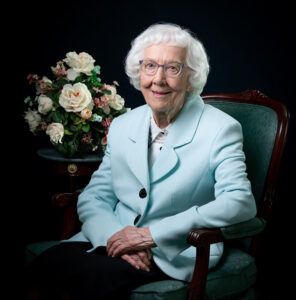
People often asked Millie why she never married. Her response was, "Just lucky, I guess." She was an elegant, petite woman with perfectly coiffed hair. She washed her lovely hair with 'white minx' rinse and rolled it with the same fastidiousness as everything else she did. She looked particularly stately behind the wheel of her white, Mercury Grand Marquis and enjoyed driving to visit her sister and brother-in-law after church on Sundays.
When Millie's brother-in-law died suddenly and her sister, Clara, became ill, Millie stepped up once again to help her family. She'd spent the first six years of her retirement caring for her ailing parents and then, at the age of 92, became her sister's court-appointed guardian and conservator. That's how many people will remember Millie: as her sister's fierce protector. At all hours, rain or shine, Millie was there by Clara's bedside for two years and was cradling her as she drew her last breath.
Millie Stanley did not suffer fools gladly. She commanded respect and met adversity head-on. When some devious greed-weasels decided to make trouble for Millie--in the form of a malicious letter to the DMV that resulted in her license being suspended pending reevaluation due to her advanced age--she did not flinch. She got a copy of the WV Driver's Handbook, studied for weeks, and even practiced parallel parking. She won back her driver's license despite being well into her 90s. She continued to drive until compression fractures in her spine seriously compromised her mobility at the age of 98; she decided when it was time to hang up her keys, and she decided when she no longer wished to stay in her home in Vienna.
As her 100th birthday approached, she said, "I'll make it to 100, but I won't last long after that." And so it was. In the last few days of her life, she was preoccupied with not having her tax return filed as promptly as she'd wished; the accounting firm made several mistakes, and she had, naturally, crunched the numbers and marked corrections. "These people don't know what it's like to need every extra penny for the streetcar," she said.
Millie invested wisely her entire life and was an unassuming and generous benefactress, especially when it came to the health and education of underprivileged children in the region. She was also blessed with many loyal friends and managed to speak with several of them in her final hours. Millie passed away peacefully with the evening sun at her window while "If We Never Meet Again This Side of Heaven" was being sung to her. In her mind, heaven was a patch of shaded, soft grass by a gently flowing stream. She also believed that animals go to heaven; she looked forward to joining her dearly departed dogs there.
Millie was grateful for the compassionate care she received at The Pines in Marietta. Ohio's Hospice at United Church Homes also went above and beyond to help make her last months as comfortable as possible. She chose not to have a funeral service, but those who wish to honor Millie are welcome to make a donation in her name to the Charles W. & Anna B. Stanley Memorial Scholarship at West Virginia University Parkersburg, the Humane Society of Parkersburg, or the Ronald McDonald House in Morgantown.
By any measure, Millie Stanley was a great lady. She took the cruel cards she was dealt and did what she could to get control of the deck and deal others a better hand. May her memory and legacy continue to be a blessing to many.