
W.Va. Supreme Court upholds admonishment of Judge Sweeney
Trending
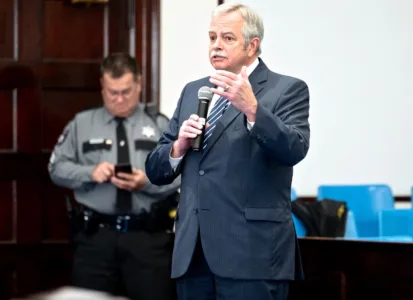
CHARLESTON – While crediting him for “honorable motives,” the West Virginia Supreme Court of Appeals upheld an admonishment of 3rd Judiciary Circuit Court Judge Tim Sweeney, accusing him of using public pressure for changes to the child welfare system and misuse of social media.
The state Supreme Court issued a disciplinary opinion Thursday evening, stemming from a two-count formal statement of charges filed by the Judicial Investigation Commission regarding Sweeney's personal Facebook activity, and his entry of an administrative order directed at the West Virginia Department of Human Services coupled with subsequent media engagements.
Chief Justice C. Haley Bunn, writing for the court, concluded that Sweeney committed seven total violations of the state Code of Judicial Conduct. While the court agreed with the Judicial Hearing Board’s findings on six violations, it identified an additional violation of Rule 2.2 stemming from the coercive nature of his February 2025 DoHS order.
Despite finding an extra violation, the court held that the Judicial Hearing Board’s recommended discipline remained proportionate. Sweeney – who had no prior disciplinary record in over four decades of legal service – was officially admonished and ordered to pay the costs of the proceedings.
“... We have no doubt that Judge Sweeney had honorable motives and commendable concern for protection of the children in his circuit,” Bunn wrote. “We also recognize that frustration occasionally reveals itself through judicial overreach or imprudence, particularly where the urgency of abuse and neglect matters is at the forefront.
“However, judges wield enormous influence that may be utilized, within the bounds of the Code, to effect improvements and change without violating the Code of Judicial Conduct,” Bunn continued. “And while his motivations do not justify his actions, we find that an admonishment adequately deters similar misconduct in the future and is a proportionate sanction for Judge Sweeney's conduct viewed in its totality.”
In a statement Friday, Sweeney said he would accept his admonishment but did not regret his actions to raise the alarm about understaffing and caseloads for local CPS workers.
“Sometimes you just have to take a punch for the kids,” Sweeney said. “Abused and neglected children were helped and shortcomings were addressed. That was and continues to be my goal.”
Arising from a Feb. 3, 2025, review hearing regarding an abused and neglected child who was denied required placement services due to severe understaffing within DoHS, Sweeney issued an administrative order appointing high-ranking DoHS leadership as local Child Protective Services workers.
Sweeney also granted two media interviews explaining the crisis, including with The Parkersburg News and Sentinel. Judicial Disciplinary Counsel Teresa Tarr alleged these actions violated rules about impartiality and confidence in the judiciary, ensuring the right to be heard and/or due process, and prohibitions about making public statements regarding pending or impending matters.
“No part of a court's charge to prioritize abuse and neglect proceedings includes the authority to use judicial powers and improper publicity to pressure the State to address an issue of its choosing and to its subjective satisfaction outside of a justiciable controversy,” Bunn wrote.
During oral arguments last month, Sweeney's attorney, H.L. Mahaney, told the justices that Sweeney’s actions led to former DoHS Secretary Alex Mayer - who had just started after being appointed by newly elected Gov. Patrick Morrisey - meeting with Sweeney and Mayer addressing staffing issues.
While judges are encouraged to address systemic problems in child welfare, Bunn said that the Code of Judicial Conduct limits such involvement to collaborative, off-the-bench meetings with local professionals rather than unilateral judicial directives or press campaigns. Bunn said the ends did not justify the means.
“While Judge Sweeney's conduct happened to concern a matter that elicits universal agreement – the well-being of children – judges who stray so far outside their role such as to violate the Code are not immunized from discipline based on the popularity or success of their misconduct,” Bunn wrote.
Bunn also wrote that Sweeney's social media activity demonstrated a pro-prosecution and pro-law enforcement bias, saying that the posts divorce a judge from the role of a neutral arbiter, creating an appearance of bias. However, Bunn did agree that Sweeney’s fundraising reposts contained no commentary or direct requests, constituting passive dissemination rather than active solicitation.
“... It would be illogical to require each isolated post to have the same impact on public confidence in his impartiality as a series of posts that create an overall appearance of law enforcement or prosecutorial partiality,” Bunn wrote. “The cumulative effect of this conduct divorces him from his role as neutral arbiter and, fairly or unfairly, creates the appearance of a pro-law enforcement or prosecution bias.”
Sweeney’s admonishment after raising issues about child welfare issues took a different turn than a similar case brought against Eighth Circuit Court Judge Maryclaire Akers around the same time.
“Curiously, despite significant similarities, a related case produced an opposite result,” Sweeney said.
The Supreme Court issued an order in August dismissing Akers’ admonishment over comments during a court case and on WV MetroNews Talkline in a separate child welfare case. She was accused last summer by the JIC of violating multiple rules within the Code of Judicial Conduct. The justices sided with a recommendation by the Judicial Hearing Board that there was insufficient evidence to determine whether Akers violated judicial ethics rules.