
W.Va. revenue officials advise caution to lawmakers about future economic conditions
Trending
CHARLESTON - Despite tax revenue in West Virginia being slightly down in October, overall general revenue fund collections remain above estimates. But state revenue officials advised lawmakers Tuesday to be cautious in thinking about new spending given potential economic factors.
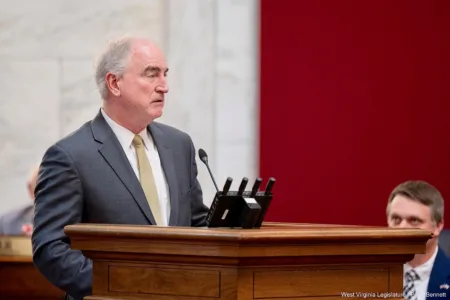
Members of the Joint Standing Committee on Finance received a briefing Tuesday morning on the final day of legislative interim meetings at the State Capitol Building.
Department of Revenue Secretary Eric Nelson and Deputy Secretary Pete Shirley noted economic caution moving through the remaining eight months of fiscal year 2027, pointing to factors such as climbing inflation rates.
"Inflation number was announced today, and it was up 0.4% percent. That was higher than the 0.3% estimate," Nelson said. "Due to last year’s 40-some-day government shutdown, we don’t have a prior year number, but unofficial estimates are that we’re trending at about a 4% year-over-year inflation number. In September, that was 3.7%."
Nelson told the committee that economists were seeing trends nationally in slower wage growth which could also affect West Virginia's economy and tax collections as Gov. Patrick Morrisey prepares his fiscal year 2028 general revenue budget proposal for lawmakers to consider next year.
"On employment and wages and employment nationally, the growth continues to remain strong, but there are trends in a slowing of wage growth nationally," Nelson said. "That’s going to be something that we look at very closely going forward."
General revenue collections for October were $380.4 million, nearly $8 million, or about 2%, below the estimate of $388.1 million set by the state Department of Revenue. But overall tax collections for the first four months of FY27 were $1.789 billion, which was 3.1% above the $1.734 billion revenue estimate. Fiscal year-to-date surplus tax collections were $54.4 million.
Nelson said anticipated adjustments in federal interest rates could have an effect on the state's economy and future general revenue spending proposals.
"Expectations ... are we will see an interest rate increase when (the Federal Reserve) meets in December, and more than likely we’ll see that followed by another rate increase in the first quarter (of next year)," Nelson said. "When you combine a higher trending inflation, slowing wage growth and then an interest rate environment, I’ll just put a level of caution as we look at our finances going forward."
The Department of Revenue is working on the FY28 general revenue budget bill, which Morrisey will present in January when the new 60-day regular session of the West Virginia Legislature begins. According to the Appropriation Request Instructions report issued for FY28 earlier this summer, state departments and agencies were urged to keep their budget requests flat for next fiscal year.
Additionally, state road fund metrics showed a temporary drop linked to federal reimbursements and reduced motor fuel consumption due to higher gasoline and diesel fuel prices. Following the Department of Revenue briefing, Department of Transportation Secretary Todd Rumbaugh addressed FY27 revenue projections, explaining to the committee that federal funding delays stemmed from mismatched fiscal calendars and continuing resolutions.
"The federal fiscal year is different from our fiscal year. Just about every year at the end of September, beginning of October - almost for a month period - their system shuts down and we cannot get reimbursed for any money for about a month period," Rumbaugh said. "So, that impacts the amount of reimbursement that we do get. It delays it a little bit.
"The other factor going in this year is the large federal transportation bill came to an end at the end of September and (Congress) enacted a continuing resolution up through December," he continued. "You only receive one-twelfth of the funds ... for each of those months. So, it doesn’t allow you to get full reimbursement at that time. Eventually it will catch up, but there is only so much federal funds that are available, and that’s part of the reason why it’s behind where it normally would be."
Motor fuel tax collections fell by $5.4 million year-over-year for October. Higher retail fuel prices have driven a decline in consumer fuel consumption. Right now, West Virginia's gas tax is 35.7 cents per gallon, but that is expected to rise next year.
Each year, the State Tax Division calculates the average wholesale price of fuel between July 1 and Oct. 31. The variable component is capped at a maximum 10% year-over-year change. The tax commissioner will issue an administrative notice detailing the rate at the beginning of December, with the new rate taking effect Jan. 1 for the entire calendar year.
Shirley said that if the 10% maximum cap is reached, the gas tax will increase by 1.5 cents per gallon next year. Democratic lawmakers and State Treasurer Larry Pack have called for Morrisey to call a special session to pause the gas tax or freeze current rates.
Steven Allen Adams can be reached at sadams@newsandsentinel.com.