
Gov. Morrisey outlines $113 billion investment surge in West Virginia at annual summit
Trending
CHARLESTON - During his inaugural address at the Governor’s Energy Summit last year, Gov. Patrick Morrisey praised more than $12 billion in potential investments in West Virginia, mostly from energy projects.
One year later, Morrisey announced the total has increased to more than $113 billion.
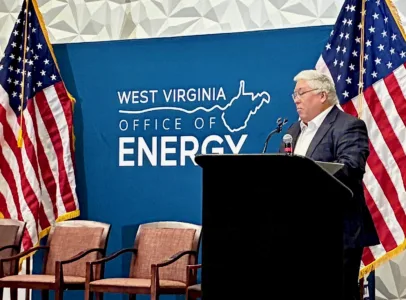
Morrisey made the announcement Thursday morning on the second day of the annual Governor’s Energy Summit put on by the state Office of Energy and Department of Commerce at the Charleston Coliseum and Convention Center, soon to be renamed the Vandalia Health Center.
According to Morrisey, Columbus-based American Electric Power - the parent company of Appalachian Power and Wheeling Power - has agreed to spend $17 billion towards adding 3 gigawatts of natural gas-fired electric power in West Virginia.
The proposal, which could involve three separate plants spread out across the state, could see more than 2,000 construction jobs created and more than 100 permanent jobs. Appalachian Power already agreed to commit an additional $7.5 billion to upgrade West Virginia's coal-fired power plants through 2050, extending their reasonable useful life.
"This is going to be good-paying jobs for West Virginia," Morrisey said. "We’re talking about construction workers. We’re talking about electricians. We’re talking about welders, sheet metal workers, and the kind of jobs that make good money for our state. And when you get those paychecks in, they don’t just stop at the job site. They support our local restaurants, our retail establishments when you go out and buy new clothes for your kids, and the small businesses throughout our communities."
Morrisey said that takes the total amount of proposed economic development investments in West Virginia from $12.9 billion between October 2025 and July 2026 to $113.6 billion with approximately 21,030 jobs that could be created should all the projects become reality.
"I knew coming into this job, we had to bring capital and private investment in, and a level the states had never seen before. And that’s what we’ve been working on," Morrisey said. "People are talking about our state, from an investment perspective, that they’ve never talked about in the past. Let’s keep going. Let’s keep making progress."
Morrisey announced more than a year ago his 50 by 50 initiative to increase the number of gigawatts produced by West Virginia from 16 to 50 by the year 2050. The American Electric Power investment could add 3 gigawatts to the 27.6 gigawatts of electric generation announced since the initiative was launched.
"Does anyone think we’re not going to get the 50 gigawatts of energy by 2050 now?" Morrisey said. "I don’t think so ... We’re on our pathway to get the 50 by 50."
House Bill 5381, introduced on behalf of Morrisey and passed by the Legislature earlier this year, created the Comprehensive Energy Policy and Development Plan Act of 2026, which tasks the Office of Energy with creating a long-term strategy to bolster electrical grid stability and energy security through 2050.
The new law calls for a diverse, "all-of-the-above" energy policy, including the use of coal, natural gas, nuclear and alternative energy. The bill mandates a five-year Comprehensive Energy Plan, with the first version due by Dec. 1. The policy must include four pillars: reliability focused on stable baseload generation, efficiency driven by technological innovations, affordability focused on low-cost energy sources and independence focused on domestic energy production.
By expanding supply across diverse energy, Morrisey said he aims to lower the per-unit cost of electricity for West Virginia families while guaranteeing ratepayer protection, so infrastructure costs do not shift to taxpayers.
"We know how important that is: affordability. Whether it’s groceries, whether it’s housing, whether it’s healthcare or paying the power bills, families are being squeezed," Morrisey said. "That’s why we have to change that. While other states retire their reliable power plants and restrict new generation, West Virginia is taking a different approach. ... If we do it the right way, the cost per unit will be lower and lower. And that will ensure, one mechanism among many, that West Virginians are going to be paying some of the lowest power prices in America."
Morrisey also sees growing the number of gigawatts produced by the state as an incentive for more data center projects to come to West Virginia. One of the largest investments since Morrisey first took office is the Nscale Monarch Compute Campus in Mason County, which has partnerships with Anthropic, the makers of Claude. The potential investment for phase one of the project, which will create up to 2 gigawatts of compute capacity, is estimated at more than $69 billion.
House Bill 2014, the Power Generation and Consumption Act introduced on behalf of Morrisey and passed by the Legislature in 2025, streamlines development of data center and microgrid projects, offers regulatory exemptions within designated microgrid districts, establishes a special valuation for property taxes and a new tax distribution framework for high-impact data centers, and creates a fund for electric grid stabilization.
According to the formula in the Power Generation and Consumption Act, 50% of property tax collections from these projects would go to a personal income tax reduction fund, 30% would go to the county or counties where the data centers are, 10% would go to all 55 counties on a per capita basis and 5% would go to the state Economic Enhancement Grant Fund. Morrisey said his 50 by 50 initiative and data center growth could go hand-in-hand in phasing out the state’s personal income tax.
"I see a pathway by 2038 where we can get to not only the 50 by 50 framework, but we have a chance ... to get our state income tax down near zero," Morrisey said. "As we’re growing our energy resources, parts of (the Power Generation and Consumption Act) will feed into reductions to the state income tax. That’s important for us to know. We need West Virginia citizens to benefit from all of this dynamic, economic development."
Morrisey also praised the recent launch of the West Virginia New Home Energy Rebate Program, receiving over 1,400 applications in its first month, coupled with a $1 million commitment from Google to fund home repairs so families in six counties can access rebate programs.
Steven Allen Adams can be reached at sadams@newsandsentinel.com.