
Golden Rules: Lawmakers consider rules on coal-fired energy, storage tanks, Hope Scholarship
Trending
CHARLESTON - With the 2027 regular session of the West Virginia Legislature more than 60 days away, it appears lawmakers have wrapped up their review of legislative rules provided by state departments and agencies.
The Legislative Rule-Making Review Committee met Monday and Tuesday, reviewing nearly 50 agency rules which will then be voted up or down in bundles during the legislative session beginning Wednesday, Jan. 13, and ending Saturday, March 13.
Among the items sent on to the full Legislature were the Public Service Commission rules for electric generating capacity utilization, which stem from House Bill 2014, the Power Generation and Consumption Act.
These proposed regulations govern electric utilities by establishing reporting standards, market participation options and consumer economic dispatch reviews. The rules also require utilities to maintain coal-fired power plants to be able to reach a minimum net capacity factor of 69% as long as doing so does not unfairly increase consumer costs.
The PSC heard public comments on its draft rules in September from consumer advocates, electric utilities, representatives of industry and manufacturing, and coal companies and miners. Attorneys for the commission took those comments under advisement and released its final rule draft in October, receiving much praise but some criticism from pro-coal groups who wanted to see a mandatory 69% capacity factor for coal-fired plants.
PSC Commissioner Bill Raney told committee members Tuesday that the goal of the rule was to encourage greater use of coal-fired power while also ensuring that West Virginians don’t have to pay for those plants to operate when that power would not be the best economic choice in the regional transmission grid of which West Virginia and 12 other states are a part.
"The ratepayer is always to be protected in this ... the ratepayer is the keystone of all of these things ” Raney said. “People spend a lot of time talking about 69%, and ... 69% is a standard to be achieved by the plants. It’s not mandatory.”
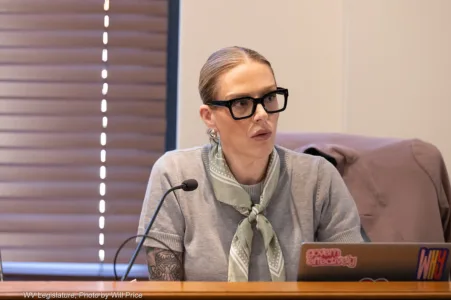
Later in Tuesday’s meeting, one of the committee’s two Democratic members - Del. Kayla Young, D-Kanawha - raised issues with a rule being proposed by the Department of Environmental Protection making changes within the Aboveground Storage Tank Act.
Originally enacted in response to the 2014 Freedom Industries chemical spill in the Kanawha Valley which contaminated the water supply of approximately 300,000 residents, the act established a framework governing the registration, construction, installation, inspection, maintenance and use of aboveground storage tanks to protect state waters and public health.
Senate Bill 641, passed by the Legislature earlier this year, amended the law, from which storage tanks containing 210 barrels or less used for oil and natural gas production activities are exempt, provided they are outside “zones of critical concern.”
The new law created a new exception for tanks containing 10,000 gallons or less that are within the boundaries of a mining permit, provided they are not within a zone of critical concern. Tanks containing 10,000 gallons or less used exclusively for brine produced in connection with oil and natural gas production and storage will be regulated as level two tanks rather than level one tanks, even when within a zone of critical concern.
Tank owners would be granted a nine-month proviso to upgrade tanks before their regulatory status changes following the creation of new zones of critical or peripheral concern. The DEP is now required to allow remote, non-destructive examination technologies during periodic inspections, reducing the need for human entry into dangerous confined spaces.
Young said the DEP rule puts in place several items included in the original version of SB 641 that were removed through the legislative process.
“I think this is, without a doubt, the most egregious rule we’re going to pass this year,” she said. “The Legislature clearly said that we don’t want to do most of this. I don’t think it’s all bad, but I think the discussion led us to show that this needs to go through the legislative procedure.
“We spend hours and hours and hours on the Aboveground Storage Tank Bill every year, and it deserves that,” Young said. “I don’t think we should be bastardizing this process by shoving it all into rules after it was already voted out. I just think this is really gross.”
State Sen. Brian Helton, R-Fayette, argued that the Aboveground Storage Tank Act was meant to protect drinking water sources and focus on larger storage tanks, not smaller tanks often used by the natural gas industry for storing brine.
“I’m not aware of any instance of this type of tank ever in the history of West Virginia creating contamination in water,” said Helton, who co-owns companies that haul sand used in fracking natural gas wells.
On Monday, the committee recommended a rule proposed by the State Treasurer’s Office for the Hope Scholarship educational voucher program. Proposed changes included extending the program’s sunset date to August 2032, transitioning the fund disbursement schedule from biannual to quarterly consistent with House Bill 5686 passed earlier this year, and formally recognizing microschools as qualified providers.
The Hope Scholarship is a voucher program that gives parents the option to use an equivalent portion of the per-pupil expenditure for their children from the state School Aid Formula, up to $5,435.62, for educational expenses such as private or religious school tuition, home school, tutoring and learning aids.
The program was previously limited to children eligible to be enrolled in a county school system's kindergarten program the year the parents are applying, public school students who were enrolled full-time during the school year prior to applying or public school students enrolled for at least 45 days during the current school year. But beginning July 1, eligibility opened to all children in the state.
Young offered three amendments to the Hope Scholarship rule, all of which the committee voted down. The first would have restricted Hope Scholarship tuition and fee spending to only West Virginia-based providers, with exceptions for purchases of equipment, technology, materials, and standardized tests.
Legislative Rule-Making Review Committee Co-Chairwoman Patricia Rucker, a supporter of school choice and the Hope Scholarship, argued that Young’s amendment was an end-run around the law that established the scholarship itself, which contains no geographic restriction limiting where parents may spend scholarship funds.
“There are lots of pieces of legislation that get passed that we don’t always approve or like, but this committee is not meant to change legislation or the code; it’s meant to clarify and ensure that the law is actually being applied,” said Rucker, R-Jefferson. “Any member of this committee can introduce legislation if they disagree with something in code. And they’re welcome to do so. But I cannot support this amendment and legislating through rulemaking.”
Young’s second amendment would have required Hope Scholarship applicants to self-report the total number of individuals residing in their household and the total annual household income on the application. Young said the data would be used for demographic reporting in the Hope Scholarship Board’s annual report and not for eligibility or award determination.
“They don’t have to submit any documents; just self-report the information,” Young said. “The intention is for it to not affect determination for eligibility or anything like that, just more information for the annual report.”
Rucker opposed that amendment, arguing that it could violate federal student privacy laws.
“There’s information that is privileged information of students and of families. And when we were crafting this legislation, we were limited on what we could ask,” Rucker said. “If we’re in violation of federal privacy law, we could get into trouble. So, it actually is an issue.”
Young’s third amendment would have required non-public schools and microschools to submit a copy of their attendance policy to the Hope Scholarship Board and allow the State Treasurer’s Office to verify compliance when a student withdraws or fails minimum attendance standards.
“All this will add is that the providers, the schools, must submit a copy of their attendance policy to the board,” Young said. “Because I don’t know how we’re going to know that the student fails to meet the attendance requirements if we don’t know what they are.”
A representative for the State Treasurer’s Office said it already requests attendance policies from participating schools, and most schools are compliant. Attendance policies are primarily used to calculate prorated refunds when a student withdraws. However, the office was not opposed to the change as long as it was limited only to schools participating in the Hope Scholarship and not all non-public and microschools. But the amendment failed regardless.