
Parkersburg City Council Finance Committee OKs shift of housing funds
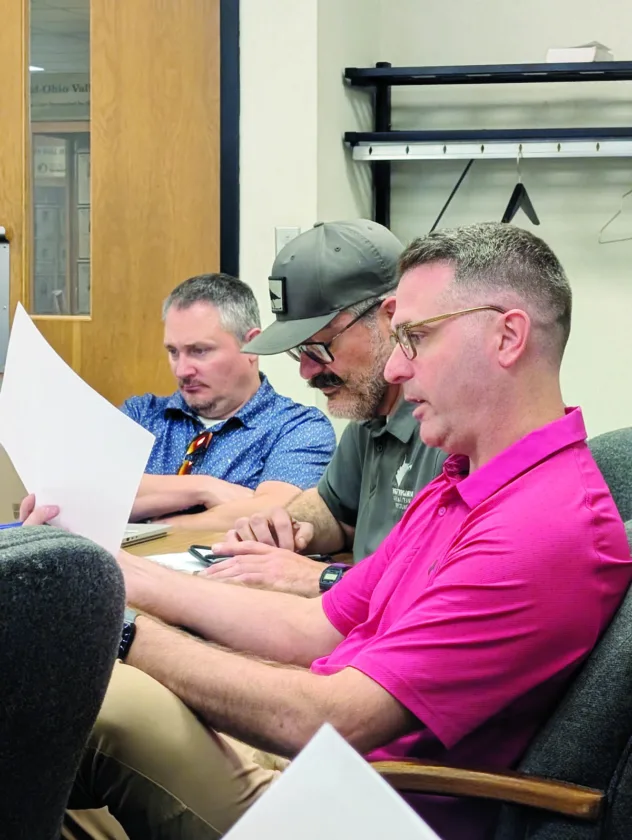
Parkersburg Development Director Ryan Barber, right, discusses a proposed budget revision during a Finance Committee meeting Tuesday as, from left, Finance Director Eric Jiles and Mayor Tom Joyce listen. (Photo by Evan Bevins)
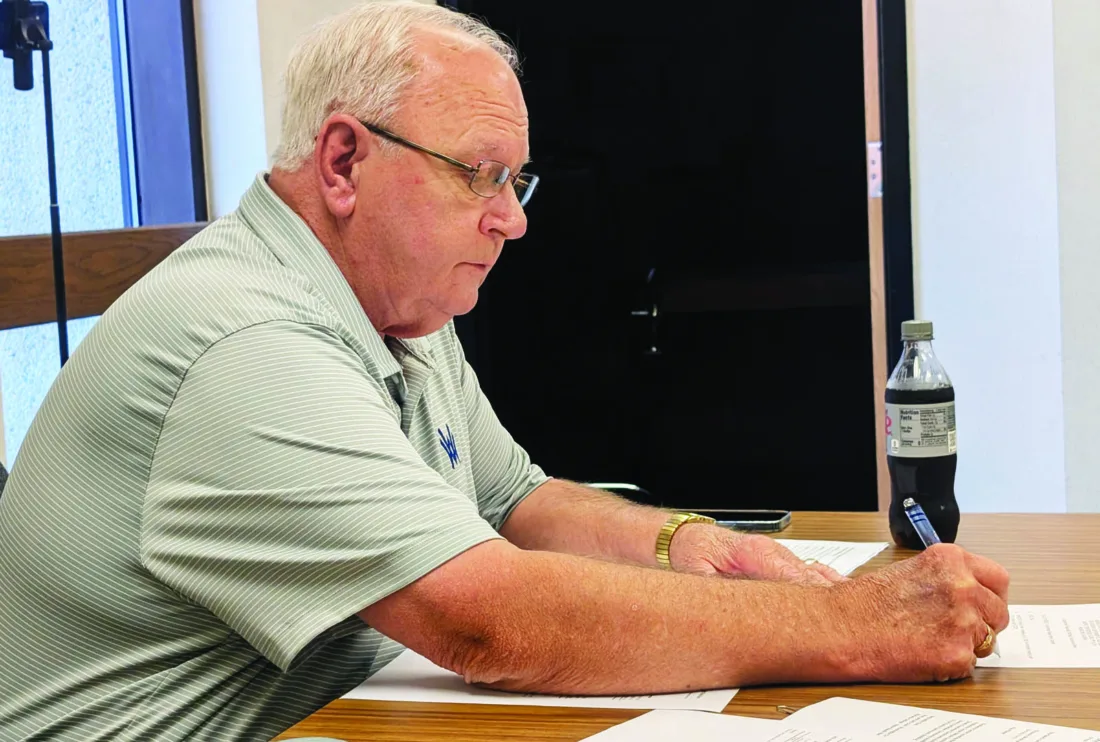
Parkersburg City Council Finance Committee Chairman Roger Brown makes a note during a meeting Tuesday. (Photo by Evan Bevins)
Parkersburg Development Director Ryan Barber, right, discusses a proposed budget revision during a Finance Committee meeting Tuesday as, from left, Finance Director Eric Jiles and Mayor Tom Joyce listen. (Photo by Evan Bevins)
Parkersburg City Council Finance Committee Chairman Roger Brown makes a note during a meeting Tuesday. (Photo by Evan Bevins)
Trending
PARKERSBURG - The city would allocate nearly $670,000 in unused federal funds to the construction of up to four affordable houses under a budget revision forwarded to Parkersburg City Council Tuesday night by members of the Finance Committee.
During a meeting Tuesday evening in the Meeks Conference Room on the second floor of the Municipal Building, Development Director Ryan Barber told the committee and other council members that the $668,142.71 proposed for the affordable housing effort would come from a rental rehab program the city established seven years ago that never caught on and money that hasn't been used by Habitat for Humanity of the Mid-Ohio Valley.
The rental rehab program was funded with $56,231.71 in federal HOME fund dollars in the 2019-20 fiscal year and bolstered with $325,911 the next year. But despite some applications being received, no money was ever awarded, for a variety of reasons, Barber said.
"It has not materialized or met our expectations, hasn't moved forward," he said.
At least 15% of the annual allocation of HOME funds, which are administered by the city on behalf of Wood County, must be reserved for a Community Housing Development Organization, of which Habitat is the only entity that meets the criteria. Barber said the city consistently allocates more than that amount but Habitat only recently finished utilizing funds from the fiscal 2019 and 2020 budgets. The amendment proposes taking the fiscal 2021, 2022 and 2023 allocations, totaling $286,000, and putting that money with the unused rental rehab funds toward an affordable housing effort.
Mayor Tom Joyce said the move is not meant to reflect poorly on Habitat but there are limits on how long money can remain unused. Barber said the city cannot have more than one-and-a-half times its annual allotment in reserve as of May 2 each year.
"The reality is there are timeliness components," Joyce said. "We had discussions with them (Habitat). No hard feelings."
According to notes provided to council members with the resolution, the money would fund construction of as many as four single-family homes on vacant parcels owned by the city's Urban Renewal Authority, which consists of all nine members of council.
Joyce said he's "not a huge fan of the city building houses" but noted they did fund construction of two homes a few years ago and the money needs to be utilized to address housing issues.
The committee voted 4-0 to move the resolution on to council, with Councilman Zak Huffman participating by phone and Councilman Mike Reynolds absent.
Two other proposed budget revisions were approved, including $31,994 left over from a floodwall mural project that only cost $3,475.25 and $48,854.20 from an initiative to reimburse property owners for installing security cameras. That money would go to the city's minor and emergency home repair programs.
"In both programs, demand is higher than our ability to serve everybody that applies," Barber said.
The city didn't find many takers on the Safer Neighborhoods Enhancement Initiative, despite it being one of their most heavily promoted initiatives, Barber said.
It reimbursed people who qualify as low to moderate income, or those living in low-to-moderate-income census tracts, up to $200 for purchasing and installing security cameras. The rationale was it would increase the amount of available security footage when police are investigating crimes.
"With six applicants in two years, it hasn't really taken off in the way that we anticipated," Barber said.
That resolution was sent to council on a 4-0 vote, as was an allocation of $10,000 from opioid settlement fund dollars to the Wood County 4-H Leadership Association. Finance Director Eric Jiles said the city previously provided that out of the general fund, but it was eligible for the opioid settlement dollars as a youth prevention and development effort and was inadvertently left out of this year's budget.
The resolutions are expected to appear on the Sept. 22 council agenda.
Council will also meet that night as the Urban Renewal Authority. One item on that agenda would designate certain URA-owned properties as "preferred locations for possible housing opportunities."
If passed, it would not approve a project or require the authority to move forward with construction, but it would allow staff to conduct additional due diligence and encourage the authority not to sell those properties - 610 Broadway Ave., 1509 Andrew St. and 202 Pickering St., for two homes - to someone else in the meantime, Barber said.
Evan Bevins can be reached at ebevins@newsandsentinel.com.