
Commission talks to engineering companies about landslide work in Washington W.Va. from 2020
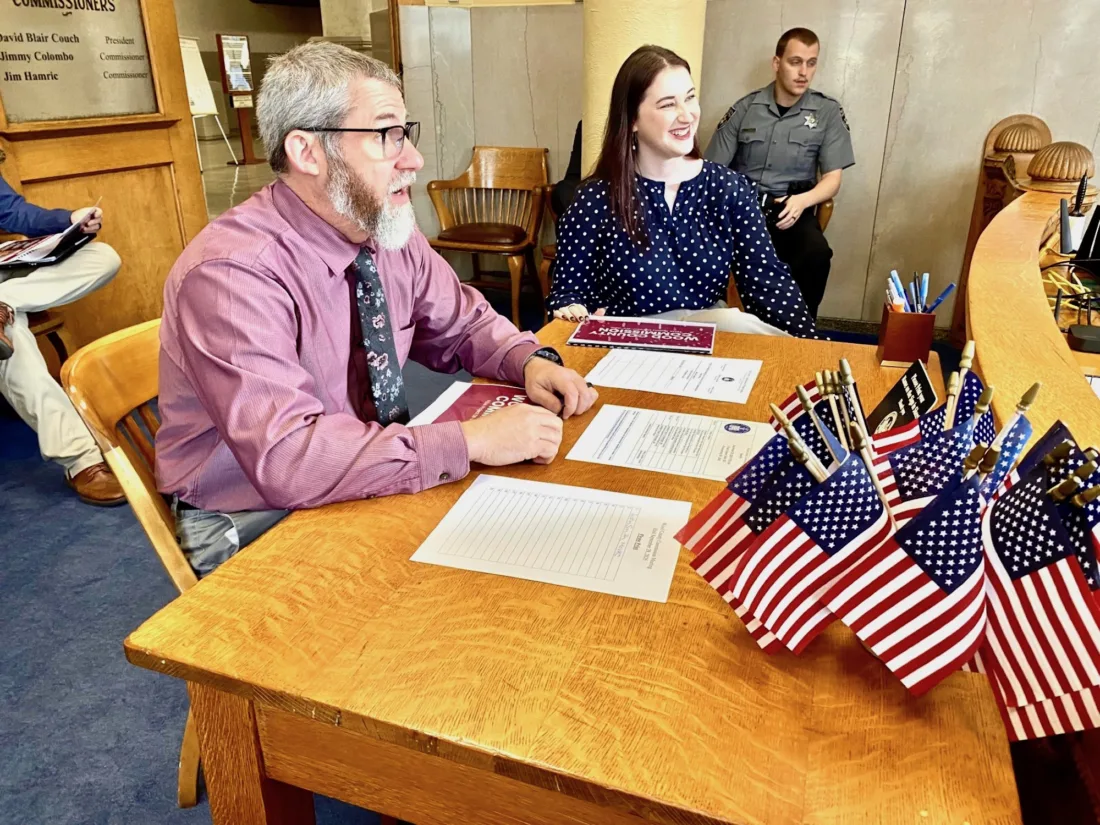
R.J Hovatter and Mary Hartley, representing the Thrasher group, talked to the Wood County Commission Monday regarding their qualifications for a landslide repair in Washington Bottom as the commission was interviewing companies to do the work. (Photo by Brett Dunlap)
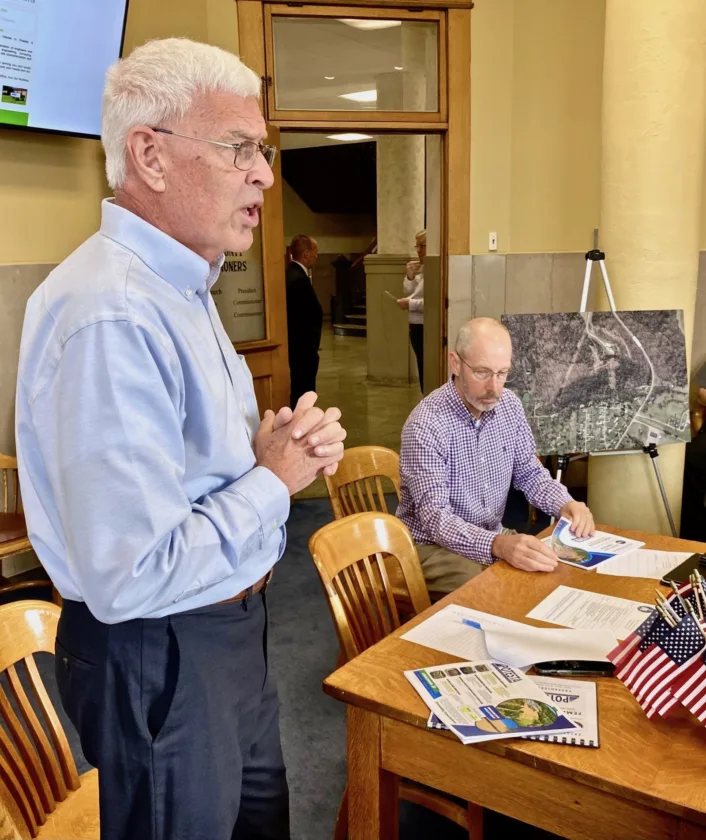
Dana Burns, President of Potesta and Associates, and Chris Grose, senior engineer with Potesta and Associates in Charleston appeared before the Wood County Commission Monday to discuss a landslide repair job in Washington Bottom as the commission was looking for a firm to handle the work. (Photo by Brett Dunlap)
R.J Hovatter and Mary Hartley, representing the Thrasher group, talked to the Wood County Commission Monday regarding their qualifications for a landslide repair in Washington Bottom as the commission was interviewing companies to do the work. (Photo by Brett Dunlap)
Dana Burns, President of Potesta and Associates, and Chris Grose, senior engineer with Potesta and Associates in Charleston appeared before the Wood County Commission Monday to discuss a landslide repair job in Washington Bottom as the commission was looking for a firm to handle the work. (Photo by Brett Dunlap)
Trending
PARKERSBURG - The Wood County Commission interviewed two engineering firms on Monday to see which one they wanted to handle a hillside stabilization project in the Washington, W.Va. area.
The commission met with representatives from the Thrasher Group and Potesta and Associates Inc. to discuss work to stabilize the hillside at 293 Oak Acres near Washington Bottom.
In April 2020, a landslide pushed the house, owned by Scott and Elaine Jenkins, off its foundation. The structure was deemed uninhabitable by emergency responders and code enforcement officials.
The county bought the property from the Jenkins for $140,480 to do the project to demolish the house and stabilize the hill.
The county worked in conjunction with the Mid-Ohio Valley Regional Council and the Federal Emergency Management Agency (FEMA) to secure grant funding. The project was ultimately split into phases to allow the county to construct a protective retaining wall to secure adjacent homes before moving forward with full demolition of the property.
Both companies gave a rundown of their qualifications, comparing other similar jobs to this project, other types of projects they have done around the state, experience working within FEMA funded projects. They would meet county officials to get their expectations of the project and what can meet the timeline.
R.J Hovatter and Mary Hartley, representing the Thrasher group, talked about their qualifications and what they could do on this project.
"We have a lot of experience with slides," Hovatter said, adding that a number of parts of the state have been hammered by heavy rains and flooding.
Hovatter said they would come in and do surveys and mapping. Geotech specialists will come in and evaluate the soils to determine how the soils are failing. About three design options would be determined to what was needed to repair the damage.
He believed the solution could be one of three options, including a gravity retaining wall with enough weight to hold back the hill; a drilled piling wall where piling is put down in the soil, with drainage, and the structure holds the earth back; or a soil nail wall where a number of holes are drilled into the side of a hill a a object is inserted that is described as a "giant drywall anchor" where all together, along with a chain link mesh, will oppose the force of the hill's movement.
"Those are the three most common solutions," Hovatter said, adding they would look at drainage issues and other factors to see what was driving the slide.
He said Thrasher provides a lot of services in-house, but they work with outside companies for GeoTech work.
Commissioner Jimmy Colombo said the problem has been lingering for some time.
"This problem needs to be fixed," he said.
Commission President Blair Couch wants anyone working on the project to be on time and on budget as the funding, through grants, is being handled by the Regional Council.
"Our concern is to get this done on a timeline that makes good sense," Couch said.
Hovatter said every project has a time frame and a budget.
"There is always a limited budget," he said.
Hartley who works in marketing for Thrasher, said she would work on communicating with the public about what is going on.
"Communication can make or break the success of a project or the conceived success of the project," she said. "We work with you all to put out the right messaging.
Dana Burns, President of Potesta and Associates, and Chris Grose, senior engineer with Potesta appeared before the commission and listed their services and gave a rundown of what they could do on this project.
Their services include civil engineering, geotechnical engineering and surveying, stormwater managing, landslide work and more.
Grose said he has done a lot of foundation and landslide work.
He detailed similar jobs for the Elk Valley PSD, north of Charleston, where flooding caused eight bank areas to slide and they reconstructed the riverbank and moved or repaired affected sewer lines.
A project in Ragland, West Virginia where a home was moved by a large debris flow and moved off its foundation was another project.
"It is almost identical to what you have out here," Burns said.
Grose said the hillside was steep on the project in Ragland. They excavated debris material out, put in drains, and did work to stabilize the home.
They detailed other projects in Charleston and Huntington where they reconstructed riverbanks and hillsides where large amounts of material had to be relocated and reconstructed the slope.
The company had previously prepared a proposal for this Washington project back in 2020, Grose said.
"The main purpose here is an engineering analysis to determine the mechanism causing this failure," he said. "We would work with FEMA to determine a long-term fix."
Colombo said stability is what they are looking for in the project in Washington.
Grose said his preliminary opinion is the slide was caused by additional fill material at the top of the slope in combination with subsurface drainage causing it to fail.
They went over some initial ideas on how to address the problem.
"Sometimes engineers design something on paper that you cannot build, we want to make sure what we put on paper can be built," Burns said. Burns is from Parkersburg and understands the conditions in the area.
They have done work locally for Hino, Parkersburg High School, First Energy Pleasants Power Station and more.
"Landslides are something we specialize in," he said.
The commission scored each company and determined Potesta had what they were looking for. The commission will enter into negotiations with the company to see if they can arrive at a price that works for everyone.
Contact Brett Dunlap at bdunlap@newsandsentinel.com