
Capito learns about WV211 services in Charleston stop
Trending
CHARLESTON - U.S. Sen. Shelley Moore Capito on Monday learned more about the services offered by West Virginia 211, the program operated by the state’s United Way chapters that connects people to state and federal resources and assistance.
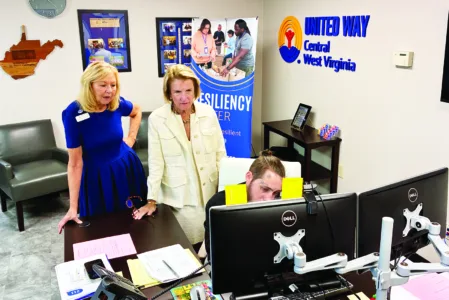
Capito, R-W.Va., toured the Charleston offices of United Way of Central West Virginia Monday morning, one of nine United Way locations in the state that participate in West Virginia 211, a phone and internet service that provides assistance to residents in need of government and nonprofit services.
Margaret O’Neal, the president of the United Way of Central West Virginia, told Capito the state’s United Way offices first began management of the West Virginia 211 program in 2018, with the Public Service Commission approving the changeover in 2019. The program receives approximately $200,000 per year from the Department of Human Services through the Temporary Assistance for Needy Families program.
People can dial 211 and be connected to an operator who can answer questions about state and federal resources, help guide callers to specific resources and even transfer calls to appropriate state and federal agencies. Residents can either call or text 211 or go to wv211.org.
"The beauty of 211 for us is that it’s connected to the United Way and it’s connected to the community," O’Neal said. "It’s not somebody in New York answering West Virginia calls."
According to the program’s most recent impact report, West Virginia 211 received 24,811 requests for help in 2025, with a single request sometimes involving multiple referrals. Referrals included 63,206 for utility assistance; 33,968 for food assistance; 23,178 for housing assistance; 4,224 for income support and financial assistance; and 3,010 for individual, family and community support assistance.
According to the 2025 Impact Report, there were 126,728 total connections made, including 18,465 calls, 5,842 texts, 60,140 web searches, 504 online and in-person assistance, and nearly 299,000 minutes of help provided. The largest percentage of top needs (43%) for those using 211 was for rent and mortgage assistance
"We’ve seen housing creep up in the number of people calling," O’Neal said. “We talked to a young woman this morning with kids. Finding them a $700 to $800 apartment that’s in a decent place, that’s really, really hard."
O’Neal said West Virginia 211 has been busy this summer helping connect West Virginians to flood recovery assistance and assisting with Survey 123 disaster reporting.
"I know we use it as a constituent service referral all the time, particularly in times of flooding and other catastrophe situations," Capito said. "So, by seeing it from the ground level, I can see how absolutely essential the funding is."
During last fall’s federal government shutdown that saw a temporary pause in the Supplemental Nutrition Assistance Program, 211 was pivotal in coordinating access to food for affected families with local food banks and the West Virginia National Guard.
At the beginning of July, West Virginia 211 was one of several TANF-funded programs that came under review after Gov. Patrick Morrisey raised concerns in May about a structural deficit between available state and federal TANF dollars and expenses.
The Department of Human Services later announced that funding for West Virginia 211 would continue, though the TANF-funded School Clothing Allowance program was delayed until July 20 and closed one week later after DoHS estimated the program would exceed the $11.4 million spent on it last year. O’Neal said residents called West Virginia 211 seeking assistance with school clothing assistance and school supplies.
Capito, who chairs the Senate's Labor-Health and Human Services Appropriations Subcommittee, said learning about programs, such as West Virginia 211, and seeing firsthand how nonprofits, such as the United Way of Central West Virginia, provide these services gives her needed information for helping craft federal budgets that direct future TANF expenditures to states.
"By seeing what Margaret and the United Way does here, I can see there is just a part of what they do that they have to supplement with other funding," Capito said. "I rest easy knowing that they’re meeting the need as best they can, but there’s still more need out there. So, from that aspect, I think, it really helps me.”
West Virginia 211 is helping assist residents with navigating changes in federal Medicaid eligibility taking effect in 2027 due to President Donald Trump’s One Big Beautiful Bill Act, passed last summer and supported by West Virginia’s congressional delegation, including Capito.
Beginning Jan. 1, 2027, certain adults between the ages of 19 and 64 who are enrolled in Medicaid’s Adult Expansion Group will be required to complete 80 hours per month of qualifying activities to maintain coverage, such as have a job, participate in work programs, go through education programs or volunteer.
It is estimated that between 30,000 and 60,000 West Virginians in the Medicaid Adult Expansion Group could lose their Medicaid benefits by not meeting the updated exemptions that would allow them to continue to receive benefits without having to meet the required 80-hour-per-month minimum of qualifying activities.
"We’re actively engaged with the state of West Virginia over the H.R. 1 Medicaid change," O’Neal said. "They’ll be able to call 211 and ask if they have an exemption, so we’ll have the FAQs from the state. ... People who are trying to qualify in January will have had to have met those standards in December. So, everybody’s trying to push it out.”
Steven Allen Adams can be reached at sadams@newsandsentinel.com.