
ACLU-WV sues West Virginia officials over 44-year-old education funding formula
Trending
CHARLESTON -- Making good on its notice provided to state and local officials last month, the West Virginia chapter of the ACLU filed a lawsuit Friday to spur changes to the formula that distributes tax dollars to West Virginia’s 55 county school systems.
The ACLU-WV filed a petition Friday seeking a writ of mandamus from the West Virginia Supreme Court of Appeals asking the justices to determine that the Legislature, members of the Board of Public Works, the Department of Education and state Board of Education, the State Tax Department, and members of the Lincoln County Board of Education have violated their constitutional duty to maintain a “thorough and efficient” public school system.
"Today's filing could well prove to be the most important case we have filed in my 10 years with the organization," said Eli Baumwell, executive director of the ACLU-WV, in statement Friday. "Access to a quality education is part of the bedrock of our democracy, and the decision by the Legislature to turn their back on their constitutional obligation to fund schools will have cascading effects on students, and on our communities, unless the Court intervenes."
Attorneys for the ACLU-WV filed a 30-day notice in August with named parties of its intent to file suit as required by state law. The lawsuit names House Speaker Roger Hanshaw, R-Clay; Senate President Randy Smith, R-Preston; State Treasurer Larry Pack; State Auditor Mark Hunt; Tax Commissioner Matt Irby; the School Building Authority, State Superintendent of Schools Michele Blatt, and members of the State Board of Education and Lincoln County Board of Education.
The state school aid formula was borne out of a 1982 decision by former Ohio County Circuit Court Judge Arthur Recht after a parent brought a class action lawsuit in 1975 against Lincoln County Schools arguing that poorer rural counties were being disadvantaged over larger, wealthier counties.
"More than 40 years later, the same problems exist in schools across the state and particularly in Lincoln County," said ACLU-WV Legal Director Aubrey Sparks. "In many respects, the school funding formula is yielding results that are even less fair, and raise more constitutional concerns, than the system previously declared unconstitutional."
The lawsuit was filed on behalf of a Lincoln County Schools student and their mother, Lakin Patten. According to Friday’s filing, the suit claims the current state school aid formula violates Article XII, Section 1, which requires the state fund a thorough and efficient school system. The suit also claims the current funding system violates Article III, Sections 10 and 17, which provide for equal protection guarantees.
“In West Virginia, each and every child is guaranteed a thorough and efficient education, a promise enshrined in our Constitution since the State’s founding,” Sparks wrote in the court filing. “Today, despite the passage of nearly half a century since this right was recognized, Lincoln County students ate receiving lower quality education than what their parents and grandparents received before them. The West Virginia Constitution does not, and should not, allow this profoundly important right to wither on the vine as the result of ongoing financial neglect by Respondents.”
While county school systems receive local funding through property tax revenue, bonds and levies, the seven-step school aid formula plays a large role in setting their budgets. That funding formula relies heavily on student enrollment numbers, which are finalized every October. Those enrollment numbers have been steadily falling for decades.
According to last October’s headcount report, there were 234,957 students enrolled in the state's 55 county school systems, a 2.52% decrease from fall enrollment this time last school year of 241,024 and a 15.32% decrease from the 277,452 fall enrollment number in 2015. Data released over the summer by the Department of Education found an additional enrollment reduction of approximately 5,000 students as of the end of the 2025-26 school year.
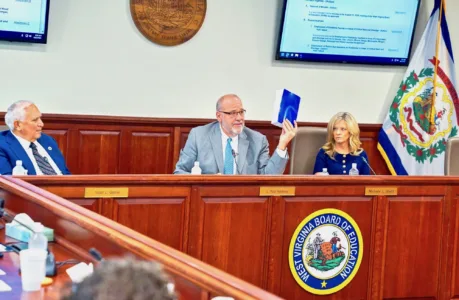
“In my four years as president of this board, I have repeatedly asked for help with regard to the school aid formula,” said state Board of Education President Paul Hardesty.” It is a 44-year-old formula that does not meet the current needs of our 55 county boards of education and the 234,000 children they serve every day.”
Lawmakers have been told the last several years that the state's seven-step school aid funding formula needs either scrapped or reformed. According to a RAND Corporation study commissioned by the Legislature and released prior to the start of the 2026 legislative session, while overall state education spending is near the national average, the school aid formula fails to adequately account for the higher costs associated with low-income students and those with disabilities.
“The lack of adequate funding for our 45,000 special needs children is the fatal flaw in the current formula that is crippling county boards and contributing to the large number of school closings across the state,” Hardesty said. “County BOE's ran a collective deficit of $224 million dollars during the last school year to educate our special needs population.”
The ACLU-WV petition identifies critical flaws in how county school systems receive state and local funding, such as the misclassification of pension debt as student spending and a tax levy system that it says disproportionately benefits wealthy districts while leaving impoverished ones behind.
“The spending capacity of a wealthy county does little to ameliorate the needs of a poorer county, and vast differences in intra-state spending lead to statewide averages that are insufficient to answer questions regarding the overall adequacy of funding,” Sparks wrote. “Inflated spending totals, high rates of poverty and disability, and significant transportation costs result in funding that is insufficient given the state’s demographics.”
“Concerningly, West Virginia’s education spending is regressive,” Sparks continued. “In contrast to national trends, West Virginia spends more on the wealthiest districts and less on the poorest.”
Among other things, the ACLU-WV petition asks the Supreme Court to require the named parties to make necessary changes to the school aid formula to bring it into compliance with the state Constitution.
Earlier this week, Gov. Patrick Morrisey told The Intelligencer that his administration was working on a plan to address the school aid formula. Ann Moore, a spokesperson for the governor’s office, said the ACLU-WV lawsuit was premature.
“It’s an odd time for the ACLU to file suit given the active and significant conversations taking place between the executive and legislative branches regarding school aid reform,” Moore said. Process and policy of this scale are best addressed through an intentional, thorough legislative approach before attempting to force judicial involvement. The Governor remains deeply engaged in reforming our school funding structure and the education system as a whole, and looks forward to continuing this work in close partnership with the Legislature.”
Pack’s office administers the Hope Scholarship educational voucher program, which receives criticism from public school advocates who see the program as a drain on the general revenue fund. But Pack is also on the record calling for school aid formula reform.
“Even though the lawsuit does not specifically cite the Hope Scholarship, the Treasurer's sentiments stand firm. We believe the Legislature and Governor should act quickly to address the real concerns facing our public schools,” said Pack spokesperson Carrie Smith. “We must strive for an education system that is student centric regardless if it is public education or education freedom. We look forward to working with policymakers on this issue.”
Hardesty, since his second term as president of the state Board of Education, has been outspoken regarding the school aid formula, using state board meetings to point out how overburdened public school systems are with state laws and calling for legislative help to reform the school aid formula, including being open to being sued in order to make change happen.
“It would be easy for me to point fingers and cast blame. I have no interest in doing that. That does absolutely nothing to help fix a problem,” Hardesty said. “I do however, stand ready to work with this administration, this legislature and anyone else who has a genuine interest to help find a solution to this problem. I remain hopeful that a solution can be hammered out prior to this lawsuit moving forward.”
Request for comments from Hanshaw, Smith, and Hunt were not returned.