
West Virginia education officials target middle schools following latest assessment results
Trending
CHARLESTON -- West Virginia has seen improvements in its summative assessment scores back to pre-pandemic levels for English Language Arts and Math, but this year’s assessment results show those improvements slowing.
The West Virginia Board of Education received a report Wednesday morning during its monthly meeting in Charleston detailing the results of the West Virginia Statewide Summative Assessments for the 2025-26 school year.
The Statewide Summative Assessment looks at proficiency in math, English Language Arts (ELA) and science. The results consist of the General Summative Assessment for grades three through eight, the SAT School Day Test for high school juniors and the Alternative Summative Assessment for grades three through eight and grade 11.
There was a 95% participation rate among the grades tested for a third year in a row. There was no testing during the 2019-2020 school year due to the COVID-19 pandemic shutting down schools in spring 2020.
“This year, we saw a slight increase in math, ELA stayed the same, and we had a one percentage point drop in science,” said Vaughn Rhudy, the director of assessment at the Department of Education.
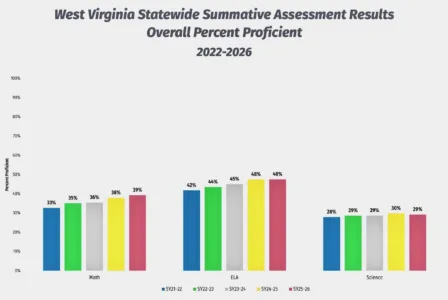
According to the overall results calculated across all grades for the prior school year, 39% of students were proficient in math, up from 38% in the 2024-25 school year, 36% in the 2023-24 school year, and 35% in 2022-23 school year.
By comparison, math proficiency dropped from 39% in the pre-COVID 2018-19 school year to 28% during the 2020-21 school year, where the first half of the school year was subject to school closings and virtual learning during spikes of COVID-19 infections. Math proficiency during 2021-22 rose to 33%.
ELA proficiency last school year was at 48%, the same as the 2024-25 school year, which was up from 45% in 2023-24 and 44% in 2022-23. Pre-COVID ELA proficiency was 46% in 2018-19, dropping to 40% in 2020-21, but rising to 42% in 2021-22.
After rising to 30% during the 2024-25 school year, science proficiency dropped back to 29% last school year, where it was during the 2023-24 school year but up from 28% for 2020-21 and 2021-22. Science proficiency was 33% in the pre-COVID 2018-19 school year.
“While science has remained fairly steady across the five years, we have seen substantial increases in ELA and math since 2022,” Rhudy said. “And in fact, an interesting point that if you go back to pre-COVID in 2019, the 2026 proficiency rates in ELA and math meet or exceed the 2019 pre-COVID proficiency rates overall and at each grade level.”
Broken down by grade level, Rhudy said ELA proficiency rates for grades three and four remained unchanged from the previous school year, while observing increases in proficiency across all four grade levels in middle school. However, 11th grade students experienced a four-percentage-point decline, returning to 2024 proficiency levels. Rhudy said an analysis from the College Board suggests this drop was a national trend among participating states and not unique to West Virginia.
“Remember, one of our summative assessments that we give is the SAT School Day (test) in grade 11, and we asked the College Board about this, and they did some analysis and this was a drop that was seen across all of the states that participated,” Rhudy said. “We don’t know exactly why that might have happened. There’s a lot of different reasons that it could have.”
Rhudy said there were percentage increases in math recorded in grades three, five, six, seven, eight, and 11, while fourth grade students saw a marginal drop of one percentage point. Eleventh grade math scores rebounded from a 2024 dip, returning to the proficiency levels seen in 2022 and 2023.
James Paul, the newest member of the state Board of Education appointed by Gov. Patrick Morrisey earlier this year, asked questions about why there were steady improvements in lower grade levels but a drop off with 11th graders.
“The picture that I see is some gains in grades three, four, five, elementary school in both subjects, but flat or declining a little moderately at the middle school (level) and at the 11th grade (level) where there seem to be real problems,” Paul said.
State Superintendent of Schools Michele Blatt said much of the focus the last several years has been implementing the Third Grade Success Act, passed by the Legislature in 2023, which required the development of screeners and benchmark assessments in ELA and math for students in kindergarten through third grade,
The Third Grade Success Act requires schools to develop a multi-tiered system of support for students exhibiting substantial reading or math deficiencies to ensure students are proficient before moving past the third grade. The bill also allows for teacher aides and interventionists in early elementary classrooms up to third grade.
Blatt credits the Third Grade Success Act for helping improve elementary school ELA and math scores. Now the department is working on its Bridging for the Future aimed at helping those same students who are now in middle school.
“I think if we look at the ELA and the math for our middle schools … we do have a trajectory. We are slowly seeing an increase there over the years,” Blatt said. “When we look at all of our schools, all programmatic levels, it is our middle schools that we need to put the most focus in and determine how we can better engage those students and make sure that they are meeting the demands and things that we have of them.”
Paul pointed out that while the four-year graduation rate in West Virginia is at a record high of approximately 93%, 11th-grade math proficiency is only 21%.
“How do you think this board and this state should reconcile those two numbers,” Paul asked.
Blatt noted that the SAT is a “one-day snapshot” and suggested that grade inflation across 55 counties may contribute to the discrepancy between classroom grades and summative assessment results. She also said that a significant portion of the student body is enrolled in Career and Technical Education (CTE). While these students may struggle with the SAT, they demonstrate a 70% proficiency rate on national occupational assessments and workforce credentials.
“We know that the students that take the national assessments for the occupations that they’re in perform at a 70% proficiency rate; that they meet and exceed those workforce credentials,” Blatt said. “So, our schools continue to focus and emphasize the importance of this 11th grade assessment to all of our students, (but) it’s not something that we believe that they see the value in.”