
Washington County Commissioner calls for moratorium on injection wells
Motion rejected in 2-1 vote
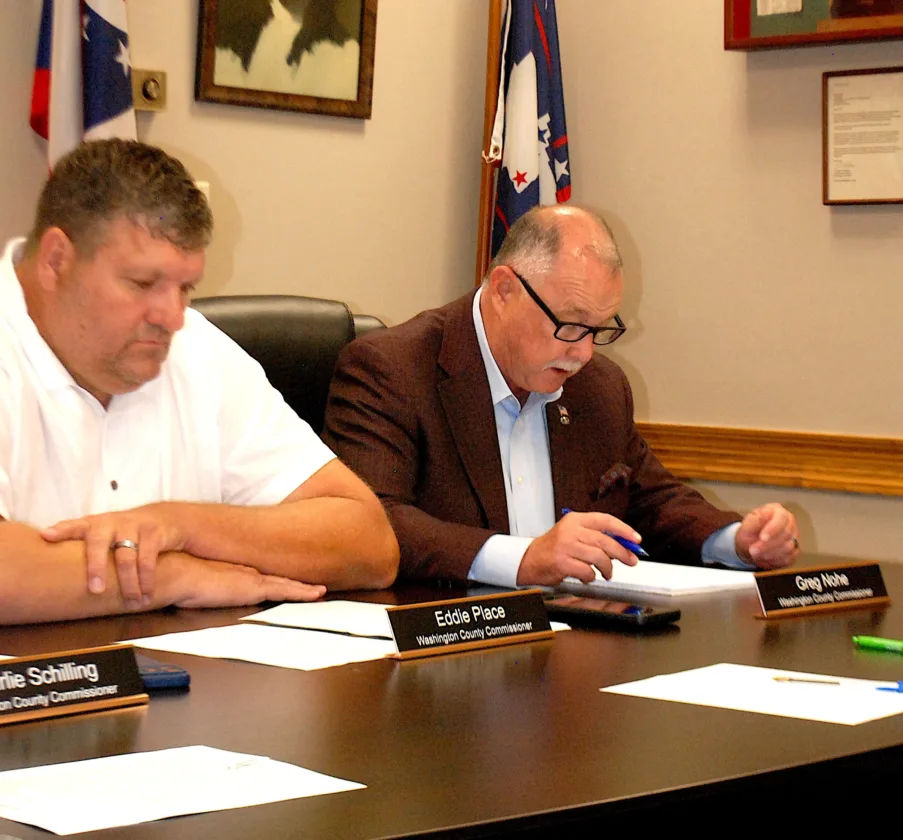
Commissioner Greg Nohe (right) reads a prepared statement proposing a moratorium for injection wells seat next to Commissioner Eddie Place (left). Photo by Sophie Wheeler
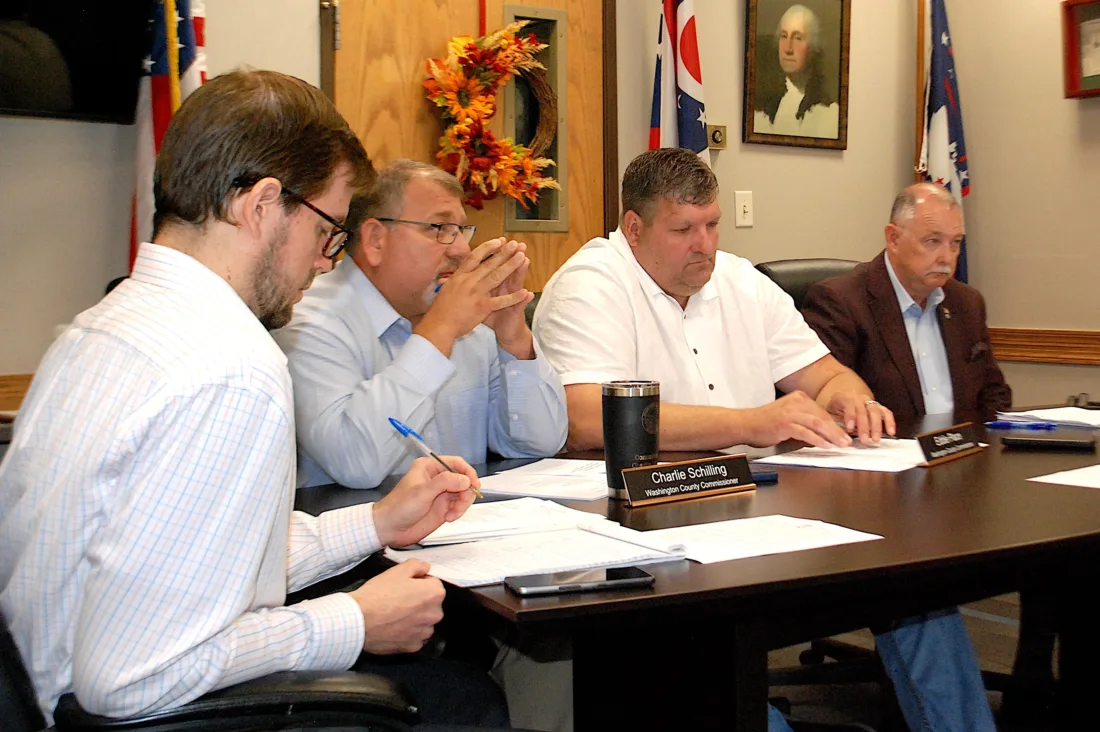
Washington County Board of Commissioners meet to discuss moratorium for injection wells. From left Ben Cowdery, Commissioner Charlie Shilling, Eddie Place, and Greg Nohe. Photo by Sophie Wheeler
Commissioner Greg Nohe (right) reads a prepared statement proposing a moratorium for injection wells seat next to Commissioner Eddie Place (left). Photo by Sophie Wheeler
Washington County Board of Commissioners meet to discuss moratorium for injection wells. From left Ben Cowdery, Commissioner Charlie Shilling, Eddie Place, and Greg Nohe. Photo by Sophie Wheeler
Trending
MARIETTA – Washington County Commissioner Greg Nohe's motion to prepare a moratorium on Class II injection wells failed in a vote, leading to intense public discussion on the safety of injection wells at a meeting on Thursday morning.
"I remain steadfast in prioritizing the well-being of our residents," Nohe said in a prepared statement. "Every human endeavor carries inherent risks, but Class II injection wells appear to present out-sized risk with minimal benefit to our community."
Class II wells contain brine and other liquids from oil and gas work.
Nohe said "the track record of Ohio Department of Natural Resources raises concerns" with instances of the agency issuing for injection wells that subsequently contaminated nearby shallow wells, albeit oil and gas wells, rather than drinking water wells.
"I urge my fellow commissioners to join me in supporting a moratorium similar to those previously proposed by other local entities,” Nohe said. “Together, we can prioritize the safety of our community and ensure our commitment to public well-being."
Commissioner Eddie Place opened the discussion after Nohe's remarks, saying, "I value our safe drinking water, and let me be clear ... our water is safe to drink."
Place said he has met with Eric Vendel, ODNR's oil and gas resource management chief, and talked to a former Environmental Protection Agency official.
"I am convinced that (Class II injection wells) pose no dangers as of today to our drinking water," he said.
Place later said he has scheduled a meeting on Aug. 21 with Vendel following the concerns raised by Nohe.
"Until I have allowed the ODNR an opportunity to comment, I cannot support a moratorium. If the ODNR or the Ohio EPA are unable to answer our concerns, then I'll reconsider my position at that time," he said.
Commissioner Charlie Schilling stated that in addition to the meeting with Vendel, commissioners are looking to meet with Dave Jeffery, a professor with the Center for Earth, Energy and the Environment at Marietta College. Schilling states he has assurances from ODNR that the Class II injection wells in Washington County are properly permitted and operated. He also clarified that no new injection wells in Washington County have been permitted since 2022.
"We effectively have a four-year moratorium," Schilling said. "I cannot support shutting down existing businesses on the basis of clearly conflicting views".
The motion for a moratorium concerning the injection wells issued by the Washington County Board of Commissioners failed in a 2-1 vote, with only Nohe voting in favor.
Members of Washington County for Safe Drinking Water spoke in opposition to the operation of Class II injection wells locally. Dee Wells Arnold prepared a statement highlighting concerns over waste water migrating from injection wells and asked the commissioners to sign a petition for a three-year moratorium on injection wells and a geological study of the area.
Nohe agreed to sign the petition and join in talks with state and federal officials about the need for it.
"This is not an anti-energy position; it is a pro-drinking water position, and it should be easy for any Ohio leader to support," Arnold said.
Holly Kellum, with Mash Focus Publication Network, asked Schilling what changed to make him willing "to look at information that is not new that the community has been bringing to you for a very long time."
"I believe there's a different perspective out there from a petroleum engineering professor from Marietta College, and that’s why I'm willing to sit down and talk with him," Schilling said.
Kellum asked Nohe how the discussion of injection wells has changed his perspective on a proposed data center in Waterford.
"I'm still in an evaluation process for that," Nohe said. "You know, there's a lot of information out there, good information, and there's a lot of bad information. So you have to separate the fact from fiction and make an informed decision on what's best for the community".
Following Arnold's statement, Place said commissioners care about the issue and it "has been top of my awareness since day one."
He then questioned the affiliation of the Washington County for Safe Drinking Water group.
"You're looking out for our safety. I love it, but is it party affiliated?" Place said. "Is this a left thing, or is it bipartisan?"
"This is a bipartisan issue for safe drinking water. It has nothing to do leftist anything," Arnold said.
Schilling responded to the public discussion by saying he's heard people suggest the commission has "a lack of transparency, backroom deals and things like that.
"I really want to be clear on how seriously I take my job," he said.
In May, sales tax increased 18.5% compared to the same period last year, Schilling said, . In June, sales tax increased 10% compared to the same period last year. Schilling stated that sales tax accounts for approximately 60% of the budget.
"We rank in the top 20 out of the 88 counties on what our economy is doing through sales tax, which funds everything that we talk about," he said.
In other business, the commissioners approved the appropriation of funds for contract services for the building department for a total of $31,250, and the advance of $500,00 for budget stabilization. Additionally, they passed transfer requests for an advance out for the Washington County home totaling $126,995.
Commissioners approved travel requests for Family and Children First, a letter of support for Marietta College's application for funds from the Department of Development's Advanced Energy fund and the Ohio High Value Network's proposal under the Ohio Department of Health Rural Health Transformation program for rural Ohio clinically integrated networks and rural health innovation hubs.
Marietta College's application for funds follows their LED lighting and Ricky Science Center chiller replacement program to provide "a significant long-term financial savings plan for Marietta, while providing a better learning environment for students and faculty." The high-efficiency chiller, for the cadaver lab in the Ricky Science Center, will significantly reduce energy consumption and ensure the comfort of students and community guests, according to the commission's letter of support.
The commissioners next meeting is scheduled for 9 a.m. Aug 20.
Sophie Wheeler can be reached at swheeler@newsandsentinel.com.